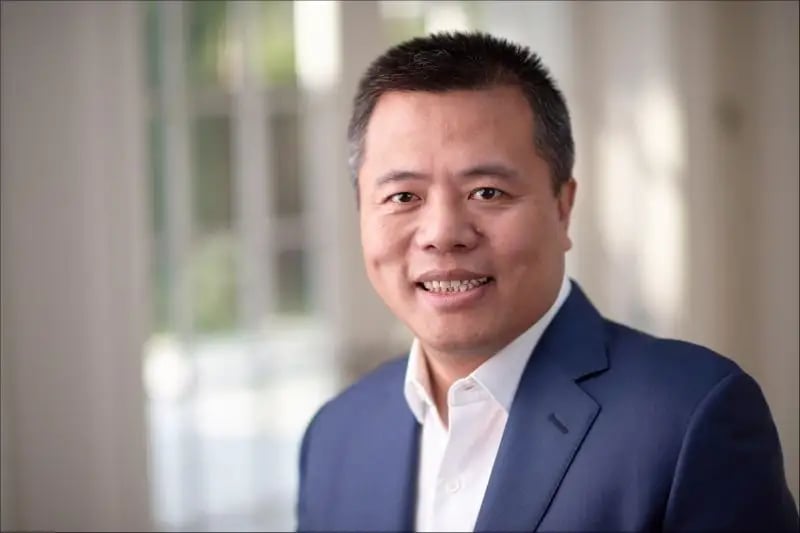
Most companies believe they are embracing artificial intelligence. According to Tianqiao Chen, founder of Shanda Group and one of China's most influential technology pioneers, they are actually prolonging their own obsolescence.
In a provocative new analysis published on his platform Chennative.ai, Chen argues that the vast majority of enterprises are stuck in what he calls the "skeuomorphic trap," strapping AI engines onto organizational structures designed for the pre digital era. The result? Short term gains masking long term structural failure.
"If you had asked a carriage driver in the late 19th century what he needed most, he would have said, 'I need a faster horse,'" Chen writes. "He would never have requested an internal combustion engine. Today's business leaders are making the same mistake."
The Three Stage Evolution: From Enable to Awaken
Chen's framework divides the AI revolution into three distinct phases, each requiring fundamentally different organizational DNA.
Stage One: AI Enable (Where Most Companies Are Stuck)
In this phase, companies follow simple addition logic: take an old process, add an AI plugin, and call it transformation. Humans remain the "CPU" of the organization, the central processors making decisions and connecting workflows, while AI acts as an external "GPU" for speed.
Chen is blunt about the limitations. "This is like strapping an internal combustion engine onto a horse drawn carriage. The speed might increase, but the chassis will eventually disintegrate under the thrust."
For California's innovation economy, this assessment hits close to home. From Silicon Valley giants to venture backed startups, most organizations remain firmly in the "Enabled" camp, adding AI copilots and chatbots without rethinking core workflows.
Stage Two: AI Native (The Coming Disruption)
The breakthrough comes when three technical "mutations" complete, Chen argues:
First, AI systems must evolve from probabilistic pattern matching to genuine logical reasoning. New generation models like OpenAI's o1 represent this shift, unfolding chains of thought internally rather than simply predicting the next plausible word.
Second, AI must move from text dialogue to tool action. Through function calling and agent frameworks, AI is now beginning to execute workflows directly, operating browsers, triggering APIs, and completing multi step processes without human handoffs.
Third, systems must develop long term memory. Using vector databases and retrieval systems, enterprises can now build what Chen calls an "enterprise grade hippocampus" that retains institutional knowledge independently of employee tenure.
When these mutations align, Chen predicts a phase change in organizational structure itself. Traditional corporations are built like "blocks of ice," rigid departmental silos designed to manage high coordination costs. But AI acts as a "massive heat source." As information friction drops to near zero, those rigid structures begin to melt.
"In an AI Native organization, data, talent, and resources flow like water to wherever the model determines they are needed most," Chen explains. "The heavy administrative skeleton becomes unnecessary."
Chen offers California business leaders three diagnostic questions to assess whether they have crossed into the Native stage:
The Survival Test: If you remove AI, does your business slow down or does it cease to exist? If it's the former, you are still Enabled. If it's the latter, you have become Native.
The Flow Test: Do AI agents pass tasks directly to one another, or are humans still connecting the nodes? A true Native organization runs end to end workflows through agent handshakes, like an automated assembly line.
The Memory Test: Does your system "devour experience," automatically converting errors into new rules? If past mistakes do not become future instinct, you are consuming data but not building intelligence.
Stage Three: AI Awaken (The Civilization Question)
The final stage is the most unsettling. Chen asks: what happens when AI stops executing predefined work and begins redefining the work itself?
In the Awaken phase, AI evolves from "Executor" to "Discoverer," breaking into unmapped territory to find solutions and patterns humans would never see. At that point, the question is no longer operational but existential.
"When AI begins to understand 'what is right' better than we do," Chen asks, "is there still a necessity for our existence?"
Chen acknowledges this sounds dystopian, but he believes competitive pressure will make it inevitable. "The limit of an AI Native enterprise is the limit of human cognition," he writes. "To breakthrough, we will be forced to allow AI to define 'what is better' beyond human logic."
Implications for California's Innovation Economy
Chen's analysis carries particular weight for California, home to both the companies building AI and the enterprises racing to adopt it. His warning is stark: organizations that remain in the "Enable" phase, no matter how sophisticated their AI tooling appears, are building on sand.
The real transformation requires rethinking organizational structure from first principles, a prospect that threatens entrenched hierarchies and power structures across industries.
For venture investors, Chen's framework offers a new lens for due diligence. Is a startup AI Enabled (adding intelligence to an old model) or AI Native (built from the ground up around machine cognition)? The distinction may determine which companies achieve escape velocity and which become cautionary tales.
Chen's own ecosystem reflects this philosophy. Through his AI research lab Evermind, venture studio Tanka, and billion dollar commitment to AI driven science, he is building what he calls a "closed loop Discoverative Intelligence" system, designed to move beyond generation toward genuine discovery.
For California business leaders, the message is urgent. The ice is melting faster than most realize. The only question is whether companies will adapt to the liquid state or be washed away by it.
Copyright © 2025 California Business Journal. All Rights Reserved.
For California Business Journal Disclaimers, go to /terms-conditions/.


