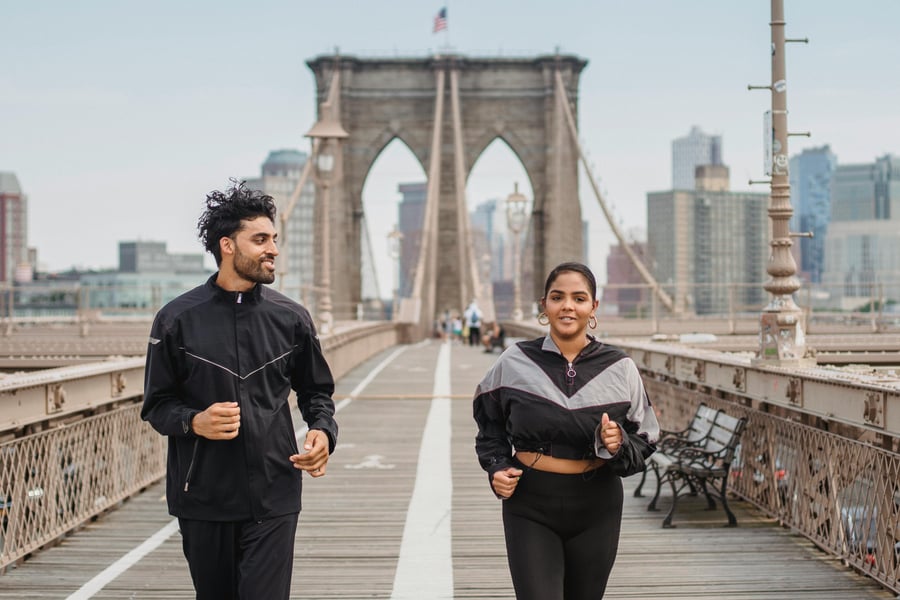
Brooklyn has more than 70 miles of coastline, a 585-acre park designed by Frederick Law Olmsted, and a boardwalk built in 1923 that still holds up under foot traffic. Most people who run here settle into one route and stay there for years. That is a reasonable thing to do, but it also means they miss a lot. The borough has enough ground to cover that you could run a different route every week for a month and never double back on yourself. What follows is a breakdown of the routes worth knowing, starting with the ones that get the most wear.
Prospect Park and Its 2 Loops
Prospect Park is where most Brooklyn runners end up at some point. The Prospect Park Alliance maps 2 loops inside the park. The inner loop covers 3.4 miles and stays relatively flat. The outer loop adds another 0.3 miles for a total of 3.7 miles, with 154 feet of elevation gain on paved asphalt. That elevation comes in rolling sections rather than a single climb, so the effort spreads out across the run.
Grand Army Plaza is the common starting point. NYRR recommends going early morning or early evening, and that recommendation holds. Midday in the summer, the park gets crowded with cyclists, dog walkers, and families, which can slow a run down to a shuffle in certain stretches. Morning runs on the outer loop are quieter, and you get the hills to yourself.
The park also hosts NYRR's annual BK 5K on its scenic roadways, which is a good low-pressure race for anyone who trains there regularly and wants a timed effort on familiar ground.
The Brooklyn Waterfront Greenway
This is the long one. The Brooklyn Waterfront Greenway currently offers 20 miles of trail running along 26 miles of Brooklyn's waterfront. The path passes through Domino Park, where remnants of the former Domino Sugar Factory are still visible along the route. If you veer off the main path at certain points, you get open views of the Statue of Liberty and the Manhattan skyline.
There is a bike lane and a pedestrian side, and runners need to stay on the pedestrian side. This is worth stressing because the bike lane gets fast-moving traffic, and conflicts between cyclists and runners are common when the boundary gets ignored.
You do not have to run the full 20 miles to get value from this route. Plenty of runners pick a 4 to 6 mile section and turn around. The stretch from Williamsburg through DUMBO is popular for a reason: it is flat, well-maintained, and has enough visual variety to keep your brain occupied.
What to Carry on Longer Brooklyn Routes
Some of these routes stretch well beyond a casual jog. The Brooklyn Waterfront Greenway covers 20 miles of trail, and runners tackling even half that distance need to think about fueling along the way. Packing a small handheld bottle, a few electrolyte tablets, and energy gels for runners can prevent a rough second half on a warm morning.
The Coney Island Boardwalk and Prospect Park loops are shorter, but they still warrant planning if you string multiple laps together or combine routes back to back.
Coney Island Boardwalk
The Riegelmann Boardwalk at Coney Island runs 2.7 miles on wooden planks laid in a chevron pattern. The surface is firm but has a slight give compared to asphalt, which some runners prefer for joint recovery days or easy miles. The boardwalk is open year-round, and subway access at Coney Island-Stillwell Av and West 8 St-NY Aquarium makes it easy to reach without a car.
Winter runs here are a different animal from summer ones. In July, the boardwalk is packed and you will spend more time dodging people than running. In February, you might have 2 miles of unbroken space to yourself with the Atlantic on your left and empty amusement rides on your right. The cold months are when this route is at its best for uninterrupted running.
Brooklyn Running Company Routes
Brooklyn Running Company maps 5K, 8K, and 10K routes from their Park Slope and Williamsburg locations. These routes are designed for group runs but work fine solo. If you are new to the borough and want a pre-mapped option that stays on runner-friendly streets, their route maps are a practical starting point. They remove the guesswork of figuring out which streets have good sidewalks and manageable crossings.
Races Worth Knowing About
The NYCRUNS Brooklyn Half Marathon is scheduled for April 26, 2026, and the event draws over 25,000 runners along the East River waterfront. The course passes under the Williamsburg, Manhattan, and Brooklyn Bridges, which gives the race a visual quality that most half marathons in the city cannot match. Registration tends to fill, so planning ahead matters.
For a shorter race, the NYRR BK 5K in Prospect Park is a solid option. The park setting keeps the course contained and easy to follow, and the post-race atmosphere tends to be relaxed.
A Final Note on Timing
Brooklyn routes reward early risers. The parks, greenways, and boardwalk all get progressively more crowded after 9 AM on weekends. Weekday mornings before 7 AM are the most reliable window for an uninterrupted run on any of these routes. Plan around that, and the borough gives you a lot of ground to work with.
Copyright © 2026 California Business Journal. All Rights Reserved.
For California Business Journal Disclaimers, go to /terms-conditions/.


