A common misconception in marketing is that traditional search is becoming irrelevant, fully replaced by chatbots and AI summaries. While this narrative is attention-grabbing, it is inaccurate.
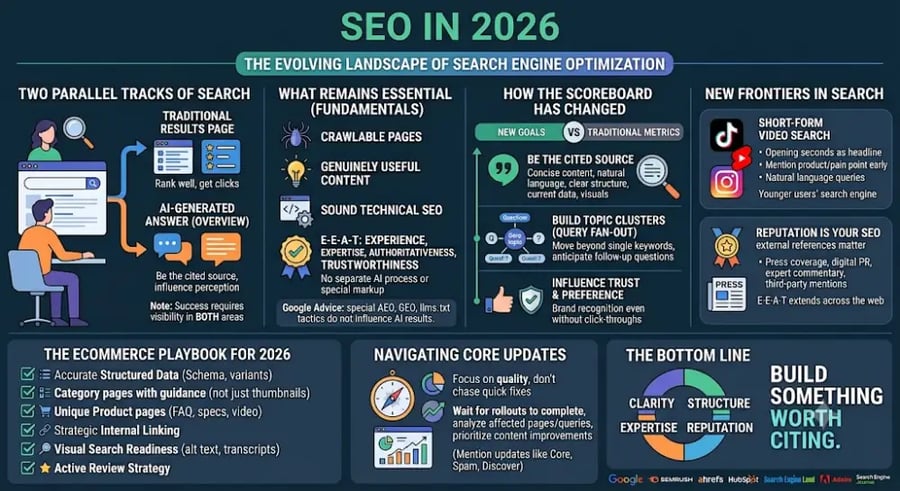
The reality is more nuanced and relevant for brand growth. Search now operates on two parallel tracks: the traditional results page and the AI-generated answer that often appears above it. Success in 2026 requires visibility in both areas.
What Google Is Actually Telling Us
Google’s guidance is clear: AI Overviews and AI Mode use the same core ranking and quality systems as traditional Search. There is no separate process or exclusive AI checklist. The company has stated that special AI markup, tactics such as “AEO” or “GEO,” and files like llms.txt do not influence how content appears in AI-powered results.
In summary, the fundamentals remain essential: crawlable pages, genuinely useful content, sound technical SEO, and sites built on real expertise rather than keyword-stuffed content. If your site excels in these areas, you are well positioned.
But the Scoreboard Has Changed
The situation is more nuanced. While the underlying mechanics remain the same, success is now measured differently. Ranking on page one is no longer the ultimate goal but one of several important metrics.
Industry researchers at Semrush note a significant shift: brands now optimize not only for ranking but also to be the source AI systems cite, quote, or summarize in direct answers. This requires concise content that reflects natural language, supported by clear structure, strong headers, current data, and visuals that enhance the text.
Analysts at Ahrefs have identified a trend known as “query fan-out.” Instead of focusing on a single keyword, AI systems generate clusters of related follow-up questions before providing an answer. As a result, a single blog post addressing one question is no longer sufficient. Brands should develop comprehensive topic clusters that anticipate the follow-up questions a reader or AI model may ask.
HubSpot describes this as an expansion of SEO rather than its decline. Clicks and rankings remain important, but they are no longer the sole metrics. Brands can influence buyer perception, trust, and preference through AI-generated summaries, even if users do not click through. This form of marketing value is relatively new and can be overlooked if only click-through rates are monitored.
Short-Form Video Is a Search Engine Now, Too
Platforms such as TikTok, YouTube Shorts, and Instagram Reels now serve as search engines for many younger users, who use them similarly to how older generations used Google.
This shift affects short-form video production. The opening seconds should not only capture attention but also function as a strong headline, using language that aligns with common search queries. Mentioning a product name, category, or specific pain point early serves both viewers and platform algorithms. The goal is to communicate naturally, reflecting how customers speak when seeking solutions.
A Local Example: Personal Injury Law
Personal injury lawyers are a good example of just how much this scoreboard has shifted. It's a category built for decades on billboards, bus benches, and daytime TV-and in a market like Las Vegas, dozens of firms are still fighting for that same visibility every single month. But that fight has increasingly moved online, and now into AI. Ask Google's AI Overview or ChatGPT for a personal injury lawyer, and the response typically isn't a scrollable list of ten options-it's usually only three to five firms.
Which firms make that shortlist comes down to the same signals covered above: structured, genuinely useful content, and a reputation that holds up across the web, not just on the firm's own homepage. For a locally competitive, high-intent category like this, being one of the few names AI recommends is quickly becoming just as important as being one of the few billboards a driver notices on the way into town.
Let AI Speed You Up. Don’t Let It Make the Call.
It is tempting to delegate keyword research and content planning entirely to AI tools, as they efficiently handle tasks such as surfacing volume data, generating related terms, and clustering ideas more quickly than manual research.
However, speed does not replace human judgment. Each opportunity identified by AI should be reviewed to ensure it reflects actual customer behavior and genuine business potential. AI is a valuable research assistant but cannot substitute for expertise in understanding the business and its customers.
Your Reputation Is Part of Your SEO Now
A significant change is that AI search visibility now depends not only on your website but also on external references across the internet.
Press coverage, digital PR, expert commentary, and credible third-party mentions all contribute to how AI systems and users assess a brand’s identity, offerings, and trustworthiness. This extends the E-E-A-T principle: a technically sound website may still lack the external validation needed to establish trust. Building such a reputation takes time but offers long-term benefits beyond on-site optimization.
Ecommerce Gets Its Own Playbook
For online retailers, the fundamentals differ slightly, but the core principle remains: provide search systems with accurate, complete information and offer shoppers compelling reasons to trust each product page.
Google’s ecommerce documentation emphasizes the importance of accurate product structured data, well-maintained Merchant Center feeds, clean URLs, and clear navigation from categories to individual products. Search Engine Land highlights trends such as AI-assisted product discovery, unified commerce experiences, and the growth of platforms like TikTok Shop and livestream selling. Product discovery now occurs across various channels, not just through traditional search bars.
The practical priorities for ecommerce brands in 2026 are worth spelling out:
- Structured data that’s actually accurate - product schema and variant-level (ProductGroup) schema, kept current.
- Category pages that guide, not just list - genuine buying advice, not a wall of thumbnails.
- Product pages that earn the sale - unique descriptions, real FAQs, honest comparisons, video, and specs that answer the questions a shopper would actually ask.
- A deliberate internal linking structure - blogs pointing to products, products pointing to categories, categories pointing to buying guides.
- Visual search readiness - descriptive filenames, thoughtful alt text, and transcripts for any video content.
- An active review strategy - because reviews remain one of the strongest trust signals a product page can carry.
A Note on Core Updates
For anyone watching their traffic dashboards nervously: 2026 has already brought several confirmed Google updates, including core updates in March and May, spam updates in March and June, and a February Discover update focused on how articles surface in that feed.
Google’s advice hasn’t changed much here, and it’s worth repeating because it’s easy to forget in the panic of a traffic dip: don’t chase a “quick fix.” Wait until a rollout is fully complete before drawing conclusions, look closely at which specific pages and queries were affected, and prioritize genuine content improvements over reactive tinkering. Publishers and ecommerce brands leaning on editorial content should keep a particularly close eye on Discover traffic, since that’s where the February update had its clearest impact.
The Bottom Line
None of this amounts to a new set of tricks to master. It’s closer to a returned emphasis on the things good marketers already knew mattered: clarity, structure, genuine expertise, and a reputation that holds up to scrutiny - whether the one scrutinizing it is a human being or the AI model standing in for one.
The brands that will do well in this next phase of search aren’t the ones chasing every algorithm rumor. They’re the ones building something worth citing in the first place.
 Author's Bio: Linn Larsson is a Senior Client Services Manager at Adaptia Design and a recognized leader in digital marketing strategy, SEO, and Generative Engine Optimization (GEO). She has partnered with some of the top seven figure companies across the US, helping them strengthen visibility, build authority, and drive sustainable growth through data backed digital marketing strategy. Linn's expertise spans traditional SEO and the emerging world of AI driven search, giving high growth brands a competitive edge across both search engines and generative platforms. Known for strategic thinking, clear communication, and a genuine interest in every client's success, she is a trusted partner for companies looking to scale their digital marketing performance.
Copyright © 2026 California Business Journal. All Rights Reserved.
For California Business Journal Disclaimers, go to /terms-conditions/.


