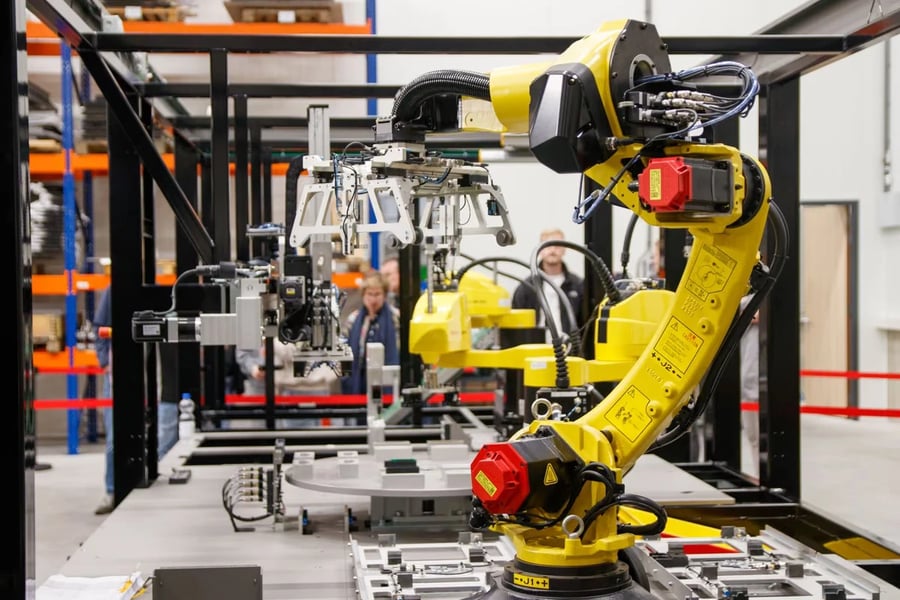
Automation is the top 2027 investment priority for 36% of manufacturing leaders in a survey reported by IndustryWeek. For a 30-person shop, the robot costs money, and someone has to learn to run it. Four programs cover part of that bill: one for training, two federal tax rules, and a California sales tax break.
1. ETP pays to train your workers
California's Employment Training Panel (ETP) repays employers for training their workers. A shop with 100 or fewer full-time California employees, and 250 or fewer worldwide, earns $28 per trainee hour for retraining under ETP's April 2026 rate table. It must face out-of-state competition and pay the state's Employment Training Tax.
The shop's share is at least 50% of the ETP amount, paid in kind, usually through trainee wages. ETP pays after each trainee finishes at least 8 hours of training and works full time for 90 consecutive days. Training done before the contract is approved never counts, so apply at etp.ca.gov before the machine arrives.
2. The R&D credit covers shop-floor engineering
Designing a custom fixture or developing a process to hold a tighter tolerance can qualify for the federal research credit. The work must aim to improve a product or process, rely on engineering, resolve real uncertainty and use a process of experimentation.
Young shops can use the payroll version. According to the IRS, a business with under $5 million in gross receipts, and receipts in no more than 5 tax years, can apply up to $500,000 a year against payroll tax. The election goes on Form 6765 with an on-time original return, never an amended one.
3. Depreciation writes off the machine
On the federal return, qualified equipment acquired and placed in service after January 19, 2025 can be written off in its first year through bonus depreciation. Section 179 also allows up to $2,560,000 for 2026. California allows no bonus depreciation and caps Section 179 at $25,000. Ask a CPA to run both returns before you buy.
4. California cuts the sales tax on equipment
California's partial exemption lowers the state rate on qualifying manufacturing equipment to 3.3125%, plus local district taxes, through June 30, 2030. On a $250,000 machine, that saves about $9,840. The buyer must be primarily a manufacturer (NAICS 3111 to 3399), and the equipment must be used in manufacturing at least half the time. Give the seller form CDTFA-230-M before the sale.
New capacity needs new orders
A robot pays off only when it runs full. Out-of-state buyers find suppliers online, and more often by asking AI tools. In a spring 2026 Semrush survey of 519 US B2B professionals who use AI at work, 92% said AI shaped their vendor shortlist.
A small shop wins those buyers with one page per capability that lists materials, tolerances and lead times in plain text, plus a clear way to send a drawing. A shop can build this in-house or hire an industrial website agency, such as Write Good Code.
FAQ
How much can a small shop get from ETP?
A single ETP contract can reach $650,000 in fiscal year 2026-27. At the $28 small business rate, 10 workers trained for 40 hours each earn $11,200.
Does California offer the R&D payroll credit?
California has no payroll version of the research credit. Its own credit covers only California research and offsets only state tax.
What if the equipment leaves California?
Equipment bought under California's partial exemption that leaves the state, or moves to non-qualifying use, within a year owes the full sales tax plus interest.
Copyright © 2026 California Business Journal. All Rights Reserved.
For California Business Journal Disclaimers, go to https://calbizjournal.com/terms-conditions/.


