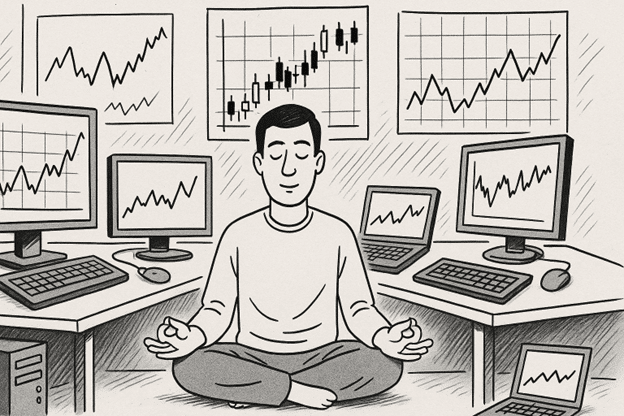
For retail traders, the appeal of online trading platforms lies in the speed - of access, of action, of potential reward. But for Rahul Bhatt, a 34-year-old software engineer based in Mumbai, his most valuable takeaway after seven years on the Olymptrade app isn’t speed at all: it’s patience.
His introduction to trading began much like anyone else’s: with excitement, ambition, and an underestimation of just how hard it is to consistently succeed in volatile markets. “I went in thinking I’d be different,” he says. “The platform was simple, the barrier to entry was low, and I figured with enough effort and a little research, I could turn a quick profit.”
Bhatt joined Olymptrade in 2018, choosing the platform for its intuitive interface. With a minimum trade of $1 and a minimum deposit of $10, the platform made it easy for a newcomer to dive in. It felt ideal for someone exploring trading without investment.
Too easy, in hindsight.
“In the beginning, I treated it like a game,” Bhatt says. “Every movement on the chart felt like a signal, every hour was a chance to win or lose money. I wasn’t trading, I was reacting.”
That impulsive behavior cost him. For nearly two years, he operated in what he now calls a “chaotic loop:” over-trading, chasing losses, and tweaking strategies with little thought or consistency.
It wasn’t until 2020 - spurred by a series of particularly painful missteps during a period of intense market volatility - that Bhatt made a deliberate decision to stop and reassess.
“I was losing while it seemed like everyone around me, especially on Reddit, was making money. I started reading about trading psychology,” he explains. “That was the first time I heard someone say, ‘The market doesn’t owe you an opportunity every day.’ That really stuck with me.”
Bhatt realized that success in trading was less about reacting to the market, and more about waiting for the right moment. “It’s ironic,” he adds. “Olymptrade made it so easy to place trades, but that ease also meant I had to work harder to resist the urge to act without thinking.”
What helped cement this new mindset was a suite of features Bhatt had previously overlooked. The platform’s built-in analytics helped him track his performance, and he started using a demo account, a type of forex paper trading app, in a more intentional way: not just to test trade setups but to practice the discipline of waiting.
“I’d set a plan, then open the demo and wait. Not click. Just wait. That was harder than it sounds.”
Platform educational resources also played a role in his transition. Rather than focusing only on charts or technical indicators or market trends, Bhatt gravitated toward lessons on emotional control and risk management. “One of the tutorials talked about setting your stop-loss before you enter a trade,” he says. “That’s when it clicked. I needed to think about what I was willing to lose, not just what I hoped to gain.”
Bhatt’s win rate improved. His losses became smaller and more manageable. But most importantly, his stress levels dropped.
“There’s this myth that trading has to be high-intensity,” he says. “But the less I did, the better I felt. Now, I spend maybe 20 minutes a day looking at the markets. If nothing meets my criteria, I just move on.”
That shift in mindset - measuring success by adherence to a plan rather than immediate profit - has spilled into other parts of his life. At work, Bhatt finds himself less reactive and more methodical. In personal relationships, he’s more present. “Trading taught me how to sit with uncertainty,” he reflects. “That’s not just useful in markets, it’s been useful in life.”
While Bhatt doesn’t claim to have it all figured out, his experience stands in contrast to the common image of the retail trader glued to a screen, chasing the next big move. His setup is lean, his strategy is patient, and his attitude is measured.
As for advice to newcomers? “Don’t rush. The market isn’t going anywhere. Use the demo account. Track your habits. Focus on your process, not your profits.”
And what of Olymptrade’s role in this evolution? Bhatt is clear: “The platform didn’t make me patient. But it gave me the tools to become patient - once I was ready to use them.”
In a retail trading environment where stories often center on either overnight success or catastrophic loss, Bhatt’s seven-year journey offers something quieter but arguably more valuable: a sustainable path forward, paved not by adrenaline, but by self-discipline.
Copyright © 2025 California Business Journal. All Rights Reserved.
For California Business Journal Disclaimers, go to /terms-conditions/.


