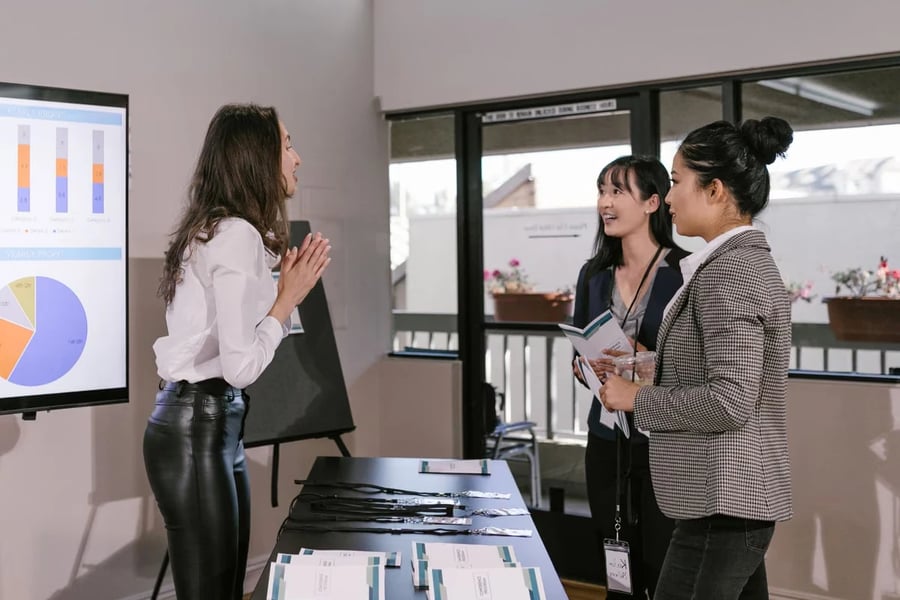
Most exhibitors in California walk away from a show believing the floor beat them. It didn't. Their booth did. I spent years watching two 10x10 spaces sit thirty feet apart on the same concrete aisle in San Diego, and only one of them pulled a steady line all three days. Same square footage.
Same crowd. The difference came down to five decisions made weeks before anyone packed a crate, and every one of them fits a startup budget. This piece walks through the whole run so you can steal the playbook: space planning, display choices, staffing math, the two-minute pitch, and what you do in the seventy-two hours after the badge scanner goes quiet.
Why a 10x10 Can Still Beat a 20x20
Booth size is a vanity number. Traffic is a visibility number, and the two are not the same thing. An open island at twenty feet invites sprawl. You end up with a table nobody wants to sit at, a banner nobody reads from the aisle, and two staffers leaning on a counter checking email. A tight 10x10 forces discipline. You pick one story, one hero product, and one reason for a stranger to stop. That constraint is a feature, not a punishment.
I'd choose a well-built small booth over a sloppy large one every single time, and I'd tell you that even if you had the bigger budget. The exhibitors who win at the Los Angeles Convention Center or the Anaheim Convention Center usually aren't the ones with the largest footprint. They're the ones whose space reads from forty feet away.
The Three Questions That Decide Your Display Setup
1. Are you shipping, driving, or buying on-site?
If your team flies in from Sacramento or Fresno, a shipping case is dead weight you'll pay for twice. If you drive a van from Bakersfield, an overhead hanging banner suddenly makes sense. Freight costs are the quiet killer of small exhibit budgets, and they change what "affordable" actually means for your show.
2. How many shows are on your calendar this year?
One show means rent. Four shows means buy. The breakeven sits somewhere in between, and it depends on your freight lane and whether you're reprinting graphics each time. Multi-event exhibitors get real value from a system with reusable graphic panels rather than a one-off setup that lives in a garage for eleven months.
3. What's your actual goal on the floor?
Brand awareness is vague and expensive. Booked meetings are measurable. If you're chasing meetings, you need a counter or podium where a conversation can happen standing up, plus a literature rack with something a prospect actually wants. If you're chasing brand, you need a backdrop wall that photographs well because attendees will do your marketing for you on social.
Space Planning Beats Graphics Every Time
Here's the part I'd tattoo on every first-time exhibitor's forearm: layout solves more problems than printing does. Stand in your assigned square, look at the aisle, and imagine a stranger walking past at a normal pace. That person makes a stop-or-keep-walking decision in roughly the time it takes to glance at a phone. Front-and-center tables kill that decision because they wall off your staff. Push the table to the side. Angle the backdrop. Keep one clear lane into the space. Leave your best display at eye level, not knee level.
Backlit panels earn their cost in any hall with flat overhead lighting, which is most of them. A lit graphic reads sharper from distance and photographs better, and photography is free marketing you've already paid for with the booth fee.
The Small Business Administration publishes an introductory small business guide on budgeting and planning that fits this exact problem well. Before you commit five figures to a floor presence, budget the way that guide suggests, line by line, including freight, drayage, and labor. Exhibitors who skip that step are the ones who discover drayage costs after the fact, and it's never a pleasant discovery.
Staffing Math Nobody Does Before the Show
California shows can run six to eight hours of floor time, and a tired staffer is a useless staffer. You need two people minimum for any 10x10 you intend to work hard, because one person cannot hold a conversation and watch the aisle at the same time.
Give each person a lane. One works the aisle and opens conversations. One handles the booth itself, demos, badge scans, and the follow-up notes. Rotate every couple hours. Eat away from the booth. If you've ever watched an exhibitor chewing a pretzel while a prospect waits, you know exactly why that rule exists.
Local labor sourcing is a real decision here, and it's not always about cost. Sometimes a trained local team outperforms a jet-lagged internal one. Sometimes your product needs the person who built it. Pick deliberately, not by default.
The Two-Minute Pitch and What Comes After
Write your pitch as one sentence, then a question. That's it. "We help X do Y. What's your setup look like right now?" That second sentence is where the real conversation starts, and it's the difference between a badge scan and a lead. Practice it out loud until you can deliver it without thinking about the words. I've watched plenty of smart exhibitors blow first contact because they led with a feature list instead of a question.
Now the post-show work, which is where most of your pipeline actually gets built. According to the U.S. Census Bureau, small firms make up the overwhelming majority of American businesses, which means most of the badges in your scanner came from companies where one person handles everything. If your follow-up email takes three days to arrive, that person has moved on.
Send a same-day email before you leave the building, even if it's short.
Segment by conversation depth, not by job title.
Reference one specific thing you discussed, because generic follow-ups get deleted.
Put a real date on the next step, not "let's stay in touch."
Log every response in your CRM so nothing falls through before the next show.
A Realistic First-Year Timeline
Say you're a software company in Irvine booking your first 10x10 at a regional show in the fall. Here's how the calendar should actually look. About twelve weeks out, lock your show goal and your budget, freight included. Ten weeks out, decide rent versus buy and start on graphics. Eight weeks out, book local labor or confirm internal travel, and check whether any international teammates need a visa for business travel, since that paperwork never moves as fast as anyone hopes.
Six weeks out, write and rehearse the pitch. Four weeks out, plan the space layout on paper. Two weeks out, run one full dry run with everything assembled. Then show up rested, which sounds obvious and almost never happens. If you're coordinating multiple events in different states, professional trade show displays built around reusable components will save you more money over a year than any single-show discount ever will. Buy once, reconfigure often, and stop rebuilding your booth from scratch every time the venue changes.
What Actually Moves the Needle
The exhibitors who generate consistent pipeline from small booths share three habits. They commit to one clear message. They staff to stay sharp rather than to look busy. They treat follow-up as part of the show, not an afterthought once the crates are shipped home.
Everything else is decoration, and some of it is expensive decoration. You don't need the biggest space on the floor. You need a booth that reads, a pitch that lands, and a follow-up cadence that respects the other person's time. So here's the question worth asking before your next show: if a prospect walked past your booth tomorrow, would they know in five seconds why they should stop?
Copyright © 2026 California Business Journal. All Rights Reserved.
For California Business Journal Disclaimers, go to https://calbizjournal.com/terms-conditions/.


