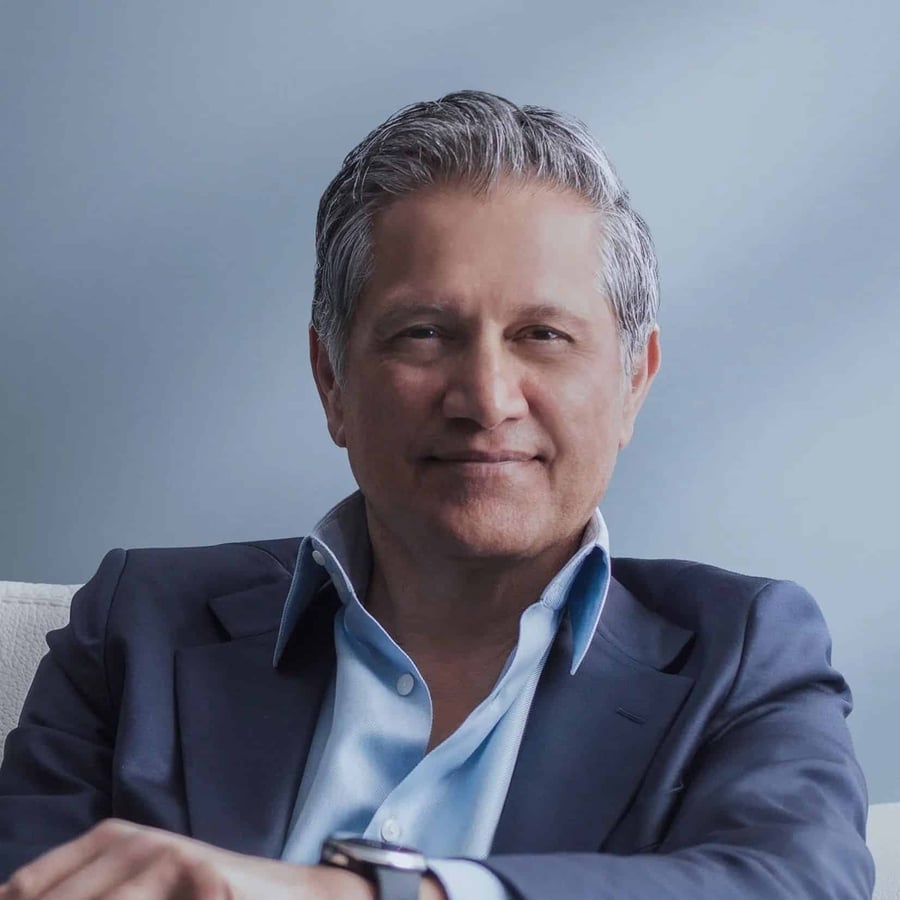
Joe Kiani’s first exposure to healthcare failures came not in a lab but while watching his sister struggle to walk again after surgery.
One of his earliest memories is of racing her through the streets of his neighborhood.
“I think I beat her,” he recalls with a soft smile.
But then came the procedure.
“After that, she couldn’t even run,” said Kiani, who is today the Executive Chairman of Willow. “And we spent years trying to undo that failure.”
This is a story that stands out in the world of medical technology founders, rooted not in engineering but in personal experience.
Before launching Masimo, a company that became a global leader in patient monitoring technology, or founding Willow, a startup pushing the boundaries of preventive health, Kiani was simply a boy trying to understand why healthcare had failed someone he loved.
That desire to make things better, to fix something that was broken, never left him. “I don’t think that at the time I decided I wanted to do something about it, but it imprinted me. I wanted to help,” Kiani told the California Business Journal.
From Shiraz to Silicon Valley
Kiani’s journey is marked by quiet determination and what he calls “microfixing”: solving big, complex problems one small piece at a time. As a child, he spent his summers with his family, traveling from their hometown to the capital city in the hope of finding better orthopedic care for his sister. Too young to be allowed upstairs at the hospital, he waited in the lobby, day after day, summer after summer.
“I would spend my time with other folks in the hospital lobby. They wouldn’t let me go up. Once, they allowed me to visit her. Just once,” Kiani said.
That sense of helplessness planted the seeds of what would eventually become a mission: To make healthcare better, smarter, and more humane.
“I’ve seen big problems around the world I couldn’t do anything about. But I thought maybe I could help in my own way,” he added.
Lessons in Leadership, Earned the Hard Way
Kiani’s professional journey spans decades of leadership, innovation, and hard-won lessons. He founded Masimo in the 1980s and propelled the startup into a $2 billion medical technology company. He led innovations in non-invasive patient monitoring that transformed care across hospitals worldwide. He dealt with investors, scaled operations, and built a company admired for both performance and purpose.
But he also learned valuable lessons.
“Wisdom only comes with time. I always had great intuition, but I didn’t have wisdom. Fortunately, we did many things right. But I learned more from the mistakes,” he said.
Those mistakes included underestimating the political realities of public markets, misjudging investor priorities, and placing too much faith in good intentions. This led to his departure from Masimo, which ultimately planted the seed for Willow’s radically different approach.
A Preventive Vision, Fueled by Research
Willow takes a different direction, focusing on prevention and consumer health tools rather than clinical devices.
Its flagship product, Nutu, Latin for nudge, is a digital wellness app that combines nutritional science, behavioral psychology, and artificial intelligence (AI) to help people live healthier lives, one small decision at a time.
“People don’t want to overhaul their lives overnight. They like their lives. That’s why they live them,” he said
Nutu does not require its users to make massive changes. It makes suggestions. If someone loves white rice, which Kiani admits he does, it might prompt them to reduce the portion or pair it with fiber-rich vegetables to counterbalance the glycemic spike. If a user has been sedentary for too long, Nutu encourages simple activity: A short walk, a few chores, or anything that helps restore equilibrium.
“It’s designed around how people actually behave. Not how we wish they behaved,” he said. Nutu™’s approach is helpful. Habits are formed by tiny changes, especially if someone can celebrate those milestones. Setting unrealistic expectations only demotivates and counteracts beneficial change.
The app tracks caloric intake and activity output, presenting users with a single goal: Reach zero by the end of the day to maintain metabolic balance. Kiani says that users who consistently hit zero lose weight, improve their blood sugar levels, and feel better without radical disruption.
Early stues back that up. “We’ve done a small study with about 20 to 30 people. Many of them lost weight and reduced their Hemoglobin A1c levels. We're about to kick off a larger study at the University of California, Irvine. Hopefully, that will show statistically significant results,” he added. Hemoglobin A1c levels measure average blood sugar over the past 2–3 months. The metric measures how well someone’s body manages glucose and is used to diagnose or monitor diabetes.
The long-term goal? A tool that feels intuitive, embedded into daily life, and scalable across populations.
“We want to build a skyscraper. We’re on the fourth floor. But I see this as a 104-story building,” Kiani said. Such ambition may be difficult to realize, but his track record suggests he thrives on long-term vision.
Building With Ethics at the Core
Kiani emphasizes the importance of trust in tech and champions ethics. At Willow, that translates into a privacy approach shaped around user needs and control.
“People pay for the devices and software, so any data sharing must serve them. If it helps improve the tools without compromising privacy, that’s fine—but the user always comes first,” he said.
Kiani has been a long-time advocate for the responsible use of data. Through the Patient Safety Movement Foundation, which he founded, he has brought together over 100 companies—including Oracle, IBM, GE, and Philips—to commit to sharing anonymized health data to build predictive algorithms that reduce preventable deaths.
“We’ve already seen it work in hospitals—detecting sepsis before it gets serious, preventing opioid respiratory depression. Now we want to do the same thing at home—reduce ER visits, predict complications before they happen,” Kiani said.
Balancing innovation through big data with respect for individual privacy remains a core challenge.
“I actually think putting in the work upfront—understanding failure modes, testing software carefully, encrypting everything—these are good ideas for every industry. Not just med-tech,” he said.
Small Changes, Big Impact
Kiani says Nutu’s strength lies not in flashy features but in its thoughtful, behavioral design. It encourages consistency, not perfection. It offers coaching—either AI-assisted or human-supported—and integrates features such as barcode scanning and meal photo recognition to reduce user friction.
“We studied everything: Food science, endocrinology, metabolism, and psychology. We brought in experts to make sure we weren’t just guessing,” Kiani said. Even small tips—such as how cinnamon can mitigate the harmful effects of sugar or how grass-fed beef is anti-inflammatory while corn-fed beef is not—are backed by evidence
“Nutu is about giving people realistic, achievable steps. So they’re still doing it next year and the year after that,” Kiani said.
Looking Ahead
Kiani is under no illusion that change will come easily. Preventive health has long been underfunded and misunderstood. In the United States, the Trust for America’s Health (TFAH) reported that decades of underfunding have left the public health system ill-equipped to protect Americans’ health and respond to emergencies.
But Kiani believes Willow can help reshape the narrative, not just through Nutu, but through a broader suite of innovations still to come. “I hope by 2035 we’ve reduced suffering. I hope we’ve made hundreds of millions—maybe a billion—people healthier. I hope we’ve revolutionized the care of prediabetes and helped people take back control of their lives,” Kiani concluded.
Copyright © 2025 California Business Journal. All Rights Reserved.
For California Business Journal Disclaimers, go to /terms-conditions/.


