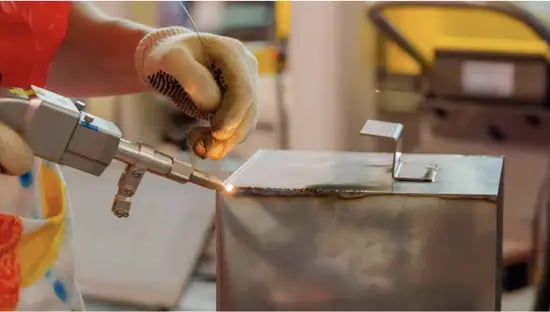
As more manufacturers turn to robotic welding to boost productivity and maintain tighter tolerances, one thing becomes clear: robots can only be as accurate as the setups that support them. Even the most advanced robotic welder will struggle to produce consistent results if the parts it works on are loose, misaligned, or distorted. This is one of the biggest challenges production teams face today achieving repeatable quality when facing part variability and demanding production cycles.
That’s why understanding the role of a welding fixture is so essential. Fixtures stabilize materials, ensure consistent alignment, and properly position components so robotic welders can follow their programmed paths with precision. In this article, you’ll learn how welding fixtures improve robotic weld quality, what features matter most, and how manufacturers can use proper fixturing to meet modern quality standards.
Why Welding Fixtures Are Essential for Robotic Welding
Manufacturers often struggle with:
- Inconsistent part placement, leading to weld defects
- Heat distortion, especially in thin metals
- High scrap and rework rates when alignment shifts during production
Robotic welders rely on predictable positioning. A welding fixture eliminates the guesswork by locking parts into a precise, repeatable configuration.
Welding Fixtures Provide the Foundation for Repeatability
Repeatability is the core strength of robotic welding but it’s impossible without stable fixturing. A welding robot follows the same path every time. If the part moves even slightly, the weld will miss its mark.
How fixtures ensure repeatability:
- They lock parts into identical positions every cycle.
- They reduce vibration and shifting during welding.
- They eliminate manual adjustments, which can cause variation.
- They maintain consistent joint fit-up, gap size, and angle.
Whether you're welding a small bracket or a complex assembly, repeatable setups are key to robotic success.
Controlling Part Distortion During Welding
Heat distortion is one of the most common issues in welding. Metals expand and contract as they heat and cool, which can warp parts and ruin alignment.
A welding fixture helps minimize distortion by:
- Securing parts tightly in place
- Supporting weak or thin sections
- Maintaining geometry during heating
- Reducing stress points that lead to warping
Robotic systems can compensate for many variables, but distortion isn’t one of them fixtures are the solution.
Faster Cycle Times and Higher Throughput
Robotic welding is designed for speed. But without the right fixturing, time is wasted on manual alignment, repositioning, or inspections.
Fixtures improve efficiency by:
- Allowing quicker part loading and unloading
- Reducing setup time between cycles
- Enabling robots to weld continuously without stopping
- Minimizing the need for rework or repair passes
In high-volume production environments, well-designed fixtures can shorten cycle times by several seconds per part adding up to hours saved per shift.
Flexible Fixture Designs Support Modern Manufacturing Needs
Today’s manufacturers handle greater product variation than ever before. Whether building small batches, prototypes, or custom assemblies, flexibility is key.
Common fixture designs include:
Modular Fixtures
- Built from standardized blocks and clamps
- Easy to reconfigure for different part types
Dedicated Fixtures
- Engineered for a single component
- Best for high-volume, automated production lines
Hybrid Fixtures
- Combine adjustable and fixed components
- Ideal for mid-volume or evolving product lines
Flexible fixturing gives manufacturers the ability to adapt without investing in entirely new systems every time a design changes.
Improving Weld Quality Through Consistent Alignment
Alignment issues are one of the leading causes of weld defects in robotic systems. Even small misalignments can lead to undercutting, lack of fusion, or off-center welds.
Fixtures enhance alignment by:
- Using reference surfaces called datum points
- Ensuring tight fit-up between parts
- Maintaining consistent joint gaps
- Positioning parts at correct angles for the robot arm
Quality welds begin with correctly aligned components; fixtures are what make that possible.
Comparison: Welding With vs. Without Proper Fixtures
| Factor | Without Fixture | With Fixture |
| Weld Accuracy | Poor, inconsistent | High, repeatable |
| Cycle Time | Longer, more adjustments | Faster, streamlined |
| Part Distortion | Higher | Reduced |
| Defect Rate | High | Low |
| Operator Involvement | High | Minimal |
| Robot Performance | Limited | Optimized |
Fixtures don’t just support the robot they elevate the entire production workflow.
Enhancing Safety and Ergonomics
Good fitting improves the working environment too.
Safety advantages:
- Reduces risk of dropped or shifting workpieces
- Keeps operators away from pinch points
- Minimizes manual handling of heavy parts
- Ensures secure clamping before robotic operation
When fixtures support safety, the entire production line benefits.
What to Look for When Choosing a Welding Fixture
If you’re selecting or designing a fixture, here are the key features to consider:
1. Rigidity and Construction Material
Steel or cast-iron bases are preferred for vibration resistance.
2. Accessible Loading and Unloading
Operators should be able to load parts quickly and safely.
3. Multi-point Clamping
Prevents shifting during the weld cycle.
4. Heat Management
Proper spacing and support help reduce thermal distortion.
5. Robot Clearance and Motion Path
Ensure no fixture components interfere with the robot arm.
6. Scalability
Consider whether future product variations may require fixture adjustments.
7. Maintenance and Durability
Fixtures should withstand repeated use in harsh manufacturing environments.
As manufacturers continue investing in robotic automation, choosing the right supporting equipment becomes even more important. Many production teams explore reliable solutions from brands like Denaliweld, which offer tools designed to complement modern fabrication workflows.
Conclusion
Robotic welding delivers exceptional speed and precision but its success depends on the stability and consistency provided by a solid welding fixture. Fixtures ensure correct part placement, reduce distortion, streamline workflow, and enhance overall weld quality. Whether you’re working with small components or large assemblies, investing in the right fixture design helps unlock the full potential of robotic welding systems.
By understanding the role fixtures play and implementing best practices into your production process, you can dramatically improve efficiency, reduce defects, and achieve long-term consistency. In today’s fast-paced manufacturing world, welding fixtures aren’t just useful they’re essential for reaching the highest levels of robotic weld quality.
Copyright © 2026 California Business Journal. All Rights Reserved.
For California Business Journal Disclaimers, go to /terms-conditions/.


