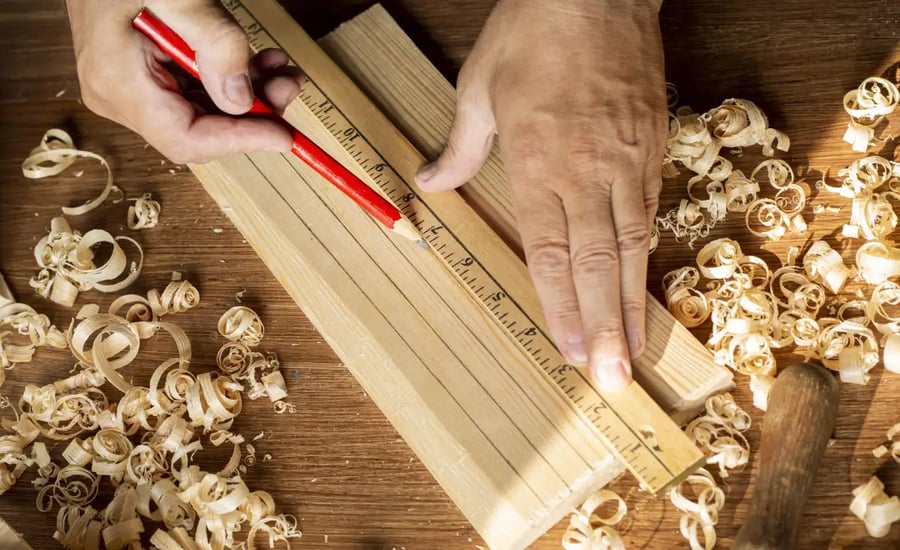
Finish carpentry lives in the details. It is the stage where a space stops looking like a construction site and starts feeling complete. Tight joints, clean lines, and seamless transitions all matter, and few techniques influence those results more than the 45-degree cut.
At first glance, a 45-degree cut might seem basic. In practice, it is one of the most important skills separating rough work from refined craftsmanship.
The Role of Angles in Visual Precision
Straight cuts are forgiving. Angled cuts are not.
In finish carpentry, corners are where the eye naturally lands. Door casings, window trim, baseboards, and crown molding all meet at angles. A clean 45-degree cut allows two pieces to come together smoothly, forming a miter joint that looks intentional rather than forced.
Even slight inaccuracies can create gaps that catch light and draw attention. That is why finish carpenters rely so heavily on precise angle cuts to maintain visual continuity throughout a room.
Why 45 Degrees Became the Standard
A 90-degree corner split into two equal angles gives you 45 degrees. That simple geometry explains why the cut is so common, but tradition also plays a role.
Over time, builders learned that 45-degree miter joints offered a good balance between strength, appearance, and efficiency. They distribute stress evenly, glue up cleanly, and hide end grain better than square butt joints.
In trim work, that balance still holds. The joint looks cleaner, lasts longer, and feels deliberate.
Miter Joints and Material Behavior
Wood moves. It expands and contracts with changes in temperature and humidity. A well-executed 45-degree miter joint accommodates that movement better than many alternatives.
When two angled faces meet, seasonal movement tends to spread across the joint rather than pulling it apart in one direction. This is especially important in longer runs of trim or in older homes where walls are rarely perfectly square.
Finish carpenters often fine-tune their angles slightly to compensate for out-of-square corners, but the foundation remains the 45-degree cut.
The 45 Degree Cut Miter Saw Advantage
A reliable miter saw set accurately to 45 degrees is one of the most important tools in finish carpentry. In professional trim work, a dependable 45 degree cut miter saw is essential for maintaining repeatable accuracy across casing, baseboard, and crown molding installations. While hand tools and coping techniques still have their place, the miter saw provides speed, repeatability, and consistency that jobsite conditions demand.
A quality miter saw allows carpenters to:
- Make precise, repeatable angle cuts
- Adjust angles easily for imperfect corners
- Maintain clean edges on delicate trim profiles
- Work efficiently without sacrificing accuracy
Blade quality, saw calibration, and fence alignment all affect results. Many finish carpenters check their saw settings regularly, knowing that even a small deviation can compound across multiple joints.
Crown Molding and Compound Angles
Crown molding raises the stakes. Here, a 45-degree cut often combines with bevel angles to create compound miters. The geometry becomes more complex, but the principle remains the same.
Clean 45-degree cuts help crown molding wrap corners smoothly, maintaining consistent reveal and profile alignment. When these cuts are off, the error is obvious, even to an untrained eye.
This is why crown work is often used as a benchmark for finish carpentry skill. It rewards precision and exposes shortcuts.
Efficiency Without Compromising Quality
Some argue that coping joints outperform miter joints in certain situations, and that can be true. But miters remain essential because they are efficient and visually sharp when executed correctly.
On large trim packages, speed matters. A carpenter who can produce clean 45-degree cuts consistently saves time without lowering standards. That efficiency keeps projects moving and clients satisfied.
Final Thoughts
The 45-degree cut is not just a technique. It is a foundation of finish carpentry. From simple baseboard corners to complex crown molding, it enables clean joints, balanced stress, and refined visual results.
Mastering the 45-degree cut, and the tools that produce it, is part of what turns carpentry into craftsmanship. The cut may be simple, but its impact is anything but.
Copyright © 2026 California Business Journal. All Rights Reserved.
For California Business Journal Disclaimers, go to /terms-conditions/.


