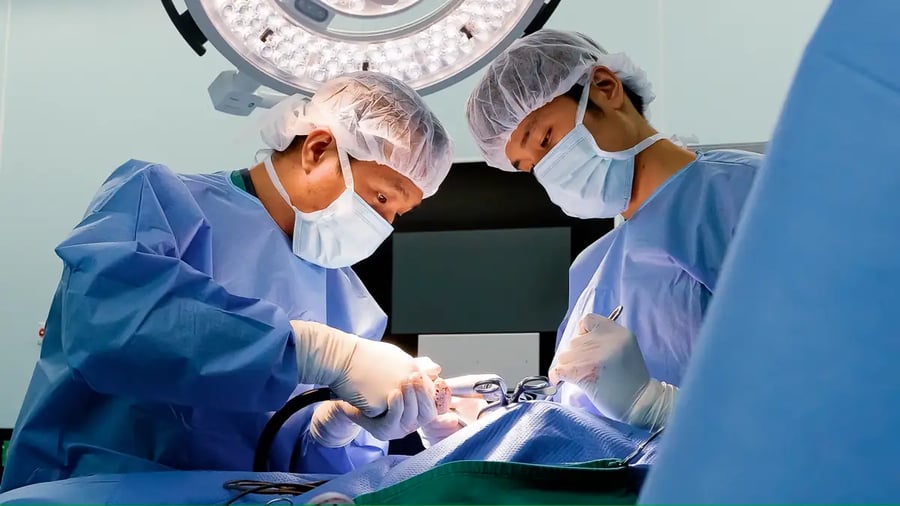
When he arrived at Vinmec, surgeons did not begin with an operating table. They began with data. Bone loss was mapped, deformity simulated, and the joint rebuilt virtually before it could ever be restored in reality. For the first time in 27 years, his future movement existed in a 3D model.
Reconstructing What Time Has Erased
Repeated hospital visits and multiple surgeries brought Phong little relief. With time, he began to accept that the deformity might be permanent. Not until a referral led him to Vinmec Times City International Hospital did the course of his treatment change.
There, clinicians recognized his condition as an exceptionally complex post-traumatic sequela. “This is an extremely rare case with a very high level of complexity, and there are virtually no precedents in Vietnam,” said Dr. Tran Quyet, Head of Upper Limb Surgery, Musculoskeletal and Orthopedic Trauma Center, Vinmec Times City.
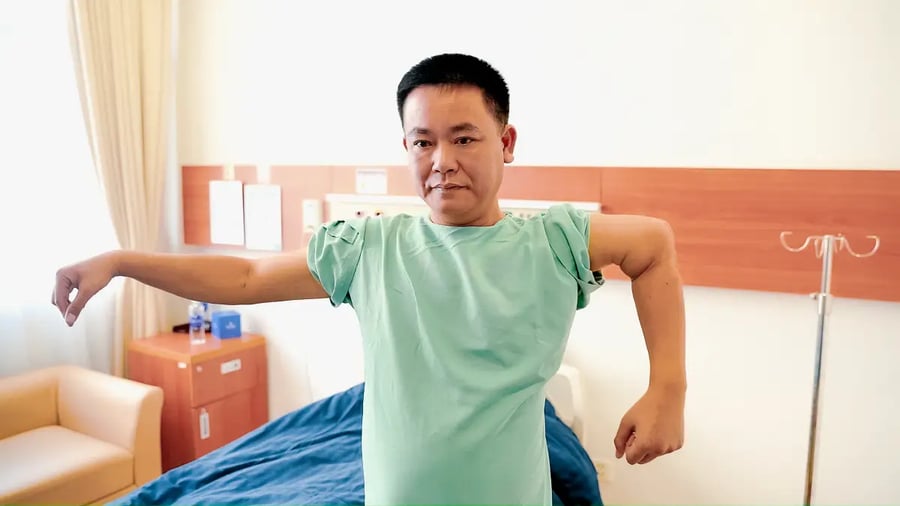
Decades of injury resulted in near-complete loss of the elbow’s original anatomy. The patient’s elbow joint was completely fused and unstable, with an estimated 6-centimeter defect in the distal humerus. This resulted in the left arm being 4-5 centimeters shorter than the right and the loss of much of its original anatomical structure.
This degree of anatomical loss placed the case beyond the scope of standard elbow arthroplasty. Although megaprostheses were originally developed for limb-salvage surgery in bone oncology, their application at the elbow, particularly in non-oncologic settings, remains uncommon.
After multidisciplinary evaluation, clinicians at Vinmec proceeded with a total elbow megaprosthesis combined with reconstruction of the extensive bone defect.
Designed in 3D, Restored in Reality
“The patient has waited for 27 years. Another failure would have had a severe psychological impact. That is why we were determined to create a new opportunity to change his life,” Dr. Quyet stated.
Vinmec’s medical team reached a decision: a total elbow megaprosthesis combined with reconstruction of the extensive bone defect. Before entering the operating room, the entire elbow anatomy was digitally rebuilt and simulated on an in-house 3D platform. Using CT-based modeling, surgeons mapped the deformity in detail, rehearsed the reconstruction, and designed a custom elbow joint tailored precisely to the patient’s anatomy.
That preparation proved decisive. The operation was completed successfully, with no nerve or vascular injury recorded. Just three days later, Phong was able to gently move his arm. After two weeks, he could fully extend and flex his elbow, abduct his arm, and raise it overhead.
“After nearly 30 years, I finally feel like I have a normal arm again. It moves so naturally as if I never had surgery at all,” the patient shared emotionally.
A Hub for Orthopedic Innovation & Care
In Phong’s case, the miracle did not arrive overnight. It was engineered, layer by layer, through a series of clinical breakthroughs driven by advanced 3D printing at Vinmec. In 2025, this system performed a highly personalized total femoral replacement for a young child with aggressive bone cancer, using a custom 3D-printed metal implant. The procedure preserved the limb in a situation where amputation had been the prevailing recommendation. Earlier, Vinmec had already marked another regional first by completing Southeast Asia’s first fully 3D-printed titanium chest wall reconstruction.
These achievements illustrate how Vinmec integrates 3D printing into a patient-first clinical model.
Stories like Phong’s extend far beyond national borders. They reach patients worldwide who have been told that conventional options are exhausted, yet continue to hope for an alternative. At Vinmec International Healthcare System, such alternatives are tangible solutions - designed, printed, and rebuilt with intention.
Copyright © 2026 California Business Journal. All Rights Reserved.
For California Business Journal Disclaimers, go to /terms-conditions/.


