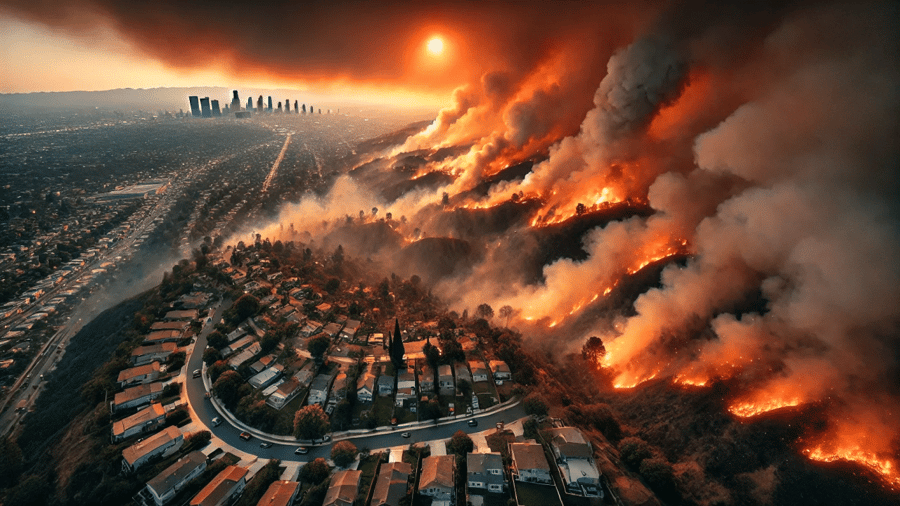
While headlines often focus on visible disasters like the Pacific Palisades wildfire of January 2025, a quieter but no less dangerous crisis is burning beneath our feet—literally. Southern California’s landfill system, plagued by underground fires and toxic emissions, has exposed a dangerous pattern of neglect, particularly at major facilities operated by Waste Management Inc. (WM), Republic Services and Waste Connections. Their influence and lack of accountability are precisely why California must enact Assembly Bill 28 (AB 28), the Landfill Fire Safety Act.
These issues aren’t confined to the highly publicized Chiquita Canyon Landfill. In fact, equally severe risks are emerging at landfills that have, until recently, escaped public scrutiny. The silence surrounding them is not a sign of safety, it’s a sign of failure.
El Sobrante Landfill (Riverside County) – Operated by Waste Management
In mid-2024, underground reactions at El Sobrante ignited dangerously high subsurface temperatures and chemical emissions. An investigation published in the Los Angeles Times on February 28, 2025 detailed numerous violations: elevated methane levels, insufficient hazardous waste screening, and improper safety signage. Waste Management even requested permission to accept wildfire debris—an ask regulators wisely rejected due to the heightened risk of igniting additional underground fires. This is not just poor judgment; it’s corporate negligence. And yet, WM continues to oppose AB 28.
Sunshine Canyon Landfill (Los Angeles County) – Operated by Republic Services
Though it has yet to experience a major underground fire, Sunshine Canyon has a long track record of regulatory violations and public complaints. More than 150 Notices of Violation for noxious odors have been issued by the South Coast Air Quality Management District (SCAQMD). These recurring failures are a warning sign. The question is not if something catastrophic will happen—but when. Without AB 28, the oversight needed to prevent such a disaster remains toothless.
Chiquita Canyon Landfill (Los Angeles County) – Operated by Waste Connections
This facility’s underground fire, active since 2022, has drawn attention due to its scale—90 acres of smoldering subsurface waste, over 28,000 odor complaints, and benzene-contaminated leachate seeping into groundwater. While Chiquita has rightly become a rallying cry, it is not the only landfill at risk. It’s merely the most visible. The true danger lies in the facilities we aren’t watching closely enough.
Why AB 28 Is the Solution
Assembly Bill 28, authored by Assemblywoman Pilar Schiavo, would force landfill operators to take real responsibility for their aging, hazardous infrastructure. Not surprisingly, the state’s largest waste companies—WM and Republic among them—have joined industry groups to oppose the legislation. But that opposition is precisely what makes this bill so urgent.
Key Provisions of AB 28
Real-Time Monitoring – Continuous detection of subsurface temperature and gases, with data publicly available.
Hazardous Waste Screening – Mandatory protocols to detect and reject unsafe wildfire debris and chemical-laden refuse.
Transparency Dashboards – Public reporting of air quality and emissions, enabling communities to track risks in real time.
Enforcement Power – Expanded authority and funding for CalEPA and the Department of Toxic Substances Control to penalize noncompliant operators.
Fire-Resistant Infrastructure – Strengthened on-site infrastructure for firefighting and toxic waste containment, with mandatory audits and emergency planning.
The Bigger Picture
As climate change fuels more wildfires, landfills are being asked to absorb debris filled with toxic and volatile materials. When this waste meets undermaintained, aging infrastructure—like that at El Sobrante and Sunshine Canyon—it becomes a powder keg. AB 28 provides the framework to defuse it.
Conclusion
We’ve already seen what happens when our state fails to act: the Palisades wildfire showed how gaps in infrastructure and oversight lead to tragedy. Landfills run by Waste Management and Republic Services reveal similar systemic weaknesses—just hidden underground.
California must act before another disaster strikes. AB 28 isn’t just good policy—it’s a firebreak between us and the next catastrophe. Lawmakers must stand up to industry pressure and protect the public. Let’s not wait until another landfill ignites to do what we already know is necessary.
Copyright © 2025 California Business Journal. All Rights Reserved.
For California Business Journal Disclaimers, go to /terms-conditions/.


