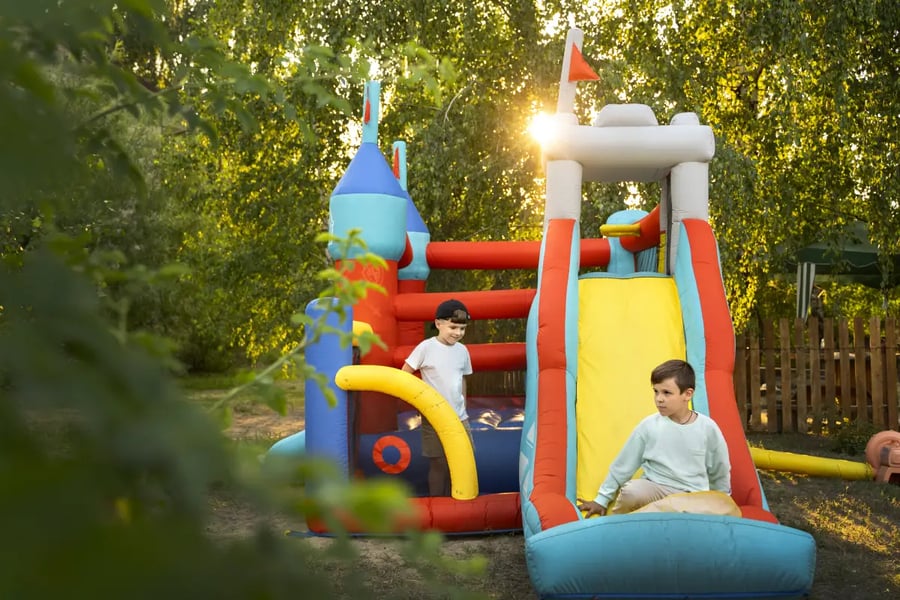
Most people buy an outdoor inflatable, set it up once, and figure it'll handle sun, rain, and rough play for years without a problem. Then it fades, cracks, or springs a leak after one summer. The material is almost always the culprit.
Understanding the materials behind durable outdoor inflatables helps you actually pick products that survive real outdoor conditions. Here are five things to know before spending money on one.
PVC Is the Most Widely Used Material in Outdoor Inflatables
PVC, or polyvinyl chloride, is one of the most common materials used for outdoor inflatables because it can hold air under pressure, handle regular movement, and stand up to outdoor conditions better than lighter plastics. The exact quality depends on the thickness, though. For example, Floatie Kings' custom inflatables and similar outdoor event inflatables are typically made with thicker PVC designed for repeated setup, storage, and use at branded events. Cheaper beach-style inflatables often use thinner PVC, which may be fine for casual use but is less reliable for arches, product replicas, or large display pieces that need to stay inflated and stable for longer periods.
Why PVC Handles Weather So Well
PVC doesn't absorb water or swell from moisture. It's ideal for pool floats, water park inflatables, and outdoor advertising structures. After repeated wet-dry cycles, quality PVC maintains its shape and air seal.
UV light's a different problem. Raw PVC degrades under direct sunlight. Manufacturers add UV stabilizers during production to slow the molecular breakdown that causes cracking and fading. Look for "UV-stabilized PVC" on the specs; don't assume it's there just because the label says PVC.
How PVC Thickness Affects Longevity
Thickness isn't the whole story, but it's important. A 0.9mm PVC inflatable handles adult weight and pool activity. A 0.4mm one can't. The difference becomes obvious fast when you put both on gravel, concrete edges, or under heavy sun.
For commercial work, festival inflatables, branded arches, manufacturers go thicker. Products designed to survive weeks of continuous outdoor use often run 1.2mm to 1.5mm PVC with reinforced seam bonding.
Seam Construction Matters as Much as the Material
The weakest point on any inflatable isn't the panel itself. It's the seam. Two methods dominate: heat welding and RF (radio frequency) welding. RF welding fuses PVC panels at a molecular level, creating a stronger, more airtight bond than adhesive stitching can produce.
Budget inflatables rely on glued seams. They work fine indoors or in low-stress situations. But sun exposure, stretching, and pressure changes cause glued seams to peel. RF-welded seams don't.
TPU Offers a More Eco-Friendly and Flexible Alternative
Thermoplastic polyurethane (TPU) sits above standard PVC in both cost and performance. It's softer to touch than PVC, stays flexible even in cold temperatures, and doesn't need plasticizers to remain pliable. That matters; PVC requires chemical plasticizers for softness, and some raise environmental and health questions.
TPU skips that step entirely. It's recyclable, doesn't off-gas the same compounds, and performs across a wider temperature range. You'll see it in high-end inflatable kayaks, premium pool floats, and products where low-temperature flexibility's important.
TPU vs. PVC for Outdoor Use
PVC still wins on price and availability. TPU costs more to manufacture, pushing retail prices higher. But for outdoor inflatables that need to flex without cracking on cool mornings or in early spring, TPU performs better. It also holds color longer, so premium decorative inflatables sometimes use TPU to keep graphics sharp through multiple seasons.
Where TPU Makes the Most Sense
TPU excels when flexibility and color retention outweigh cost concerns. Cold-weather events, high-end branded pieces, and products expected to last several years are the right fit. You're buying once and want it looking good in year three? TPU justifies the extra expense.
Environmental Considerations Around TPU
TPU's lower chemical footprint has made it the go-to for environmentally conscious brands. It's free from phthalates and heavy metal stabilizers found in some PVC versions. Several manufacturers now produce eco-focused inflatable lines using TPU to meet corporate environmental standards.
Nylon and Polyester Fabrics Add Structure and Puncture Resistance
PVC and TPU grab the headlines, but the fabric layer underneath does serious work. Most durable outdoor inflatables aren't just coated plastic. They're laminated structures; a woven fabric layer sits bonded between or behind the outer coating. That fabric is typically nylon or polyester.
Why Fabric Reinforcement Changes the Performance
Plain PVC stretches under pressure and tears at stress points. Fabric-reinforced PVC laminate distributes that stress across the weave and resists tearing. Consider the difference between a plain plastic bag and a woven tarp. The tarp doesn't just stretch and split. The same principle applies to inflatables.
Polyester gets used more often because it's cheaper and resists moisture well. Nylon is lighter and stronger per unit weight, which makes it the choice for inflatable products where both portability and strength matter.
Drop-Stitch Technology for Structural Inflatables
Some outdoor inflatables need to hold a rigid, flat shape under pressure. Inflatable paddleboards, inflatable floors, and event platforms rely on drop-stitch construction. Thousands of vertical fibers connect the top and bottom panels. When you inflate, the fibers tighten and create a rigid, flat surface instead of a balloon bulge.
Drop-stitch products hold 10 to 25 PSI without deforming. That's why an inflatable paddleboard can support a 200-pound adult. The material science isn't mysterious; it's the right engineering for the task.
Choosing Between Coated Nylon and Laminated Polyester
Coated nylon products pack lighter and smaller. Laminated polyester products feel stiffer and show slightly better puncture resistance. For outdoor inflatables that stay in one spot, polyester laminate wins. For products you transport regularly, coated nylon wins on weight.
Conclusion
The materials that go into a durable outdoor inflatable aren't mysterious. PVC works well in most situations, provided it's the right thickness, UV-stabilized, and RF-welded at the seams. TPU steps in for products needing flexibility, color longevity, or a lower chemical impact. And fabric reinforcement, whether nylon or polyester, transforms a flexible film into something that can take real punishment.
Knowing what materials are used to make durable outdoor inflatables means you don't pick the wrong product for your needs. Match the material spec to what you're doing with it, and your inflatable will outlast the cheap alternatives by years.
Copyright © 2026 California Business Journal. All Rights Reserved.
For California Business Journal Disclaimers, go to /terms-conditions/.


