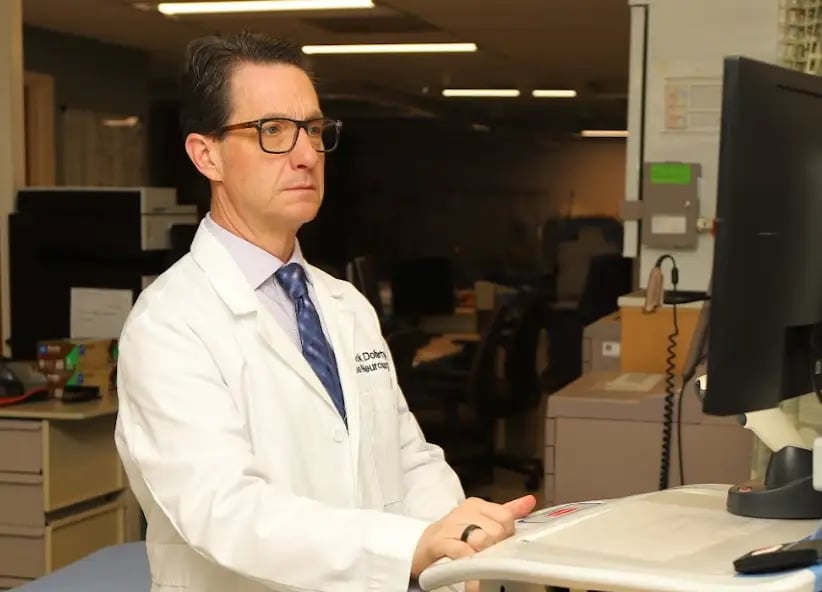
What if the spine surgeon you visit is just as passionate about keeping you out of the operating room as getting you through it? That’s the provocative philosophy guiding Dr. Patrick Doherty, Associate Professor of Neurosurgery at Yale and a leader in minimally invasive spine care.
In a medical world obsessed with the latest gadgets—robotic surgery, AI diagnostics, high-frequency spinal cord stimulators—Dr. Doherty’s most disruptive idea may actually be his commitment to helping people reclaim their lives without surgery whenever possible.
“I want to empower people with the knowledge and tools they need to actively participate in their own recovery and long-term health,” Dr. Doherty says. “The best outcome is sometimes the one that doesn’t involve surgery at all.”
Innovation With a Human Touch
Dr. Doherty’s approach bridges the divide between high-tech innovation and human-centered care. He’s been at the forefront of introducing advanced techniques like high-frequency spinal cord stimulation (SCS), which has shown promise not just for pain relief but for restoring function in patients with nerve damage or even foot drop. In a recent case series, patients treated with 10 kHz SCS not only reported less pain, but some regained movement and strength in their legs—an outcome that would have been “unthinkable” a decade ago [ResearchGate].
But while Dr. Doherty is a champion of surgical innovation, he’s equally outspoken about weeding out the hype. “Technology should serve the patient, not the other way around,” he says. It’s an attitude that stands out in a field where new devices can cost tens of thousands of dollars—and where not every ‘breakthrough’ benefits the people who matter most.
Turning Patients into Partners
One of Dr. Doherty’s most memorable stories isn’t about a dramatic operation, but about a firefighter who came in barely able to walk. With a tailored plan of physical therapy and lifestyle changes, the patient not only returned to firefighting but competed in stair climbing events—a testament to what can be achieved when physician and patient work as a team.
This philosophy is echoed in his writing for national publications, where he offers expert advice on exercise for back pain, ankylosing spondylitis, and even the intersection of COVID-19 and musculoskeletal symptoms [HealthCentral] [HuffPost]. His message to readers is clear: you have more control than you think, and small steps—literally—can change your life.
A Vision for Concierge Spine Care
Dr. Doherty is also a proponent of “concierge spine care,” a nascent concept where patients receive not just surgery or injections, but coordinated, personalized treatment—often involving non-surgical specialists, nutritionists, and even yoga or Pilates instructors. “The spine world is changing fast,” he says. “We’re moving toward patient-directed care, more education, and more collaboration—not just between doctors, but with patients themselves.”
So, What’s the Future of Spine Surgery?
Dr. Doherty believes the next frontier isn’t just in robotics or augmented reality, but in prevention, education, and empowering patients—helping them avoid the knife whenever possible. “I’m humbled every day by people overcoming pain, weakness, and disability,” he says. “Sometimes the greatest triumph is simply helping someone get their life back.”
For those facing back pain or spinal problems, Dr. Doherty’s advice is simple: “Find a doctor who listens, who explains your options—and who sees your recovery as a partnership, not just a procedure.”
Want to learn more? Read Dr. Doherty’s patient-centered advice in national publications:
- Yale New Haven Health Expands Treatment Options for Surgical Pain
- Exercise for Ankylosing Spondylitis: What You Need to Know
- Are Muscle Aches or Back Pain a Symptom of the Omicron COVID Variant?
Copyright © 2025 California Business Journal. All Rights Reserved.
For California Business Journal Disclaimers, go to /terms-conditions/.


