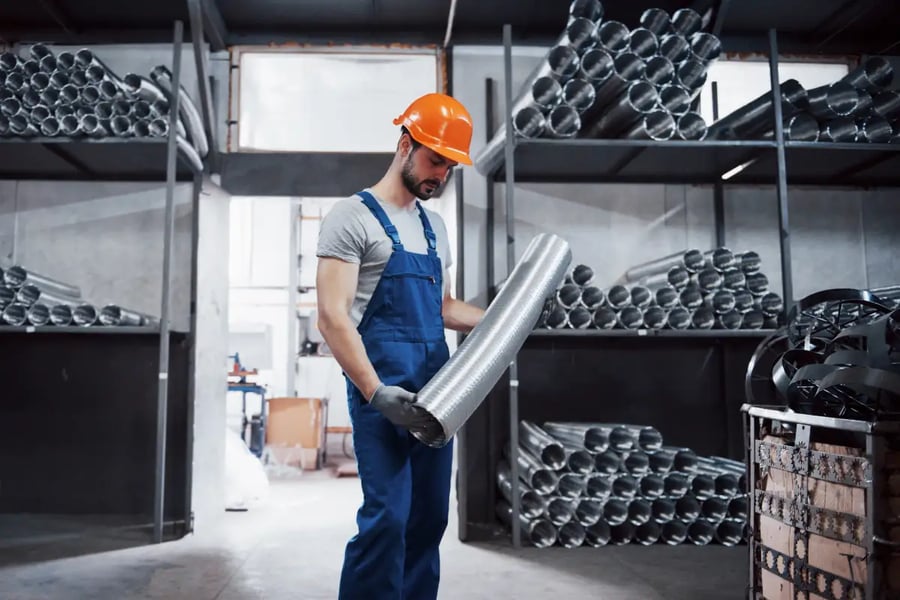
Stainless steel ornamental tubing is widely used in architectural frameworks, commercial railings, furniture systems, and equipment structures. These applications demand consistent appearance, mechanical reliability, and predictable fabrication behavior. ASTM A554 provides the standardized requirements that allow manufacturers, fabricators, and end users to specify tubing with confidence. By defining mechanical properties, dimensional tolerances, and surface finish criteria, the standard helps ensure that ornamental tubing performs as intended across a broad range of industries.
For organizations sourcing ornamental tubing, working with a supplier that adheres to ASTM A554 specifications is essential for maintaining consistent performance and appearance.
What ASTM A554 Covers
ASTM A554 establishes specifications for welded stainless steel mechanical and ornamental tubing produced from flat-rolled stainless steel. It applies to round, square, rectangular, and specialty shapes, and outlines requirements for manufacturing practices, weld integrity, chemical composition, mechanical properties, and surface conditions.
The intent is to create a uniform baseline for tubing used in applications where both function and appearance are critical. When a product is certified to ASTM A554, the purchaser gains assurance that the tubing meets consistent structural and cosmetic expectations.
Why ASTM A554 Matters for Quality Assurance
In ornamental or mechanically sensitive applications, variation in surface finish, weld consistency, or dimensional accuracy can lead to fabrication challenges, premature wear, or visible irregularities in finished assemblies. ASTM A554 reduces these risks by providing measurable thresholds for tolerances and performance. This standardization is particularly important for large-scale projects in which multiple batches must match seamlessly or where fit-up tolerances are tight.
In fabrication environments, predictable material behavior also supports more efficient processing during bending, rolling, cutting, and welding operations.
Material Grades Recognized Under ASTM A554
The standard includes several common austenitic stainless grades, each selected according to the needs of the application:
- 201 and 202 for cost-sensitive projects requiring good strength and formability
- 304 and 304L for general-purpose corrosion resistance and broad applicability
- 316 and 316L for environments with elevated chloride exposure or stringent corrosion requirements
While ASTM A554 defines the permissible chemical composition ranges, material selection remains the responsibility of the designer or purchaser. The standard ensures that whichever grade is specified will meet the mechanical and compositional criteria required for reliable performance.
Dimensional and Surface Requirements
Dimensional accuracy is essential for components that must align precisely during installation. ASTM A554 specifies tolerances for outside diameter, wall thickness, straightness, twist, and squareness of corners for shaped tubing. Consistency across these parameters ensures smooth assemblies and reduces corrective work during fabrication.
Surface finish requirements are equally important for ornamental and architectural applications. The standard outlines acceptable levels of surface imperfections, weld bead appearance, and finishing treatments. Whether a project requires a satin polish, a high-reflectivity finish, or a uniform brushed appearance, compliance with A554 helps ensure that the supplied tubing meets those expectations.
Mechanical Properties and Testing Protocols
ASTM A554 includes mechanical performance criteria designed to verify suitability for structural and semi-structural use. The required tests include:
- Tensile and yield strength evaluations
- Elongation measurements to assess ductility and formability
- Flattening tests to evaluate weld seam integrity
- Reverse-bend tests to assess resistance to cracking during fabrication
- Hydrostatic or nondestructive electric testing to confirm weld continuity
The standard places particular emphasis on weld quality because A554 tubing is typically produced through autogenous welding. Adequate weld penetration, minimal distortion, and smooth seam blending are essential for both appearance and performance.
Where ASTM A554 Compliance Has the Most Impact
A554-compliant tubing is utilized in environments where aesthetics, durability, and fabrication reliability intersect. Common applications include:
- Architectural railings and guardrails
- Building facades and structural accents
- Equipment frames and supports
- Retail fixtures and display systems
- Medical and food-service environments requiring corrosion resistance and cleanability
In these sectors, inconsistent welds, surface defects, or dimensional deviations can undermine both design intent and service life. ASTM A554 compliance mitigates these risks.
Important Considerations for Purchasers and Fabricators
Professionals typically evaluate several factors when sourcing or processing A554 tubing:
- Availability of mill test reports verifying compliance
- Uniformity of weld seams, especially on highly visible surfaces
- Batch-to-batch dimensional consistency for large installations
- Material behavior during forming operations such as bending, coping, or rolling
- Surface finish compatibility with final polishing or coating requirements
Reliable compliance helps reduce fabrication time, minimizes scrap, and improves installation efficiency across multi-stage projects.
Conclusion
ASTM A554 serves as a key reference point for the quality of stainless steel ornamental tubing. By defining clear expectations for material composition, mechanical performance, dimensional tolerances, and surface finishing, the standard ensures predictable results in both functional and decorative applications. For architects, engineers, fabricators, and procurement teams, A554 represents not only a specification but a dependable measure of quality that supports long-term performance and project consistency.
Copyright © 2025 California Business Journal. All Rights Reserved.
For California Business Journal Disclaimers, go to /terms-conditions/.


