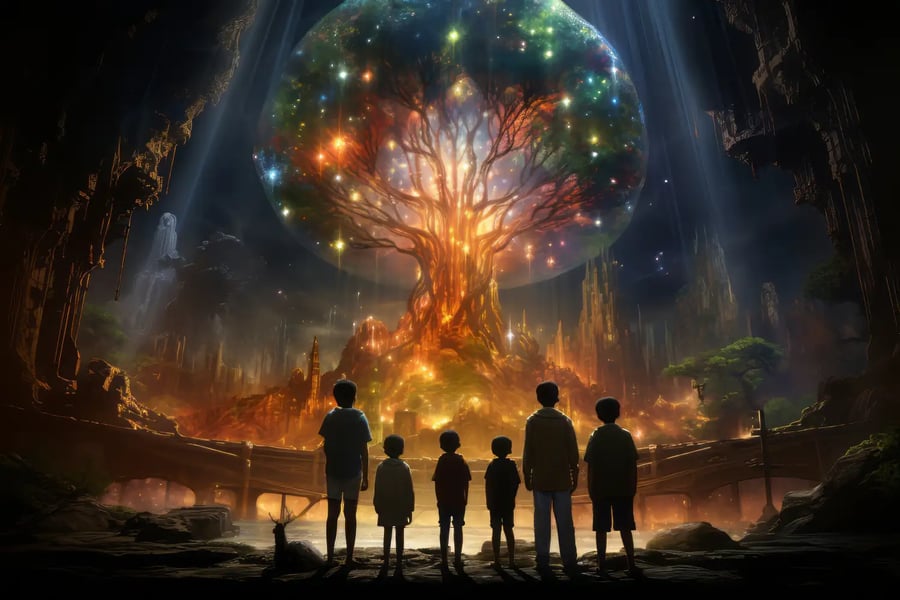
Humanity stands at a critical crossroads between extinction and unprecedented transformation. Are science and technology leading us to ruin, or to an ultimate summit?
Today’s scientific weapons of mass destruction have grown frighteningly more destructive. A pair of atomic weapons destroyed two Japanese cities to end World War II. Today's fusion bombs are 100 times more powerful.
These are the kinds of dangerous activities that could lead humankind to an early self-extinction. To avoid self-extinction, we must first identify what I term our great progression's summit, and then take charge of our progression.
My main message is for business leaders, policy makers, and elected public officials to challenge their basic assumptions about science and technology. While I realize this statement is controversial, it could be a matter of life and death for the human race.
For most humans, it’s difficult today to accept limits on the growth of science and technology because this expanding knowledge keeps providing us with so many surprising new abilities. Accepting limits also seems difficult because an advance in one area can often produce unexpected advances in very different areas.
Who, for example, would suspect that the arcane technology of shaping bits of hot glass would turn out to reveal, in the form of microscopes and telescopes, not only the existence of invisibly tiny forms of life on Earth, but also new planets and moons in the solar system and, of course, trillions of galaxies?
Finally, scientists and others tend to strongly agree with Vannevar Bush, the leader of America’s Second World War scientific work, such as the atomic bomb. who declared science to be “an endless frontier.”
In my book, Thinking Bigger, I introduce a concept called "Calousia"—humanity's theoretical greatest-future summit—achievable by maximizing crucial knowledge.
Since the chief progressive factor in our human progress is science and technology growth, whether mankind’s great progression has a summit or not depends upon whether there are limits to the benefits of science and technology growth or not.
Then, where will science and technology take us? Do we face an infinite progression, or does our great progression have a natural endpoint, a summit?
Here is the crucial point. Even if science and technology can grow forever, this does not mean that this growth can keep enlarging a particular ability forever. For example, we can imagine that future advances in science and technology will keep reducing travel time between San Francisco and Paris, but it seems unreasonable to expect this trend to continue forever. Limits like this one, which prevent ever-growing science and technology from ever-increasing specific abilities such as travel speed, are the key to the existence of our progression’s summit and so also to our discovering it.
Therefore, if we look not at all possible science and technology growth, but instead focus on particular benefits of science and technology growth that are important to us humans—like those that significantly expand our abilities, such as increasing travel speed—then a particular greatest future begins to emerge.
This occurs when the growth of science and technology in certain important abilities eventually reaches a level as great as universal conditions allow. Once an ability growth reaches this condition, it becomes maximized; its growth thereafter, of course, becomes impossible. For example, once you can truly maximize travel speed from San Francisco to Paris, you can never go faster, no matter how much SciTech grows or how much intelligence may increase.
Therefore, to find whether our abilities-expanding progression can have a summit, a greatest future, we must focus not just on science and technology growth itself, but also on the science and technology growth most important to our human species fulfilling its extraordinary potential by maximizing us humans.
To find out whether or not our species’ long great progression has a brilliant summit, we must be clear about what kind of progression, or evolution, we chiefly participate in. Is it our great abilities-expanding progression or is it still our biological evolution? To find out, let’s see how these two evolutions differ.
Please note that there are two views of the relationship between biological evolution and our species’ great abilities-expanding progression.
One view is that our species’ great abilities-expanding progression, with its changes in how we live, is just our species’ way of adapting to the biological evolution that governs all of Earth’s other living species. We humans are biological beings, after all.
The other view is that our species’ great progression is its own distinctively separate process in the progressing universe.
Why do we need to choose one of these viewpoints? It’s because we are trying to understand where our primary progressive activity, our growing abilities, our progressing human evolution, so to speak, should take our species.
Humankind's advance can't succeed the way we're going.
It's too slow and erratic. Our great progression strongly tends to accelerate and grow more complex, so it becomes ever more difficult to manage.
There is a natural summit to humankind's great progression.
Therefore, we are no longer lost. We know the summit conditions are vastly greater than those we experience today. And this knowledge gives our species, for the first time, a new primary purpose: it's to strive for this summit.
This decision, in turn, means that we will reach this summit far sooner and more certainly.
Warren Musser is the author of the book, Thinking Bigger: The Essential Guide to Humanity’s Greatest Future. A former veteran of the U.S. Army, Musser graduated from Yale University with a bachelor's degree in literature, history, and psychology. He also studied musical composition for three years at The Juilliard School.
Copyright © 2025 California Business Journal. All Rights Reserved.
For California Business Journal Disclaimers, go to /terms-conditions/.


