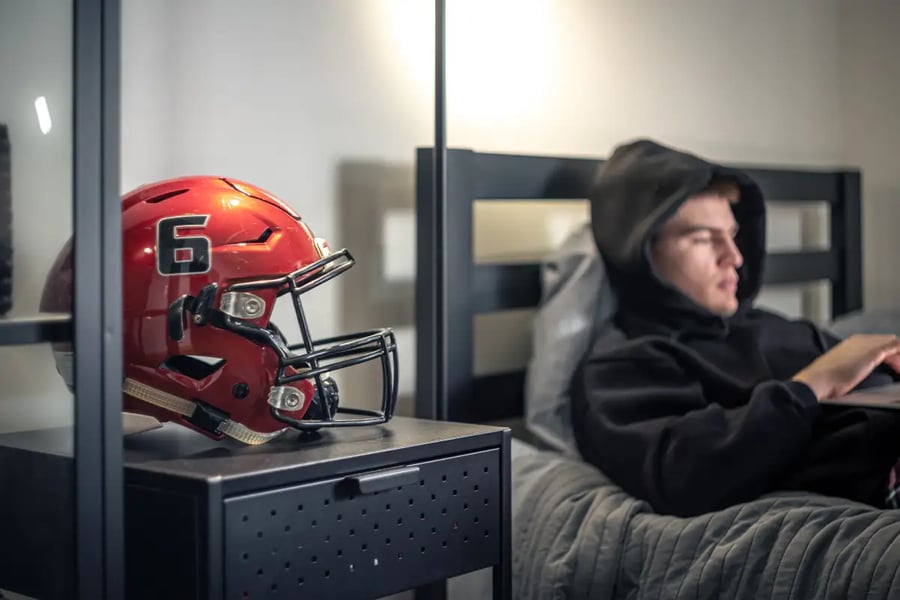
The New York Post recently reported on the death of a former NFL player and noted he suffered from CTE. Whatever the exact details of any one case, the larger point is hard to ignore: repeated head impacts can echo long after the stadium lights go off-showing up as problems with mood, impulse control, sleep, relationships, and the ability to stay stable day-to-day.
Hall of Fame linebacker Harry Carson knows this firsthand. In a FRONTLINE interview, he described the lingering effects: "Headaches. Memory. Blurred vision occasionally, processing information. A little forgetful sometimes... there are times when I feel I should be emotional about certain things... There are times when I don't feel anything. And when I feel that lack of emotion sometimes, I think there's something wrong here that I don't grieve the way that most people would grieve."
Carson added, "Knowing what I know now? You only get one brain. Once that brain gets injured, you never know how you're going to be from that point on."
This isn't about blaming football. It's about refusing to accept preventable brain trauma as "the price of admission."
The uncomfortable truth: brain injury attacks the very skills you need to get help
One reason concussion/TBI outcomes can spiral is brutally simple: after injury, you may struggle to regulate emotions, plan your days, and make decisions-all while the world expects you to do more of those exact things (schedule appointments, advocate for yourself, follow complex instructions, stay calm, "push through").
Former NFL running back Larry Johnson captured this internal fracture when describing his own symptoms: "One is telling you to do it; one is telling you don't. One is telling you it'd be fun." He's had to create video archives of his own life just to remember who he was: "If I can't remember who I was, I've got YouTube; I've got music videos that I'm making for myself, so when I watch these things I can remember."
The Model Systems Knowledge Translation Center confirms what players like Johnson and Carson experience: "People with mild to severe traumatic brain injury may experience changes in mood and emotion management, including irritability, anxiety, depression, and emotional outbursts. Some may also have difficulties in controlling impulses or mood swings, and problems with sleep and fatigue."
And it's not just acute symptoms. Research tracking athletes seven years post-concussion found "chronically impaired attention, working memory, inhibition, and interference control"-exactly the executive functions you need to navigate recovery.
That's why "rest and wait" has failed so many people for so long. The system was built for short-term, uncomplicated concussions in healthy athletes-not for repeated hits, persistent symptoms, or the long tail of brain injury.
Dr. John J. Leddy at the University of Buffalo put it plainly: "Our work has taken an exercise physiological approach to a neurological injury that has changed clinical treatment from a passive, strict rest approach to a prescribed active rehabilitation approach."
Survivors deserve answers, not dismissal-and they deserve a roadmap, not random advice.
Better helmets aren't a cure-but they're a real, immediate lever
No helmet can fully prevent concussion (especially rotational forces). But better protective headgear can reduce impact forces and lower risk. And in a sport defined by collisions, reducing even a fraction of cumulative force matters.
Recent research on helmet technology backs this up: "Both rotational technologies resulted in lower peak rotational acceleration and brain strain... these results support the notion that a specific technology may be more effective in managing rotational acceleration under specific impact conditions. The improved protection provided supports the importance of including rotational test protocols in helmet certification standards."
The NFL and NFLPA have started to move. For the 2025 season, seven new helmet models were released-all ranking in the "Top-Performing" category under new lab testing that measures both linear and rotational forces. Players wearing top-rated helmets had significantly lower concussion rates than those in "Lesser" helmets. Several older "Not Recommended" models were prohibited entirely.
There's also been a shift toward position-specific helmet designs-quarterback helmets engineered differently than linemen helmets-because impact forces and types differ by role. Models like Riddell's SpeedFlex Precision QB and the Axiom 3D QB performed best in recent testing.
Some of the newest technology includes liquid crystal elastomers-rubbery materials inside helmets that absorb and dissipate energy more effectively. And the Guardian Cap, an extra-padded cover once limited to practice, became optionally allowed in live NFL games in 2024. League data suggests it can reduce impact forces by 11-12% in helmet-to-helmet hits.
"Better" should mean:
- Independent testing (not marketing)
- Testing that includes rotational acceleration, not just linear hits
- Transparent, public rankings (so fans/players/teams can compare)
- Proper fit + replacement schedules (old, ill-fitting helmets are a safety issue)
If the league can measure everything from next-gen stats to toe-tap angles, it can demand higher helmet standards with real transparency.
The part fans can change: culture and accountability
NFL culture still rewards denial:
"He got his bell rung."
"He's fine."
"Warrior."
But the brain doesn't care about toughness. And the people who pay later are often the ones least equipped to fight for themselves when symptoms linger.
So here's a fan-friendly way to reframe it: You can still celebrate big hits and demand a game that doesn't chew through human brains to entertain us.
A practical tool fans can share: the "clear communication" framework
A huge gap in brain injury recovery is communication-especially when someone is foggy, overwhelmed, or intimidated in medical settings. The best survivor-centered resources now emphasize structure: symptom logs, pacing trackers, and scripts that keep appointments focused.
If you know a current or former player (or any athlete) dealing with lingering symptoms, share this simple approach for medical visits:
The 60-second opening script
"Before we begin, I'd like to share a one-minute summary of my main symptoms and goals so we can stay focused."
Key sentences that help when you're overwhelmed
- "Can you explain this in plain language?"
- "I'm having trouble following-can you repeat that slowly?"
- "Can we focus on one issue at a time?"
- "What are my top priorities right now?"
- "What should I NOT be doing?"
- "Can I have written instructions?"
Close the appointment with clarity
- "What are my next 1–2 steps?"
- "When should I follow up?"
- "What symptoms should I watch for?"
This matters because when your brain is struggling, clarity and sequencing aren't "nice"-they're treatment.
The Four-Pillar self-check (simple, actionable)
One of the most helpful ideas in modern TBI recovery resources is a short weekly reset-questions that reduce overwhelm and restore control:
- What one action can I take this week to support recovery?
- What is NOT needed right now? (cut noise, reduce crashes)
- Who can help me stay on track? (advocate, friend, caregiver)
- What's my plan to communicate clearly at appointments? (notes, written instructions, symptom log)
That's not "soft." That's how you keep someone from getting lost in the cracks.
What's working now: the recovery revolution
While helmet technology and cultural shifts matter, some of the most exciting developments are happening in how we assess and treat brain injuries after they occur.
Virtual reality is changing assessment and rehabilitation
Johns Hopkins researchers developed a VR game that transforms routine clinical tests-memory, reaction time, attention-into engaging tasks that give clinicians objective data for return-to-play decisions, moving beyond athletes' self-reports.
Penn State is using a fully immersive VR environment with 12×10 foot screens, balance platforms, and EEG to establish baseline metrics in athletes and track how they change after injury. This catches cognitive changes invisible on standard tests.
In 2025, a Division I football player with multiple concussions completed a 10-week VR balance training program. Not only did his balance and dizziness improve-so did his mood and cognition. Reviews from 2023-2024 show that VR interventions for vestibular dysfunction, balance, and gait tend to perform at least as well as traditional therapy, and often better at keeping people engaged and achieving steady gains.
Precision measurement is getting personal
A 2025 study introduced instrumented headbands using multiple sensors and advanced signal processing to track rotational acceleration and velocity during impacts. While still being refined for off-axis hits, the technology shows promise for tracking cumulative head load outside formal game or lab settings-giving athletes and teams real-time data on brain stress.
Alternative approaches are emerging (with caution)
There's growing interest among current and former NFL players in psychedelics like ayahuasca and psilocybin. Some report improvements in mood, identity, and emotional regulation. Researchers are exploring whether these substances can reduce brain inflammation or promote neuroplasticity-helping the brain rewire itself. But as of now, evidence is mostly anecdotal or preliminary. It's not standardized or approved for clinical use.
What's still missing
Long-term outcome studies for newer treatments remain scarce. We don't yet have standardized protocols for VR rehab-how much, how often, what intensity. And many recovery programs still focus on acute symptom relief rather than comprehensive support for planning, day-to-day management, and long-term cognitive and emotional health.
But the direction is clear: from passive rest to active rehabilitation, from self-reporting to objective measurement, from one-size-fits-all to personalized, position-specific, technology-enhanced care.
What NFL fans can do this week (one concrete action)
Pick one:
- Ask your team/beat reporters to cover helmet testing standards the way they cover combine metrics. Demand transparency: Which helmets perform best for rotational forces? What's the replacement schedule?
- Support organizations and reporting that push independent concussion research and player aftercare (not PR).
- Stop glorifying obvious head trauma on replay. It sounds small, but culture changes faster than policy-and the league follows culture.
If we're going to call football "family," then we have to act like it: protect the people who make the sport possible, before and after Sundays.
Copyright © 2026 California Business Journal. All Rights Reserved.
For California Business Journal Disclaimers, go to /terms-conditions/.


