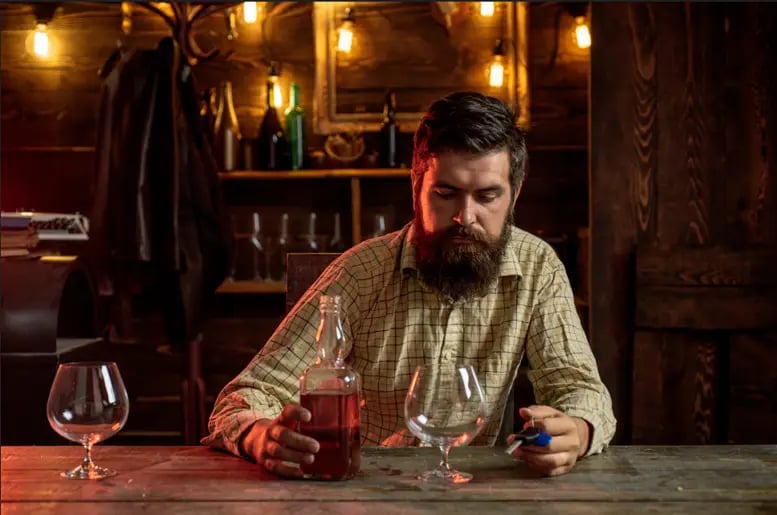
A bartender does inventory shots at 2am, telling himself it's quality control. A server joins the kitchen staff in drinking a round after a busy night to feel like she belongs.
In nearly 40 years of working with people in recovery, I've watched the hospitality industry produce some of the most talented, hardworking people I know, and lose some of them to the very product that keeps the lights on.
The Numbers We Don't Talk About
Restaurants, bars, and hotels don't run on food and rooms alone. They run on liquor margins, and that fact shapes the culture in ways the industry rarely says out loud.
Workers in the accommodations and food services industry have the highest rate of past-month illicit drug use of any industry in the country, at 19.1%, and the highest rate of past-year substance use disorder, at 16.9%, according to a national survey from the Substance Abuse and Mental Health Services Administration (SAMHSA). A more recent study focused specifically on bartenders and servers found that 44% showed moderate to high alcohol problem severity, and notably, despite being a clearly at-risk population, only a small fraction had ever been diagnosed with or treated for a substance use disorder.
That last part is the real story. It's not that hospitality workers don't have a problem. It's that almost nobody around them is positioned to notice, because everybody around them is part of the same culture.
Why the Silence Here Is Different
When I talk to people in other high-stress professions about why they don't seek help, the fear is usually about a license, a credential, a board somewhere that could end a career on paper. Hospitality workers carry a different kind of fear, one that's arguably more immediate: if you're not on the floor, you're not making money.
When you’re a server or a bartender, there's often no PTO. No salary to fall back on. Tips dry up the moment a shift is missed, and many workers are one or two missed shifts away from not making rent. Walking into a four-week residential treatment commitment doesn’t just feel risky to a hospitality worker; it feels financially impossible, even when the underlying problem is getting worse by the week.
Add to that a workplace where the product is the substance. Liquor is the highest-margin item on most menus. Shift drinks, walk-out cocktails, and a comped round after close aren't bugs in the system, they're baked into how the business runs and how the staff bonds. Asking someone to step back from that isn't just asking them to change a habit. It's asking them to step outside the culture that makes the job feel like a community in the first place.
A Model Already Emerging From Inside the Industry
The good news is that hospitality people have started building their own answer to this, and it didn't come from outside the industry telling them what to do.
In 2016, two longtime restaurant veterans, Mickey Bakst and Steve Palmer, started a small Sunday meeting in Charleston after losing their friend and colleague, a young chef named Ben Murray, to addiction. They called it Ben's Friends. It wasn't built around shame or discipline. It was built around the idea that people who'd worked the same late nights, carried the same trays, and felt the same adrenaline could help each other stay sober in an industry that everyone assumed made sobriety impossible.
Ben's Friends has since grown into a national network with meetings in dozens of cities and dozens more virtual sessions each week, and it's been joined by a broader cultural shift: a growing number of sober bartender communities, the rise of zero-proof cocktail programs, and more restaurant groups quietly phasing out the tradition of the after-shift drink. None of this erases the underlying numbers. But it tells you something important: hospitality workers don't need to be convinced that this is a real problem. They've already started organizing around it themselves. What's missing is treatment built to fit their lifestyle.
The Infrastructure Gap
Here's what these types of workers really need. Treatment meetings that accommodate a hospitality schedule, which often means late nights, early mornings, or whatever window exists between the lunch and dinner rush, not a 9-to-5 framework built for office workers. Real discretion, in an industry where everyone in a local restaurant scene tends to know everyone else, and word travels between kitchens and bars faster than most people realize. And a program that doesn't assume someone can disappear for 30 to 90 days, because very few hospitality jobs allow for that as a realistic option.
Outpatient treatment, done right, can work around a working schedule instead of requiring someone to choose between treatment and their paycheck. That distinction matters enormously for a workforce that is, by the nature of the job, paid by the shift and not the month.
Treatment Isn't Failure. It's Risk Management.
Nobody chooses this industry because they want to struggle in silence. Most people in hospitality love the pace, the camaraderie, and the satisfaction of taking care of people well. The goal isn't to ask anyone to leave that behind. It's to build a path back to health that respects the realities of the job instead of ignoring them.
At Confidential Recovery, we work with hospitality professionals who need flexible scheduling, including evening and weekend sessions, and treatment delivered in a private, judgment-free setting. We understand that for someone in this industry, asking for help can feel like it threatens the only income they have. Our approach is built around removing that barrier, not adding to it.
If you're a server, bartender, or hotel worker who's been quietly worried about your relationship with alcohol or another substance, you're not alone, and you don't have to figure this out by yourself. Reach out to Confidential Recovery to talk privately about what treatment that actually fits your life could look like.
About the Author
 Scott H. Silverman is a best-selling author, and his new book, ‘You're Not God, That Job is Taken’ can be purchased here: https://a.co/d/57SuidG.
Scott is also a family crisis coach, an interventionist, and speaks frequently about addiction and recovery on television and at public appearances. Scott empowers individuals and families to move forward past the crisis and onto the road of recovery. Confidential Recovery, the San Diego outpatient drug rehab program for professionals that Scott founded in 2014 provides drug and alcohol treatment for restaurant workers.
Copyright © 2026 California Business Journal. All Rights Reserved.
For California Business Journal Disclaimers, go to /terms-conditions/.


