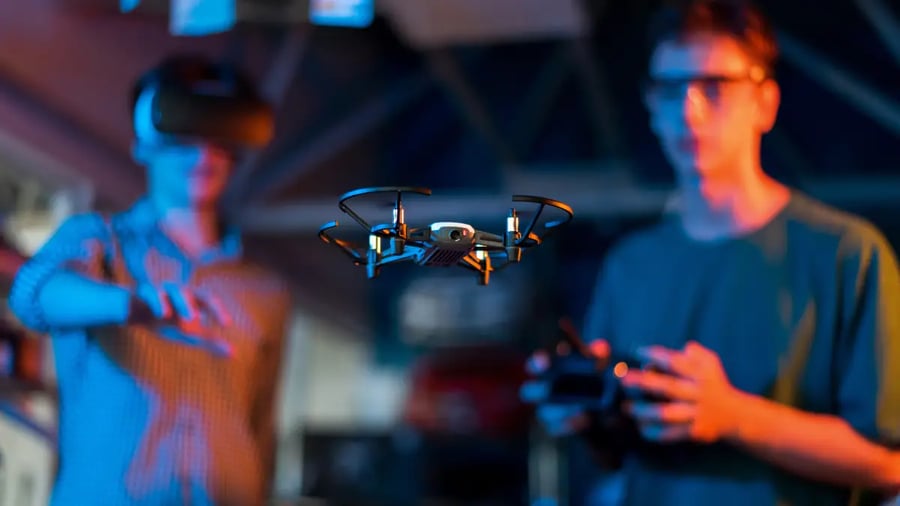
Drones have quietly become a normal business tool across California. Vineyards use them to scout stressed vines, utilities send them along power lines to spot wildfire risk, and real estate agents fly them over listings. Somewhere along the way, the drone stopped being a gadget and became a line on the budget. For a growing number of companies, the question is no longer whether to use drones, but who should fly them.
That usually comes down to a familiar business decision: build or buy. A company can hire an outside vendor to handle its drone work project by project, or stand up its own program with in-house pilots and aircraft. Both are legitimate, and the right choice depends on how often the company flies, how much control it wants, and how sensitive the work is.
Running a program in-house is a real operational function, not a hobby with a company logo on it. It means certified pilots, registered aircraft, insurance, and records you can produce when a client or a regulator asks. That's part of why in-house teams tend to lean on a dedicated operations platform like FlybyOps to keep pilots, equipment, and paperwork in one place, while companies that outsource hand most of that overhead to their vendor.
The case for hiring it out
For a company that needs drone work only occasionally, outsourcing is hard to beat. A licensed vendor carries the certification, the insurance, the equipment, and the recordkeeping. You pay for a defined piece of work, a roof inspection or a set of listing photos, and you're done. There's no aircraft depreciating between jobs and no compliance paperwork landing on someone's desk.
The math shifts as flying becomes routine. Per-project pricing that looks fine for four flights a year gets expensive at four flights a week. Control is the other issue: you're on the vendor's schedule, so a job the morning after a storm may wait for an opening. And the flight records, imagery, and site access all sit with a third party, which can be a real concern on confidential work.
The case for bringing it in-house
Owning the program flips those trade-offs. An in-house team flies on the company's schedule, responds quickly when something urgent comes up, and keeps every record and image inside the organization. At volume, the cost per flight drops well below what a vendor charges. For firms that fly often, that control is usually the whole argument.
The catch is that everything the vendor handled becomes your responsibility. Flying commercially in the US means operating under the FAA's Part 107 rules, and a business starting its own program has to set up a Part 107 account, register its aircraft, and get its pilots certified before anyone lifts off. From there it's ongoing: keeping certifications current, renewing registrations, carrying insurance, maintaining the aircraft, and holding on to the records that prove it.
What running a program in-house involves
It helps to be honest about the moving parts. Each pilot needs a Remote Pilot Certificate, kept current with recurrent training, and every drone has to be registered, marked, and (since 2023) broadcasting Remote ID in flight. Jobs in controlled airspace need authorization, and unusual work like night or beyond-line-of-sight flying needs extra approval. Alongside the flying sit the business records: insurance certificates, a risk assessment per job, maintenance logs tied to specific aircraft, and the occasional incident report.
The load grows with the team. One pilot can keep it all in a folder. Add several pilots and clients, and someone has to track who flew what, whose certification is lapsing, and which client's data each pilot should see. Competing clients often require that one client's work stay walled off from another's, which a shared drive can't enforce. That's where scattered spreadsheets stop being enough.
Where the line usually falls
The biggest factor is frequency. A company that needs a handful of flights a year almost always comes out ahead outsourcing, while one flying regularly, weekly inspections or ongoing site mapping, usually reaches a point where owning the program is cheaper and more responsive. In the middle, the decision turns on softer factors: how much scheduling control the work demands, and how sensitive the data is.
Plenty of companies land on a blend: routine, high-frequency work in-house, and specialists hired for the occasional job that needs equipment or approvals they don't have. The point is to match the model to the work, not treat it as all or nothing.
FAQ
Is it cheaper to hire a drone company or run drones in-house?
It depends almost entirely on how often you fly. For occasional jobs, a vendor is usually cheaper, since you skip the equipment, certification, and insurance costs. For regular work, an in-house program tends to cost less per flight once fixed costs spread across enough missions.
What does a business legally need to fly drones commercially?
In the US, commercial flights fall under FAA Part 107: at least one certified remote pilot, each aircraft registered and marked, Remote ID broadcast in flight, and airspace authorization where required. Businesses running a program also set up a Part 107 account with the FAA.
How long does it take to get a pilot certified?
Most people can prepare for the FAA knowledge test in a few weeks. After passing, the certificate goes through a background check before issue, adding a few more weeks. A month or two from decision to first legal flight is realistic.
Do we still need software with only one or two pilots?
A very small program can run on spreadsheets for a while. The usual trigger for something more structured is a second or third pilot, multiple clients whose data has to stay separate, or the first time an old record proves hard to find.
Copyright © 2026 California Business Journal. All Rights Reserved.
For California Business Journal Disclaimers, go to /terms-conditions/.


