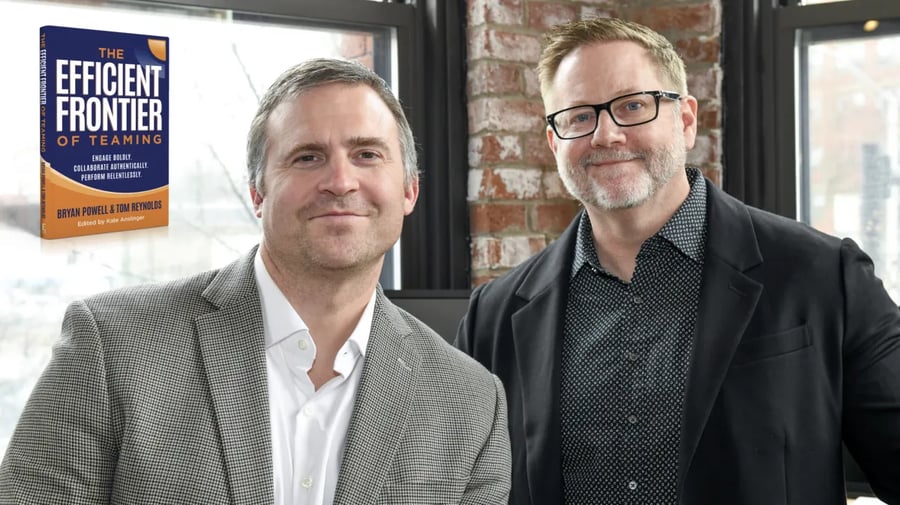
There’s a particular kind of silence that forms when teams hesitate to speak freely. It settles in quickly, changes the room's tone, and reveals where trust is frayed. Team and leadership coaches Bryan Powell (MS, PCC, and CPBA) and Thomas Reynolds focus on understanding how that silence takes shape.
Their work sits at the intersection of hesitation, pressure, and group habits. They study how teams behave when the façade of harmony starts to crumble, and the real operating system emerges. They have found that engagement and authenticity drive trust, accountability, and psychological safety among teams, resulting in increased success. This concept shaped the contents of their book, The Efficient Frontier of Teaming.
When Talent Alone Stops Working
A strong résumé can give everyone confidence on day one, but Powell and Reynolds have watched well-staffed groups lose momentum because the basics don’t hold. A comment may go unnoticed, or a decision may float because no one claims ownership. Then, people start guessing instead of checking.
Once these small slips pile up, the team moves more slowly, even though no one can point to a single breaking point. Powell and Reynolds examine the early warning signs because those tiny stalls often reveal how the group behaves under pressure.
When Leadership Design Starts Shaping Behavior
Powell and Reynolds approach leadership coaching like they’re helping teams build a working rhythm rather than a lofty vision. They focus on structures people can rely on, especially during busy cycles. Decision rights give teams a way to track who drives what.
Communication habits steady the pace so conversations don’t drift or disappear. Leaders influence this pattern by showing steadiness and consistency. When they do, accountability feels like a part of everyday movement.
Why Performance and Psychology Can’t be Separated
In their book The Efficient Frontier of Teaming, Powell and Reynolds argue that results stem from how people show up for one another. Reynolds’ background in psychology helps him see the invisible rules shaping a group’s behavior.
Powell’s experience with leadership, psychology, and real-world execution in high-pressure environments shows how those rules affect execution as deadlines mount. The Forbes Coaches Council contributor has a background in coaching senior leaders, with 4,000 coaching hours and graduate-level training. He was also featured on the April 2025 cover of The Journal of Financial Planning.
Meanwhile, Reynolds’ complementary background is rooted in psychology, assessment, and long-term organizational design. Together, they discovered that teams that build clarity, shared norms, and predictable communication tend to outlast those that rely solely on talent. That’s the backbone of high-performing teams. They run on a mix of emotional steadiness and operational consistency.
Lessons Forged Under Pressure
Powell and Reynolds have spent years inside systems where mistakes surface quickly and can’t be glossed over. Those settings reveal what is or isn’t working. Powell recalls moments where a team believed everyone agreed until a single question pulled the thread.
Reynolds has watched groups shift their behavior after realizing how much their output relied on people feeling able to contribute fully. These experiences shaped their view of executive leadership as a blend of emotional presence and disciplined follow-through.
A Movement Built on Authenticity and Intention
Powell and Reynolds see their work growing far beyond coaching sessions. Powell talks about helping people show up as themselves without shrinking to fit a style that never belonged to them. Reynolds brings a slower, steadier perspective focused on habits that last.
Together, they encourage leaders to look closely at how their teams communicate, make decisions, and share responsibility. When organizations do that work, patterns shift. Then, people contribute more freely. Leaders stop managing for appearance and start focusing on alignment. It’s a grounded path toward cultures where participation feels real.
What remains steady in their philosophy is simple. Teams move better when people understand each other, share responsibility, and feel free to speak without calculating the cost. Powell and Reynolds have built their careers around helping leaders create that kind of environment.
Copyright © 2026 California Business Journal. All Rights Reserved.
For California Business Journal Disclaimers, go to /terms-conditions/.


