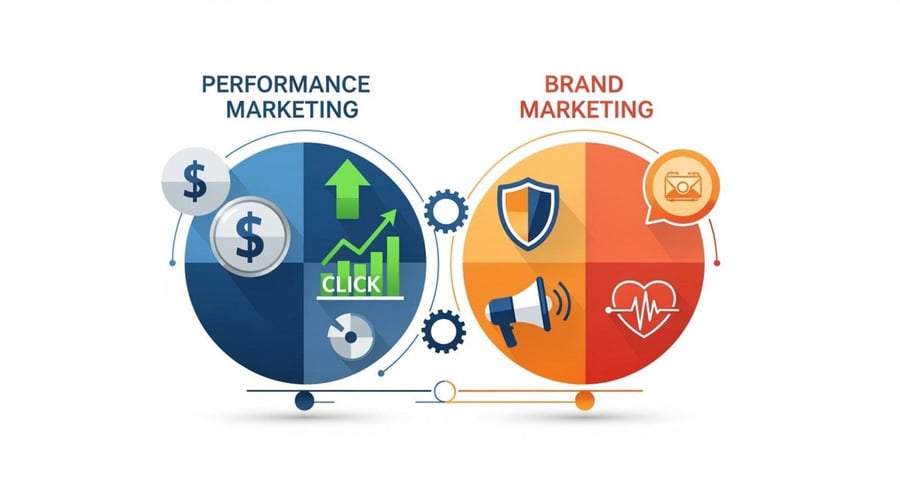
Today's digital marketing landscape is rapidly evolving, and companies are constantly trying to capture customer attention. A common question arises: should we focus on quick, easily measurable results, or rather on building a lasting image and trust?
The answer isn't straightforward. Success lies in understanding how performance marketing differs from brand marketing and skillfully combining them in one strategy.
It's worth remembering that even in areas such as employer branding agency services, where a company's image as an employer is crucial, performance-oriented activities can significantly help achieve future goals.
Currently, many marketing directors emphasize result-oriented activities, sometimes abandoning brand building altogether. The Gartner CMO Spend Survey 2025 shows that for 54% of CMOs, quick conversions and return on investment (ROI) are most important. They’re tempted by quick data and clear results, brought forth by marketing initiatives, such as strategic mobile tour activations.
However, research proves that investing in brand awareness is still important if we want the company to develop long-term. Companies that consistently build their brand achieve good results - they understand that brand awareness also helps achieve better performance marketing results.
Brand building and performance marketing don't compete with each other - it works the opposite way: a good brand strengthens campaigns focused on quick results.
Performance Marketing vs Brand Marketing - How Do They Differ?
At first glance, these two approaches look like opposites, but the main differences concern goals, methods, and expected timeframes for results.
Understanding these differences makes planning marketing activities easier.
|
Performance Marketing |
Brand Marketing |
|
|
Main Goal |
Quick, measurable effects |
Recognition and trust |
|
Timeline |
Short-term |
Long-term |
|
Success Measure |
Results, numbers (clicks, sales) |
Changes in brand perception |
|
Tools |
Google Ads, Facebook Ads, email, affiliates |
Image campaigns, PR, social media, influencers |
What Is Performance Marketing?
Performance marketing is based on precise data and quick results. Advertisers pay only when customers take specific actions (e.g., click an ad, make a purchase, download an app). Precision and continuous monitoring of what works best are key here.
- Very easy to measure results (every click, sale, or signup is monitored)
- Money is spent only on actual results
- Most commonly used channels: Google Ads, Meta Ads, email marketing, and affiliate marketing
- Popular metrics: CTR, conversion, CPA, ROAS
What Is Brand Marketing?
Brand marketing (branding) works differently. It doesn't focus on quick sales, but on building trust, recognition, and positive associations with the brand. The goal is for people to recognize and like the company.
- Effects aren't immediately visible and are hard to quickly measure with numbers
- Long-term activities are most important - storytelling, showing company values, strengthening visual identity
- Common tools: reach campaigns (e.g., videos, billboards), influencers, PR, social media, sponsorship
- Long-term effects: greater customer loyalty, easier employee recruitment, lower cost of acquiring new customers
Basic Goals of Both Approaches
Performance Marketing - focus on here and now, generate quick and measurable actions (sales, leads).
Brand Marketing - invest in the company's future. Build a brand that will attract and retain customers, help stand out from competition, and reduce future costs.
Advantages and Disadvantages of Both Approaches
Advantages of Performance Marketing
- Precise result measurement - you know what you're paying for
- Money is spent only on effective activities
- Quick improvement and campaign changes if something doesn't work
- Ideal for companies with modest budgets wanting quick sales
Disadvantages of Performance Marketing
- Works short-term - quick effect, but doesn't build lasting advantage
- Company may become dependent on constantly paid campaigns
- Without a strong brand, customer acquisition costs may grow over time
- Lack of image investment leads to decreasing effectiveness indicators
Advantages of Brand Investment
- Customer trust - they buy more willingly, even if prices are higher than competitors
- Better loyalty and repeat purchases
- Easier process of acquiring employees and business partners (employer branding)
- Performance campaigns are cheaper and more effective when the brand is recognizable
Google and Ipsos data show that combining both approaches can increase brand recall by 28% and improve conversion by up to 15%!
Disadvantages of Brand Marketing
- Takes a lot of time before you see effects
- Harder to precisely calculate how invested money translated to sales growth
- Requires larger initial budget
- Brand building alone without performance won't ensure sales
When to Focus on Performance vs Branding?
Industry, Company Phase, and Goals
Choosing strategy depends on factors like:
- Company development stage (start-up or established market player?)
- Main goals - quick sales or long-term market position?
- Advertising budget - can we invest in long-term activities or is quick sales most important?
- Industry specifics - in some sectors (e.g., medicine, finance) trust and reputation are crucial
For new companies and e-commerce, performance marketing helps enter the market and quickly acquire customers. Mature brands wanting to stand out and build loyalty invest more in branding.
Does Performance Marketing Work Only in E-commerce?
Not at all! Performance marketing also works in B2B services, education, tourism, medicine, or real estate - you just need to properly define what conversion means in a given business (e.g., form completion or webinar registration).
Mistakes When Choosing Only One Path
Focus only on performance: Quick growth, but no solid foundation. Customer acquisition costs will rise, customers will be less loyal, and the company will depend on paid ads.
Focus only on branding: Recognition will grow, but it won't show in sales. The company may lose money without seeing effects in real numbers.
Better Performance, Branding, or Both Together?
Only combining both tools gives full power. Instead of asking "either-or," it's worth considering how to combine activities so they mutually strengthen each other.
Questions to Help Make Decisions:
- What are our current goals?
- What stage is the company at (new to market or already known)?
- How big is our marketing budget?
- What does the competition look like?
- How long can we wait for results?
Pitfalls of Thinking Only Short-term
Focusing only on quick results leads to dependence on paid campaigns and lack of loyalty. Fixation only on brand - recognition grows, but sales aren't visible. The best strategies balance both aspects: performance brings quick effects, and branding builds stable future.
When to Invest More in Branding?
- When the company wants to be a market leader and stand out from competition
- When the market is already heavily saturated with ads
- For companies planning long-term development and entering new markets
- In industries where customer decisions take long (e.g., services, luxury products)
- When building community and loyalty is important
When to Focus on Performance?
- Start-ups that must quickly achieve sales to survive
- Companies with limited marketing budgets
- During short-term promotions and limited offers
- When testing new products or entering new markets
Synergy - How Combined Activities Bring Long-lasting Effects?
Examples of Effective Combinations
Many companies first build awareness through video campaigns or billboards (branding), then use remarketing to acquire customers (performance). Tech companies often use current topics (e.g., AI, ESG) to strengthen the brand and then promote specific products with performance ads.
It's important that messages are consistent - the same slogans appear in ads, social media, and Google campaigns. This makes customers recognize the company faster and buy more willingly.
Impact of Strong Brand on Performance Campaign Results
- Increases ad clicks (CTR)
- Lowers customer acquisition cost (CPA)
- Raises conversion rate
- Increases loyalty and makes customers return for products
Trends: Growing Role of Integration
Although most marketing budgets are allocated to quick effects, more companies are noticing how important it is to return to balance between performance and branding. Marketing leaders are starting to talk about brand effectiveness and "performance branding" - meaning that short-term activity effects also depend on brand strength, and sales-activating activities simultaneously strengthen the brand.
How to Effectively Combine Performance and Branding Activities?
Recommendations for Companies
- Don't separate teams responsible for sales and image - plan together, share data, and jointly measure effects
- Ensure consistent messaging - how the brand presents itself in image campaigns should be visible in sales campaigns too
- Create valuable content (blog, video, guides) that builds image but contains clear calls-to-action (CTA) leading to purchase
- Use remarketing for people who learned about the brand but haven't decided to buy yet
Budget Division and Control
|
Company Type |
Suggested Budget Split |
|
Start-up |
Mainly performance (e.g., 70% performance / 30% branding), then gradually increase branding share |
|
Mature brand |
More balanced (even 50/50 or more on branding if goal is position strengthening) |
How to Check if Everything Works?
For performance marketing: conversion numbers, customer acquisition cost, return on ad spend (ROAS), click-through rate (CTR)
For branding: brand awareness studies, campaign reach, social media reactions and engagement, brand queries, returning customer numbers
"Combined" metrics: brand awareness impact on ad effectiveness, organic traffic growth, more brand queries in Google.
Copyright © 2025 California Business Journal. All Rights Reserved.
For California Business Journal Disclaimers, go to /terms-conditions/.


