
Complex mechanical components rarely challenge manufacturers because of their geometry alone. Problems usually emerge when machining realities are overlooked during design. Deep cavities, intersecting bores, thin-walled housings, and multi-plane features all influence tool access, workholding, cutting forces, and inspection.
Even the most detailed CAD model cannot account for every manufacturing variable, making custom CNC machining services essential for turning engineering intent into repeatable production.
Where Complex Geometry Becomes a Manufacturing Problem
Complexity rarely lies in the number of features drawn on a drawing. Instead, it comes from how those features behave during machining. A deep cavity might need a long cutting tool but adding thin surrounding walls introduces vibrations that affect surface quality and dimensional accuracy. Intersecting bores that look simple in CAD can leave burrs that are hard to remove without also damaging adjacent surfaces.
Datum selection is another frequent challenge too. Logical datum schemes for design often require multiple setups on the machine and this increases risk of cumulative positioning errors..
Behavior of the material also complicates production. Poor support for thin sections can cause aluminum to deform during CNC machining aluminum parts and harder alloys generate higher cutting forces and accelerate tool wear. These interactions result in parts that meet individual dimensional specifications but fail to achieve overall accuracy.
CNC Machining Strategies That Actually Work for Complex Mechanical Parts
Controlling variability as early as possible provides significant advantages. 5-Axis machining can effectively machine all faces of a part in one setup. The need for re-fixturing of the workpiece is eliminated and therefore relationships between critical features are preserved and tolerance accumulation reduced throughout the entire part.
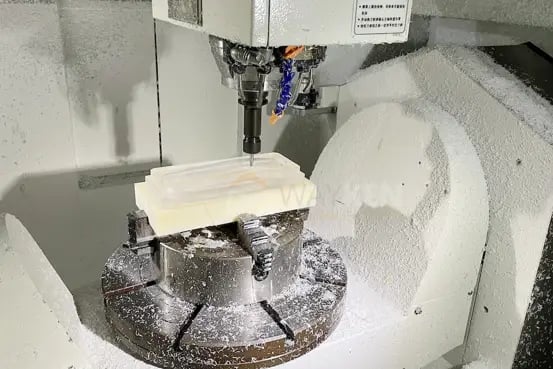
Just like machining strategy, Workholding has also been shown to significantly impact the quality of manufactured parts. Parts made from thin wall materials are often rejected due to lack of proper support. Either the part moves during the machining process or relaxes once removed from the work holding device. Use of custom soft jaws or vacuum fixtures designed specifically around the part will ensure even distribution of clamping force.
Trochoidal and High Efficiency Milling (HEM) allow for consistent radial engagement to reduce the cutting forces experienced by thin wall components while maintaining better surface finishes and longer tool life. In Process Probing (IPP) provides an additional means to detect positional changes of the work piece due to either tool wear or thermal expansion before continuing with critical operations, providing time to make necessary adjustments before scrapped parts are produced. Operation sequence is equally important. Stress relieving roughing pockets and cavities before completing precision surfaces reduces potential movement of the part's dimensions post material removal and enhances repeatability.
Planning Beyond the First Prototype
A component that machines successfully once is not necessarily ready for production. A prototype may be produced using fresh tooling, stable fixtures, and a single material batch, but those conditions change over longer runs. Tool wear, fixture wear, material variation, and thermal drift gradually affect machining consistency.
For this reason, manufacturing strategies should account for production conditions from the first article rather than after prototypes have been approved. Process documentation, inspection plans, tooling strategies, and setup instructions establish repeatable methods that reduce variation as production volumes grow.
This is where WayKen fits naturally into the workflow. Before machining begins, custom CNC machining services include reviewing CAD models and engineering drawings for manufacturability to identify potential issues involving tool access, workholding, operation sequencing, and tolerance risks.
As projects move beyond prototype quantities, WayKen applies the same process philosophy across 5-axis CNC machining, precision milling, turning, and finishing operations, including projects involving CNC machining aluminum parts. Maintaining consistent setups, documented inspection methods, and controlled machining parameters helps ensure repeat orders perform the same way as the validated first article rather than becoming a new manufacturing exercise.
Conclusion
Successful manufacturing of complex mechanical components requires both machining capability and effective process planning. Proper fixturing, optimized toolpaths, and early DFM reviews help minimize variation. Turning prototypes into repeatable processes enables manufacturers to improve quality, reduce rework, and deliver consistent production parts.
Copyright © 2026 California Business Journal. All Rights Reserved.
For California Business Journal Disclaimers, go to /terms-conditions/.


