
ELISA stands for Enzyme-Linked Immunosorbent Assay. It is a plate-based technique used to detect and quantify various biomolecules, such as proteins, peptides, antibodies, and hormones, in a biological sample. These kits are known for their high accuracy, sensitivity, and reproducible results.
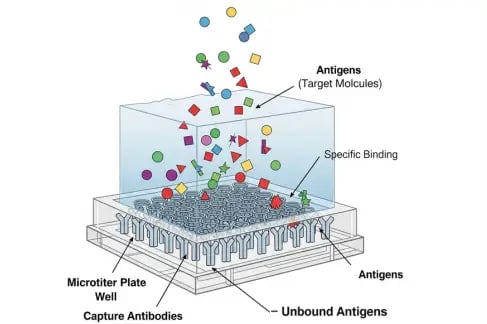
These kits rely on antigen-antibody interactions to measure the concentration of a specific molecule. Its basic principle involves:
- Coating, where an antigen or antibody is immobilized onto a microplate
- Blocking to prevent non-specific binding
- Sample addition for target molecule binding
- Addition of an enzyme-linked detection antibody
- Enzyme-substrate reaction, where the enzyme produces a measurable signal
- Addition of a stop solution to stop the reaction
- Signal measurement using a microplate reader
While standard ELISA kits are designed to detect well-known biomarkers, such as cytokines, hormones, antibodies, or infectious disease antigens, they are not ideal for novel or less-studied biomarkers and complex samples.
At times, scientists use custom ELISA kits. However, these kits require optimization in terms of antibodies, ELISA format, Immobilization (coating) strategy, microplate type, blocking buffer, detection system, sample type, sensitivity, reagent type, etc.
Since immobilization is the first step of ELISA, it determines how efficiently the target analyte will bind. It directly affects signal intensity, background noise, and reproducibility. That is why choosing the right immobilization strategy is crucial when designing custom ELISA kits.
What is Immobilization in ELISA?
Immobilization is the process of antigen or antibody coating to a solid surface. The surface is usually a polystyrene microplate well. The immobilized molecules act as the capture agent that binds specifically to the target analyte in the sample.
In ELISA, immobilization is done in three strategies, including:
- Physical Adsorption
- Covalent Immobilization
- Bioaffinity Immobilization
Each strategy has its unique binding chemistry and suitability, depending on the nature of the biomolecule and the assay’s purpose. So, choosing the right immobilization strategy is crucial.
But before we learn how to choose the right strategy, let’s discuss each strategy.
What is Physical Adsorption?
Physical adsorption is the simplest and most common way to attach an antigen or antibody to an ELISA plate. In this process, the protein (antigen or antibody) sticks to the surface of the microplate without any chemical reaction.
In this strategy, polystyrene plates are used that can easily attract proteins through weak forces. When the protein solution is added to the plate, the molecules move towards the surface and stick there naturally.
This happens because of:
- Hydrophobic interactions: Non-water-loving parts of the protein and plate attract each other.
- Van der Waals forces: Weak attractions between nearby molecules.
- Electrostatic forces: Slight positive or negative charges that pull the protein toward the plate.
After adding the protein, the plate is incubated for some time. This allows the molecules to fully attach to the surface. Then, the plate is washed to remove any unbound material.
Why It’s Used
- Scientists use physical adsorption because it is easy, quick, and inexpensive.
- It does not need any special chemicals or extra steps.
- Most proteins naturally bind well to polystyrene surfaces.
It works well for standard ELISA kits where very high precision is not required. This makes it a great choice for routine laboratory tests and the detection of common biomarkers like hormones, cytokines, or antibodies.
What is Covalent Immobilization?
Covalent immobilization is a stronger and more stable coating method used in ELISA. As the name suggests, in this strategy, the antigen or antibody is attached to the plate through covalent bonds. As a result, coated molecules stay firmly attached to the plate even after many washing steps or long storage times.
In this method, the surface of the ELISA plate is first chemically activated.
This is done by adding special chemicals that create reactive groups (for example, amino, carboxyl, or epoxy groups) on the surface.
When the antigen or antibody is added, the reactive groups on the plate form covalent bonds with matching groups on the protein, such as amino or thiol groups.
These chemical reactions link the protein to the surface in a strong and permanent way. Common chemicals used for this include glutaraldehyde and EDC/NHS.
Why It’s Used
Scientists use covalent immobilization when they need highly stable and durable coatings. This method is ideal for custom ELISA kits that need:
- High sensitivity to detect very low amounts of analyte
- Long-term stability of the kits stored over time
- Reproducible results for repeated use or large-scale testing
Because the attachment is permanent, there is almost no risk of losing the protein during washing or handling.
What is Bioaffinity Immobilization?
Bioaffinity immobilization uses biological interactions instead of weak or chemical bonds to attach molecules.
It relies on specific binding pairs that naturally attract each other. For example, biotin and streptavidin or protein A/G and antibodies.
This method helps the antigen or antibody attach in a more controlled and oriented way. As a result, the active binding sites of the protein remain exposed and ready to interact with the target molecule.
In this method:
- The ELISA plate is first coated with one binding partner, like streptavidin
- The antigen or antibody, such as biotin-labeled, is modified
- When the labeled protein is added, it binds tightly and specifically to the coated surface
Since this bond is not covalent, it helps the antigen or antibody stay attached to the plate during washing steps.
Why It’s Used
- Bioaffinity immobilization gives excellent control over the orientation and activity of the coated protein.
- It helps increase assay sensitivity because all binding sites remain active and accessible.
- This strategy is often used for complex or delicate proteins, or for assays where orientation matters, such as sandwich ELISA or multiplex assays.
Factors to Consider When Choosing the Right Immobilization Strategy For ELISA
When choosing the immobilization strategy for a custom ELISA kit, there are several factors you should consider, including:
1. Nature of the capture molecule
Decide whether it is an antigen, antibody, peptide, or small molecule. The chemical properties of your molecule, such as charge, hydrophobicity, and reactive group, affect the binding efficiency.
Physical adsorption is ideal for proteins or antibodies as they easily attach to polystyrene plates. For small molecules or peptides, covalent or bioaffinity immobilization is better because these molecules need a more secure attachment. Bioaffinity immobilization is ideal for fragile or sensitive molecules. It helps preserve the molecule’s natural shape and activity.
2. Required Stability
A stable coating method is crucial to avoid signal loss or inconsistent results.
So, if you are using your kit for a short-term or single-use assay, physical adsorption is enough. However, if you will be using your kit for long-term or reusing the plates, go with covalent immobilization. Bioaffinity immobilization is ideal for moderate stability needs.
3. Orientation of immobilized molecule
The orientation of the molecule on the surface affects how well it captures the target analyte. So, choose your immobilization strategy carefully.
- In physical adsorption, proteins attach randomly. This may hide the active binding sites, which further helps reduce sensitivity.
- In covalent immobilization, the binding can also be random unless you carefully choose the reactive groups.
- In bioaffinity immobilization, the orientation is controlled. For example, when using biotin-streptavidin systems, the antibody binds in a uniform way. As a result, this leaves the antigen-binding sites exposed.
If your assay needs high sensitivity and reproducibility, especially in a sandwich ELISA, controlled orientation using bioaffinity methods is ideal.
4. Type of Microplate Surface
The type of ELISA plate used plays a major role in immobilization efficiency. For instance, polystyrene plates work well for physical adsorption because of their hydrophobic nature. Modified plates with carboxyl, amino, or epoxy groups are used for covalent immobilization. They help form chemical bonds with proteins. Pre-coated plates are used for bioaffinity immobilization. They save time and ensure consistent coating.
Remember, always match your immobilization strategy to the plate surface type. For instance, a biotin-labeled antibody will only work effectively with a streptavidin-coated plate.
5. Sensitivity and Specificity Requirements
Different immobilization methods provide different levels of assay sensitivity. For instance, physical adsorption is sufficient for standard assays where the analyte concentration is moderate or high. Covalent immobilization improves sensitivity because the bound molecules are stable and uniformly attached. It helps reduce background noise. Bioaffinity immobilization provides the highest sensitivity. It keeps the binding sites active and ensures maximum interaction with the target analyte.
If your custom ELISA kit is designed to detect very low concentrations of biomarkers or rare molecules, choosing covalent or bioaffinity immobilization will give you better results.
The Bottom Line
While these are the factors you should consider when customizing your ELISA kit, there are many more, including cost, ease of use, reproducibility, scalability, and preservation of protein activity. Also, make sure you choose a reliable supplier to customize your kit. Otherwise, you may end up having inaccurate results!
Copyright © 2025 California Business Journal. All Rights Reserved.
For California Business Journal Disclaimers, go to /terms-conditions/.


