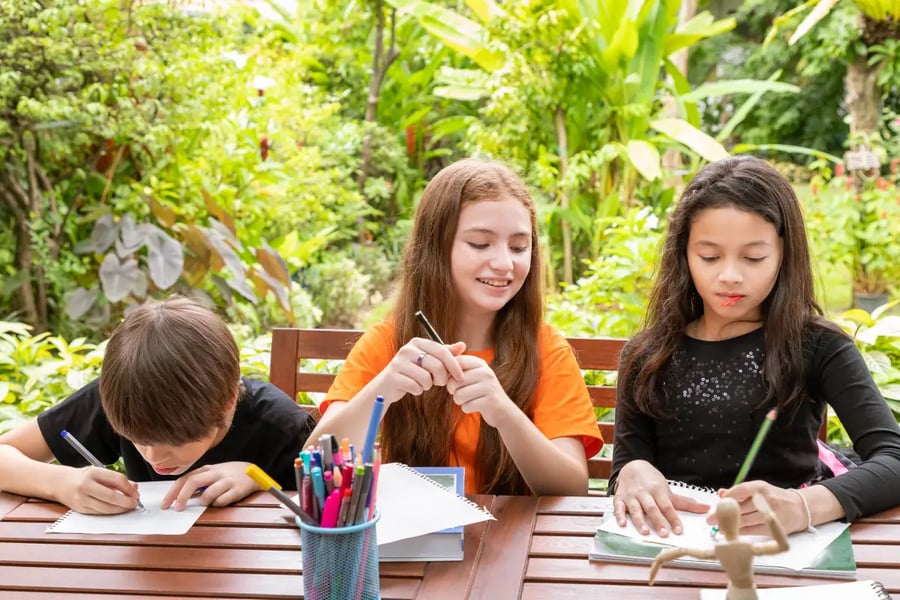
When school ends, kids do not stop developing. In many ways, summer is a prime season for growth because children have more time to move, explore interests, and practice social skills in lower-pressure settings. Families often think about summer in terms of childcare logistics, but summer programs can also be viewed as learning environments that support physical health, confidence, and emotional regulation.
This post looks at what is actually learned at kids summer camps, why those outcomes matter, and how parents can evaluate a program through an educational lens. The goal here is not to sell any specific option, but to give you a practical framework for understanding what “a good summer experience” can teach.
What kids learn in summer that school does not always cover
Schools do a lot well, but they are not built to meet every developmental need every day. Summer environments can fill some natural gaps, especially when the program design includes movement, teamwork, and challenge-based learning.
1) Self-direction and responsibility
In a good program, kids practice managing small choices all day long:
- Packing what they need
- Following multi-step instructions
- Taking care of personal belongings
- Showing up on time for transitions
- Asking for help appropriately
These are “executive function” skills. They do not always show up on report cards, but they are strongly tied to long-term success.
2) Social problem-solving in real time
Summer groups are often mixed by age or include children from different schools. That means kids are constantly negotiating:
- How to join a game
- How to handle disagreement
- When to take turns leading
- How to respond to a teammate’s frustration
These micro-moments are where children practice empathy and conflict resolution with guidance.
3) A healthier relationship with challenge
Some kids avoid hard things because they fear embarrassment. Others rush in and get discouraged when they are not instantly good. Well-run summer programs can normalize effort, mistakes, and second tries.
A child learns:
- “I can try again.”
- “I can ask for a strategy.”
- “I can calm my body and restart.”
That mindset is transferable to school, sports, and friendships.
The role of movement in learning
Movement is not just exercise. For many kids, movement is the most direct route to focus, mood stability, and confidence.
Physical activity supports
- Attention and task persistence
- Sleep quality and energy regulation
- Stress reduction and emotional balance
- Body awareness, coordination, and injury prevention
Importantly, movement can also be a learning tool. When kids climb, balance, crawl, or navigate a sequence, they are training planning, memory, and decision-making at the same time.
Why group challenges can be more educational than they look
Many summer activities look like “just play,” but the structure underneath is what turns play into learning.
For example, a group challenge often includes:
- A clear goal (finish a course, solve a puzzle, complete a mission)
- Limited resources (time, turns, materials)
- Constraints (rules that require cooperation)
- Reflection (what worked, what did not, what to change)
That is a real learning cycle.
Structured collaboration can come in kid-friendly formats through team-based activities and events. These reflect the kinds of cooperative challenges that build communication and shared problem-solving without needing a classroom lecture.
What to look for in a high-quality summer program
If you are evaluating options, it helps to ask questions that reveal how the program is designed, not just what it offers.
Staffing and supervision
Look for clarity around:
- Adult-to-child ratios
- Staff training and experience with kids
- How behavior is handled (coaching vs. punishment)
- How safety rules are taught and reinforced
Program design
A strong program usually has:
- Predictable routines (kids feel secure)
- Variety (kids stay engaged)
- Skill progression (kids feel growth)
- Rest and recovery (kids do not crash)
Culture
Culture shapes learning more than a schedule does. Ask:
- How do staff talk to kids when they struggle?
- Is effort praised more than “winning”?
- Do kids cheer for each other?
- Are shy kids supported, not overlooked?
Age-appropriate challenge matters
One reason some children dislike programs is not the activity itself, but the mismatch between difficulty and readiness.
Signs a challenge is age-appropriate
- Kids can succeed with effort and coaching
- Failure is brief and recoverable
- Instructions are clear and repeated as needed
- Children feel proud after trying, even if imperfect
Signs it is not
- Kids are confused most of the time
- Kids are regularly embarrassed
- The environment feels chaotic
- The same few kids dominate activities
A good program adjusts the challenge so all children are participating, not just spectating.
How summer programs support confidence without forcing competitiveness
Some parents worry that active programs become overly competitive. They do not have to. In fact, many children thrive in environments that focus on personal bests, teamwork, and skill-building rather than rankings.
Healthy confidence grows when kids experience:
- Mastery (I learned how to do that)
- Belonging (I am part of this group)
- Autonomy (I can make choices)
- Support (an adult helps me reset)
A child who learns to regulate frustration and persist through a hard task is learning something deeper than “being athletic.”
Skill-building does not have to be limited to summer
One of the most useful ways to think about youth programs is as a rhythm across the year. Summer often provides the longest stretch of time to practice new habits, but shorter seasonal breaks can reinforce the same developmental goals.
For example, school break programs can support:
- Routine stability when school is off
- Continued peer interaction
- Movement and outdoor time
- Reduced screen time drift
Seasonal options also exist, and spring break programming is an example of how shorter breaks can still provide structured, learning-centered days.
A simple checklist for parents
Here is a practical way to evaluate any program through an educational lens.
Before enrolling, consider
- What does my child need most right now (confidence, friends, movement, structure)?
- Does the program’s day match my child’s energy level?
- Are there clear routines and expectations?
- Is there a balance of challenge and fun?
- How does the program support kids who struggle?
After the first few days, watch for
- Your child can describe what they did (not just “fine”)
- Your child shows healthy tiredness, not burnout
- Your child mentions a staff member positively
- Your child references a friend or a group moment
- Your child wants to return, even if they were challenged
Helping your child get more out of a summer program
Even the best program benefits from a little support at home.
A few simple practices
- Keep mornings calm and predictable
- Pack snacks and hydration that actually get eaten
- Ask specific questions:
- “What was tricky today?”
- “What did you get better at?”
- “Who did you work with?”
- Normalize fatigue and recovery
- Celebrate effort, not just results
This reinforces the idea that growth comes from practice.
Conclusion
Summer programs can be much more than a way to fill time. When designed well, they support executive function, social skill development, confidence, and emotional regulation through movement and guided challenge. The educational value is not about worksheets. It is about repeated opportunities to practice real-life skills in an environment where children can safely try, fail, adapt, and improve.
If you evaluate summer experiences based on structure, culture, and age-appropriate challenge, you will be able to choose options that genuinely support your child’s development, regardless of theme or setting.
Copyright © 2026 California Business Journal. All Rights Reserved.
For California Business Journal Disclaimers, go to /terms-conditions/.


