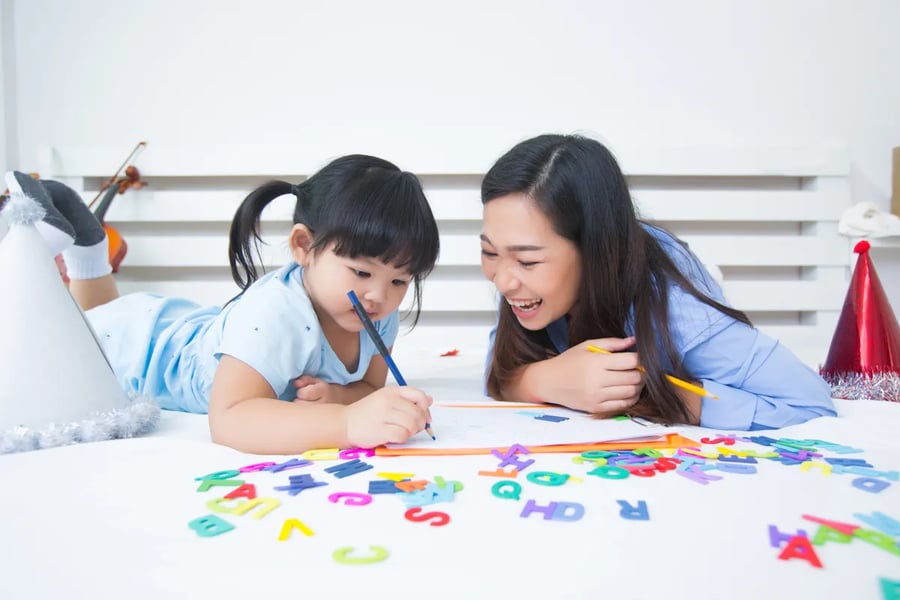
The skills children develop during the early years of their academic journey form an important foundation for future learning. Young learners who demonstrate strong literacy and numeracy skills, for instance, can process written information and numerical concepts with greater accuracy. This helps them grasp new ideas more quickly and apply what they learn more effectively, allowing them to navigate the increasing complexity of academic work with more confidence.
One of the factors that shapes this foundation is the quality of the early education children receive. A reputable kindergarten in Singapore, for example, often follows a curriculum that supports the gradual development of language and mathematical abilities. The sections below explore how this approach helps young learners develop essential literacy and numeracy skills.
Help Kids Establish Strong Oral Language Foundations
Strong reading and writing skills often begin with a child’s ability to understand and use spoken language. Early familiarity with words, sounds, and sentence patterns allows kids to recognize how language works and how it enables them to express their ideas in everyday communication. Children who are given opportunities to listen and respond in meaningful ways become more comfortable communicating with others and participating in classroom conversations.
This connection is why many kindergarten in Singapore incorporate activities that focus on oral development. Storytelling sessions, show-and-tell, and even singing simple songs introduce new vocabulary while helping young learners become more familiar with sentence patterns and spoken expression. Over time, these experiences help children strengthen their listening and comprehension skills, and they lay the groundwork for early literacy development.
Improve Reading and Writing Skills through Guided Practice
Early reading and writing skills develop more steadily when children receive clear guidance. Young learners often need help understanding how letters combine to form words and how those words communicate meaning, and a supportive learning environment can make these connections easier to recognize.
Kindergarten teachers provide this support by leading structured classroom activities that show children how written language is used and practiced. Guided reading sessions, for example, allow children to follow simple stories while learning how to connect sounds to written symbols and practice forming basic words. Writing tasks, on the other hand, may involve tracing letters, labeling pictures, or copying short words, which help children become familiar with how written language is organized.
Through guided practice, young learners build confidence in recognizing words and forming simple sentences. As these skills improve, children begin to see reading and writing as tools they can use to understand information and communicate their own ideas.
Teach Basic Math Skills through Age-Specific Classroom Instruction
Young learners can grasp basic mathematical ideas better when numerical ideas are introduced in a structured way tailored to children of their age. Early exposure to guided math lessons helps children understand how numbers, quantities, and simple operations relate to one another, allowing them to approach basic math tasks with greater clarity.
Short math lessons that focus on building these foundational skills can reinforce children’s understanding of numbers and simple calculations. For example, a teacher may introduce the concept of addition by demonstrating how two small groups of objects can be combined to form a larger group. This gives students a clear visual example of how numbers change when quantities are added together.
In addition to numerical concepts, regular classroom instruction allows teachers to adjust lessons to match students’ level of understanding. If a child struggles to understand a concept or complete an exercise, educators can offer additional explanations and targeted practice. This helps young learners build stronger numerical understanding and apply what they’ve learned more confidently.
Develop Number Sense through Hands-on Learning
A strong understanding of numbers forms an important part of early numeracy development. Number sense allows kids to recognize quantities and understand how numbers relate to one another.
Young children often learn mathematical ideas more easily when they can see and interact with quantities in tangible ways. Thus, kindergartens in Singapore often introduce number concepts through activities that involve using physical objects. Counting blocks or beads enables children to connect numbers with actual quantities and practice counting in a concrete way. Meanwhile, using number cards helps them recognize numerals and understand how numbers are represented in written form.
Simple sorting exercises may also be included in classroom routines. Grouping objects into sets or arranging items in numerical order helps children develop a clearer sense of how numbers represent real amounts. These hands-on experiences give children the chance to experiment with basic mathematical thinking, helping them build confidence when working with numbers.
Encourage Skill Development through Play-Based Exploration
While structured lessons introduce important concepts, play allows young learners to interact with language and numbers in ways that feel natural and engaging. Activities such as building with blocks, taking turns in board games, or engaging in imaginative role-play provide children with opportunities to use the skills they’ve learned in more open-ended situations. Through these experiences, the concepts they learned during their lessons are reinforced without making the activity feel overly formal.
Furthermore, play-based exploration gives children the chance to approach small challenges with curiosity and creativity. This freedom to experiment encourages young learners to repeat activities and discover new ways to complete them, deepening their understanding of the skills they’re developing.
Kindergarten in Singapore offers both structured and exploratory learning opportunities to help children become more comfortable working with language and numbers. Reading, writing, and mathematics are introduced in ways that enable students to build early literacy and numeracy skills in a manner that reflects how young children learn best. Through this early educational experience, young learners develop the foundational understanding that supports more complex learning in the years ahead.
Copyright © 2026 California Business Journal. All Rights Reserved.
For California Business Journal Disclaimers, go to /terms-conditions/.


