
Legal professionals often deal with a vast array of documents, contracts, court filings, regulatory submissions, discovery materials, and compliance reports that must be translated into multiple languages with precision. As law firms and corporate legal departments navigate increasingly globalized workflows, the demand for multilingual legal communication continues to rise. However, traditional translation methods, relying solely on human linguists, are often slow, costly, and prone to bottlenecks, particularly when formatting consistency, legal terminology, and jurisdictional nuances are critical.
A single mistranslation can lead to disputes, delays, or even legal liability. In response to these challenges, AI-powered legal translation tools are emerging as game-changers. These advanced platforms combine speed with linguistic accuracy, preserving document structure, ensuring data privacy, and incorporating expert human review when needed. This article explores how artificial intelligence is transforming the legal translation landscape, making it faster, more reliable, and scalable for the modern legal industry.
The Legal Translation Bottleneck
In the legal landscape, law firms, corporate legal teams, and regulatory bodies face an urgent and growing challenge: how to manage the translation of increasingly complex legal documents across multiple jurisdictions. From international mergers to immigration filings, legal professionals are expected to produce accurate, multilingual legal documents on tight deadlines, and often under strict confidentiality requirements.
However, legal document translation is notoriously slow and expensive. Each translated contract, affidavit, or compliance form must retain its original formatting, respect strict legal terminology, and comply with privacy regulations. The stakes are high. A minor mistranslation could result in financial loss, legal disputes, or regulatory penalties.
Thankfully, artificial intelligence (AI) is transforming how legal documents are translated, offering speed, accuracy, and peace of mind for law professionals around the world.
The Limitations of Traditional Legal Translation
Historically, legal translation has been performed entirely by human translators. While human linguists bring critical contextual and cultural understanding, this method is not without significant drawbacks, especially for fast-moving legal teams.
Key Limitations
- High Costs
Legal translators charge premium rates due to the specialized nature of their work. When multiple languages are involved, costs can escalate quickly.
- Slow Turnaround Times
Human translation of lengthy contracts or discovery documents can take days or weeks, delaying legal workflows.
- Limited Scalability
As firms handle more cross-border matters, relying solely on human translators becomes unsustainable.
- Formatting Challenges
Legal documents require precise formatting, sections, clauses, exhibits that don’t always survive the translation process intact using traditional methods.
- Risk of Errors
Manual translation processes, especially under deadline pressure, can lead to mistakes or inconsistencies.
Ultimately, these challenges compromise service quality, delay legal proceedings, and increase the risk of non-compliance. That’s where AI-powered legal translation tools step in.
How AI-Powered Translation Tools Work
AI translation tools are revolutionizing the way law firms and legal departments approach multilingual documents. Unlike generic translation software, legal-specific AI tools are designed with accuracy, compliance, and privacy in mind.
How It Works
- Neural Machine Translation (NMT)
Uses deep learning to understand sentence structure and context, resulting in translations that are more natural and accurate.
- Domain-Specific Models
Some tools are trained specifically on legal language corpora, enabling better understanding of legal terms and syntax.
- Human-in-the-Loop Systems
Many platforms offer optional human review for sensitive or complex translations, combining the speed of AI with expert validation.
- Real-Time Previews
Instant side-by-side comparisons allow users to verify content and formatting on the fly.
6 AI Legal Translation Tools to Know
Compare business background, pricing, and legal-ready features
1. MachineTranslation.com
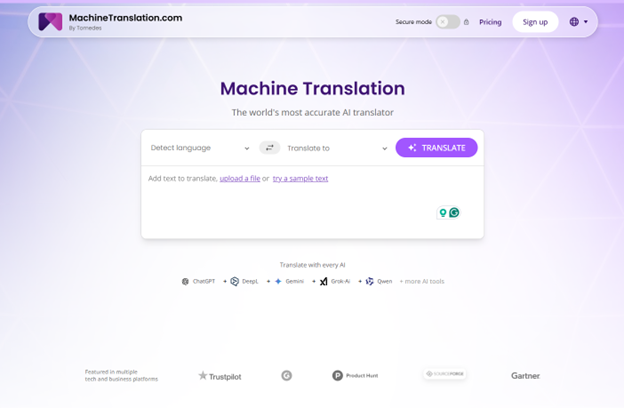
MachineTranslation.com is an accurate and secure AI translation platform developed by Tomedes, a global leader in professional language services. It uniquely combines AI translation with customizable, human-in-the-loop workflows tailored for legal, regulatory, and enterprise-grade use. Its aggregation of 20+ top AI and LLM sources ensures unparalleled output diversity, while tools like Secure Mode and the AI Translation Agent with memory offer user-driven customization and control.
Pricing
- Free: 100,000 words (no sign-up)
- Registered: 100,000 free words/month
- Business Plan: Includes 5,000 words/month of human verification
- API, team, and enterprise plans available
Key Legal Features
- Secure Mode (SOC 2-compliant engines only)
- Key Term Translations + Important Terms for Review
- Smart AI Translation Agent (remembers user preferences)
- Segmented Bilingual View for line-by-line editing
- Preserves Original Layout (DOCX, PDF)
- Anonymize text before translation
- Human Verification (court-ready QA)
- Supports over 270 languages
- Large File Translation
2. DeepL Pro
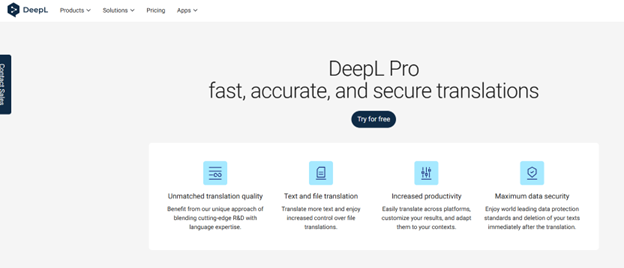
DeepL is a German AI company renowned for its superior fluency and contextual accuracy, especially in European language pairs. DeepL Pro is widely adopted in legal and business sectors for its privacy safeguards and high-quality translations. While language coverage is narrower, the results are often favored by linguists for their natural flow and tone.
Pricing
- Free: Limited characters and features
- Starter: $8.74/month
- Advanced tiers: Pricing scales by number of glossaries, file support, and API use
Key Legal Features
- Glossary customization
- Tone selection (formal/informal for select languages)
- AES-256 encryption for uploads
- Supports DOCX, PPTX, TXT
- API for custom integrations
- Excellent quality for European languages
3. Google Cloud Translation
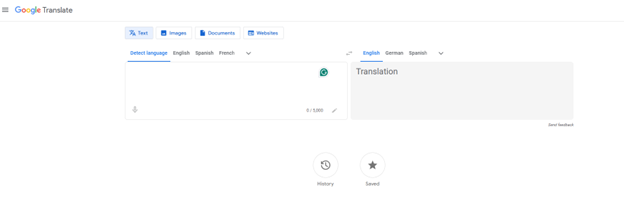
Part of Google Cloud's AI suite, this enterprise-focused tool supports over 130 languages and enables firms to train custom translation models using AutoML. Legal departments with recurring or structured content benefit most, thanks to model training capabilities and seamless integration with Google Docs, Drive, and APIs.
Pricing
- Base: $20 per million characters
- AutoML: $80 per million characters for custom model use
- Pay-as-you-go model via Google Cloud Console
Key Legal Features
- Train custom translation models with legal datasets
- Integration with cloud-based legal tools and storage
- Glossary and terminology support
- Highly scalable API for high-volume use
- 130+ languages supported
4. SYSTRAN
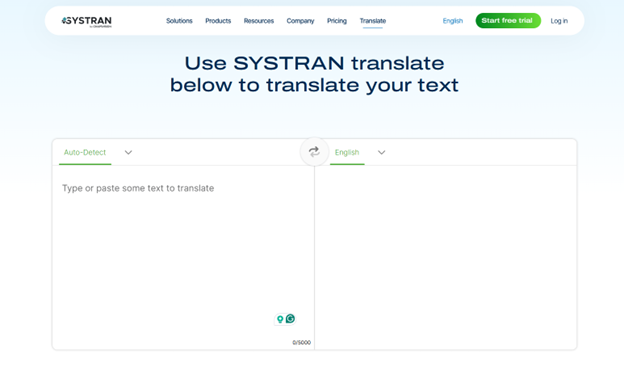
SYSTRAN, one of the oldest names in machine translation, offers a platform tailored specifically for legal professionals. SYSTRAN includes pre-built legal glossaries, terminology control, and support for high-volume, on-premise, or cloud deployments. It is trusted by government agencies, law firms, and multinational corporations worldwide.
Pricing
- Custom enterprise pricing
- Available for on-premise or cloud licensing
Key Legal Features
- Built-in legal glossaries and terminology databases
- Terminology management dashboard
- Large-scale batch translation
- On-premise installation option for sensitive environments
- Document formatting retention
- Integration-ready with legal CMS
5. Unbabel
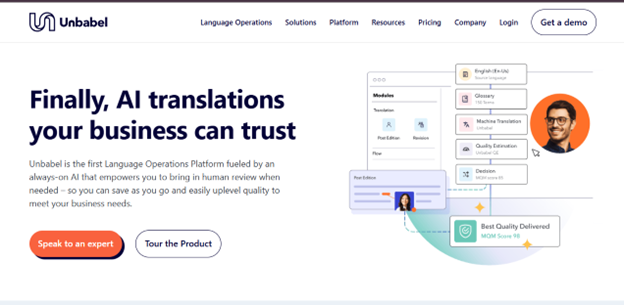
Unbabel offers a hybrid approach by combining machine translation with professional human post-editing. It’s widely used in legal operations that involve multilingual customer service, contract communication, and external-facing documentation. Unbabel integrates with CRM and support platforms, making it ideal for client-facing legal teams.
Pricing:
- Custom pricing (based on volume and SLA)
- Subscription + per-word cost for post-editing services
Key Legal Features
- AI + human post-editing workflow
- Supports multilingual legal communication
- Integrated quality review and scoring
- CRM/API integrations (Zendesk, Salesforce, etc.)
- GDPR-compliant and scalable for support/legal ops
6. Microsoft Translator for Business
Part of Microsoft Azure's Cognitive Services, Microsoft Translator integrates directly with Microsoft 365 tools like Word, Teams, Outlook, and SharePoint. It's designed for businesses that want built-in, secure, and fast translation within familiar environments. Custom translation models can be trained via Azure’s Custom Translator.
Pricing
- Free tier available
- Standard: ~$10 per million characters
- Custom Translator: Add-on cost via Azure pricing
Key Legal Features
- Real-time translation across Microsoft 365 apps
- API available through Azure Cognitive Services
- Supports glossary upload for legal terms
- Enterprise-grade security and compliance
- 100+ languages supported
- Custom translation models available via Azure
Legal AI Translation Tools – At-a-Glance Comparison Table
| Tool | Secure Mode / Privacy | Legal Glossaries | Human Review | Format Support | API Access | Language Support | Starting Price |
| MachineTranslation.com | SOC 2, anonymize, expiring URLs | Yes | Yes | DOCX, DOC, PDF, TXT, CSV, XLSX, JPG | Yes | 270+ | Free (100k words), Business plan |
| DeepL Pro | Encrypted uploads | Yes | No | DOCX | Yes | ~30 | $8.74/month |
| Google + AutoML | Cloud security via GCP | Yes | No | Docs, text | Yes | 130+ | $20/million characters |
| SYSTRAN Legal | On-prem/cloud secure | Built-in | No | Yes | Yes | ~50 | Custom enterprise |
| Unbabel | GDPR-compliant | Optional | Yes | Yes | Yes | ~30+ | Custom quote |
| Microsoft Translator | Azure-compliant | Customizable | No | Word, Excel | Yes | 100+ | ~$10/million characters |
Accuracy and Legal Terminology: Can AI Be Trusted?
One of the biggest concerns in adopting AI legal translation tools is accuracy. After all, legal terminology is complex, often non-translatable word-for-word, and fraught with consequences if misinterpreted.
Fortunately, modern AI has made significant progress in translating legal terminology thanks to:
- Specialized Language Models
Trained on millions of legal documents, these models are better at understanding legal syntax, clause structure, and terminology.
- Legal-Specific Glossaries
AI tools often allow integration of firm-specific or jurisdiction-specific glossaries to maintain consistency.
- Near-Human Accuracy
In many cases, such as NDAs, standard contracts, or compliance disclosures, AI can achieve accuracy levels close to professional human translators, particularly when used with a post-editing workflow.
For example, a study found that AI tools could accurately translate 85–95% of legal documents, with the remainder requiring light human review. This is a game-changer for law firms handling large volumes of repetitive or templated legal texts.
Protecting Client Privacy and Confidentiality
Legal documents often contain highly sensitive information, client identities, financial data, proprietary business terms, or case-specific details. When translating these materials, even a minor data leak could result in serious legal consequences, regulatory violations, or reputational damage. That’s why data security is non-negotiable in legal translation workflows.
Modern AI translation platforms are rising to this challenge with advanced privacy safeguards. For example, MachineTranslation.com recently launched Secure Mode, a feature that ensures translations are processed only through vetted, SOC 2-compliant AI engines.
“Secure Mode was created to meet that need directly,” says Emilyn Sinamban, Global Customer Success Manager at Tomedes, in a statement to Slator. “It removes the guesswork, letting users see which AI engines meet the highest standards for data protection. That level of clarity builds real trust.”
With Secure Mode enabled, any non-compliant sources are automatically hidden or grayed out, giving law firms confidence that their documents are being translated securely, with privacy and regulatory compliance as top priorities.
Key Security Features in Trusted Platforms
- Encrypted Uploads
Data is transmitted through secure, encrypted channels.
- No Data Retention
Premium tools avoid storing any user content after translation.
- Compliance with Global Standards
Many platforms adhere to GDPR, HIPAA, and other privacy regulations.
- Optional Anonymization
Some tools offer automated redaction or anonymization of sensitive terms.
- Private APIs
For enterprise clients, translations can run on private infrastructure to ensure full control.
Legal teams should never use free, consumer-grade translation tools for sensitive materials, as these platforms may retain or repurpose user input for training purposes.
Real-World Applications for Law Firms
AI-powered legal translation is not just theoretical; it’s already in use across the legal industry. Legal professionals are leveraging these tools to handle high volumes of documentation with increased accuracy and efficiency. Here are some of the most common and impactful applications:
- Cross-Border Contracts
Translating agreements between parties in different countries, including sales contracts, licensing agreements, and supply chain documentation. These documents often require fast turnaround to meet tight deadlines and preserve negotiation momentum.
- Immigration and Asylum Cases
Speeding up the translation of identity documents, affidavits, and legal filings for clients navigating complex immigration processes. Time-sensitive applications benefit from AI’s ability to generate rapid translations without compromising confidentiality.
- Multinational Litigation
Translating discovery documents, court submissions, and witness statements for international cases. AI allows law firms to sift through multilingual material more quickly, giving them a litigation edge.
- Compliance and Regulation
Assisting corporations in translating legal notices, compliance manuals, and government filings in multiple jurisdictions. This ensures companies stay ahead of legal obligations in all operating regions.
- M&A Due Diligence
Quickly translating acquisition documents across multiple languages for legal review during cross-border mergers. AI tools help legal teams assess risks and obligations in a fraction of the time it would take manually.
- Client Communication
Translating routine updates, reports, and correspondence for multinational clients. Ensuring clear communication helps build trust and minimizes misunderstandings.
These applications are saving law firms both time and money, while maintaining the quality and reliability their clients demand. AI tools empower legal teams to operate more efficiently, serve more clients, and expand into global markets with confidence.
The Future of Legal Translation with AI
The legal industry is only beginning to unlock the potential of AI-enhanced translation.
What’s Next?
- Generative AI & Large Language Models (LLMs)
Tools like GPT-4 are being fine-tuned for legal content, allowing for even more accurate translation with context-specific logic.
- Multilingual Compliance Monitoring
AI tools will scan documents across languages for legal inconsistencies or regulatory gaps.
- Voice-to-Document Translation
Emerging AI tools may soon enable live interpretation with real-time transcription and legal translation.
- Regulatory Frameworks for Legal AI
As usage grows, expect clearer standards around transparency, auditability, and ethical use of AI in legal settings.
Importantly, AI is not replacing human legal translators; it’s augmenting them. The future is collaboration, where AI handles the bulk work and humans step in for quality assurance, nuanced interpretation, and final approval.
Conclusion: Embracing AI for a More Efficient Legal Workflow
The translation of legal documents no longer needs to be a bottleneck. With AI-powered legal translation tools, law firms can:
- Deliver faster turnaround times for clients
- Reduce translation costs without sacrificing accuracy
- Keep sensitive data secure and private
- Scale legal services to meet cross-border demands
- Empower staff with better tools and workflows
By adopting AI early, firms gain a competitive edge, offering faster, smarter, and more reliable services in an increasingly global legal environment.
Legal AI isn’t the future. It’s already here.
Copyright © 2025 California Business Journal. All Rights Reserved.
For California Business Journal Disclaimers, go to /terms-conditions/.


