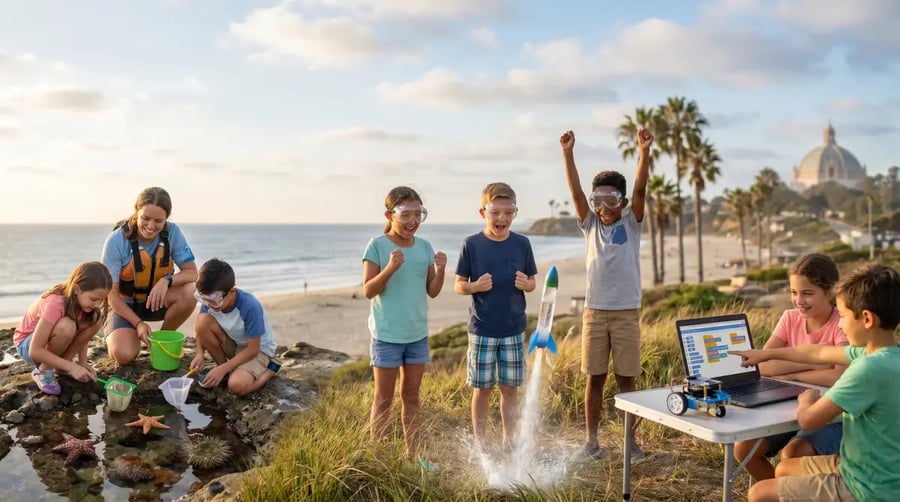
San Diego breathes innovation—from biotech labs to drone hangars—so summer here means kids code robots, dissect squid, or track Saturn instead of watching TV. The hitch? Seats vanish fast: San Diego Magazine (January 15, 2026) notes top sessions can sell out in minutes. We audited more than 30 science camps within a 2.5-hour (≈ 160 km) drive, grading each on six metrics—curriculum depth, instructor expertise, hands-on time, safety standards, parent reviews, and true value—then built a defensible Top 10. Many winners hold American Camp Association accreditation, so you can register with confidence.
Ready? Let’s dive in.
How we picked the winners
Choosing the “best” isn’t a popularity contest—it’s a scorecard. We wanted camps that stretch young minds, keep kids safe, and respect a family’s budget.
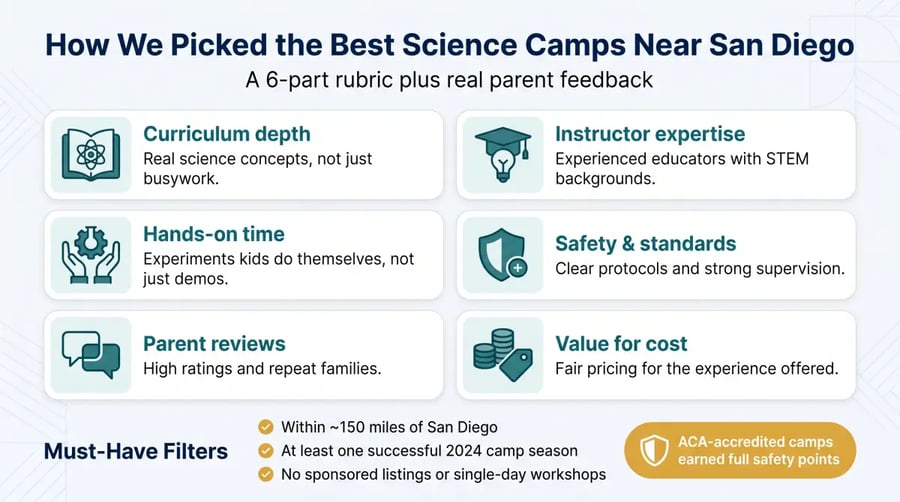
First, we plotted every science or STEM program within about 150 miles (≈ 240 km) of San Diego. Then we graded each one against six hard-nosed benchmarks:
- Curriculum depth
- Instructor expertise
- Hands-on time (real experiments, not demos)
- Safety standards and accreditation
- Parent reviews and repeat attendance
- Value for cost
Scores were weighted, tallied, and ranked. Camps accredited by the American Camp Association automatically earned full safety points because the ACA audits hundreds of health and staffing rules every year.
Programs also had to complete at least one successful 2024 season with solid parent feedback. Sponsored directories and single-day workshops didn’t make the cut.
The result is a list you can trust—grounded in data, flavored with firsthand parent insight, and free of pay-to-play bias. Let’s see who tops the leaderboard.
1. Pali Adventures: Wacky science in the pines
Imagine a place where your child launches a homemade rocket in the morning, tries flying trapeze after lunch, and ends the night sharing star stories around a campfire. That mash-up of mad-scientist thrills and classic sleepaway bonding is exactly what Pali Adventures delivers. Its Wacky Science specialty lets kids whip up edible gummy worms, craft homemade lava lamps, and launch water-propelled rockets, all experiments they can recreate at home to keep the learning going.
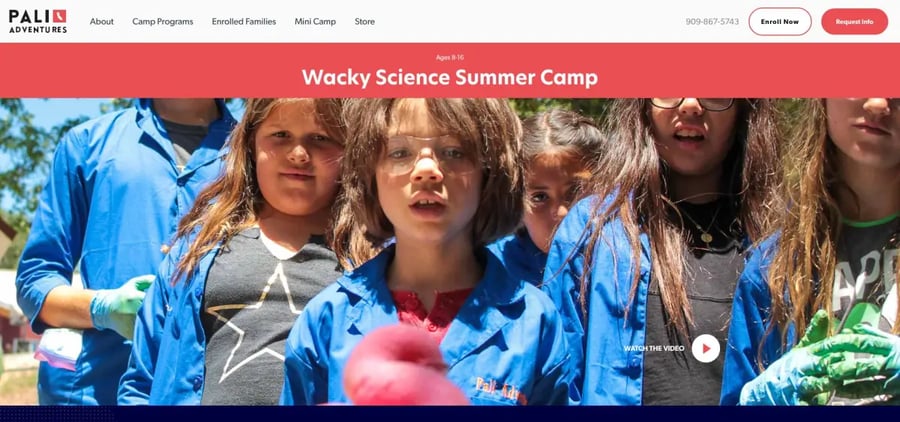
Set in Running Springs, California, in the San Bernardino Mountains, the camp sits about 90 minutes (≈ 145 km) east of Los Angeles. It is a residential-only program—no day-camp option—and serves ages 6 to 16, divided into Mini Camp (6 – 8), Juniors (8 – 12), and Seniors (13 – 16).
The Wacky Science specialty meets for three hands-on hours each day. Campers don goggles, grab beakers, and whip up everything from elephant-toothpaste foam to edible ice-cream chemistry. Instructors treat “messy” as a teaching tool, turning every fizz and pop into a lesson on pressure, polymers, or pH. The rest of the schedule is choose-your-own-adventure: film making, flying trapeze, and motorsports are three of 27 specialties across Adventure, Creative, and Performance tracks, so siblings with different interests can attend the same week and still forge their own paths.
Parents praise the staff. Every counselor passes LiveScan and U.S. Department of Justice background checks and holds first-aid, CPR, and AED certifications. Small cabin groups mean your shy Junior camper will not be overshadowed by the bunk’s chatterbox. Medical professionals stay on-site, and the camp carries accreditation from both the American Camp Association (ACA) and the Western Association of Independent Camps (WAIC).
The program is an investment, yet tuition covers everything: meals, lodging, activities, and specialty supplies. That buys full room and board, professional-grade lab materials, and memories most programs cannot equal. If your young scientist is ready to spread their wings and their mind, Pali Adventures is worth the road trip.
2. Fleet Science Center camps: Big discoveries in Balboa Park
The Fleet Science Center sits in the heart of Balboa Park, yet its summer classrooms feel more like mini mission control. Walk in during Rocket Week and you will find clusters of kids troubleshooting fin designs, measuring launch angles, and counting down before cheers echo across the patio. Visit during Chemistry Week and the same tables transform into safe, bubbly labs where color-changing foams reveal pH secrets.
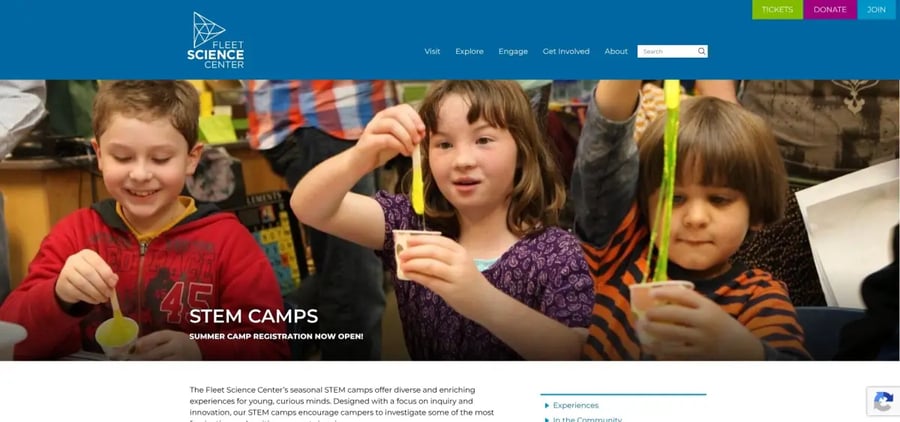
Each session locks onto a single theme, so campers stay immersed instead of sampling a shallow buffet. Younger groups experiment with balloon cars to learn forces, while middle-schoolers wire solar circuits to decode renewable energy. Lessons follow an inquiry model: instructors pose a question, hand over materials, then guide kids as they test ideas—and retest when those ideas flop. Failure becomes part of the fun.
Instructor quality matters. The Fleet draws museum educators and college STEM majors who already run daily demos for thousands of visitors, so they know how to pivot when a curious eight-year-old asks, “What if I mix them all together?” Security stays tight: check-in is controlled, classroom doors remain locked, and every adult passes a background check.
Parents appreciate the value. A full-day week costs about $425, one of the most affordable large science camps in town. Factor in exhibit-hall time, surprise IMAX screenings, and the occasional guest scientist, and the cost per “wow moment” drops even further.
Logistics are the only challenge. The Fleet no longer offers extended care, so pickup lands at 4:00 pm sharp. Plan a carpool if you can; Balboa Park traffic near closing time tests any parent’s patience. Sign up the moment registration opens, because popular weeks sell out before spring break.
3. San Diego Zoo Safari camps: Wildlife science that walks right up to you
If your child’s dream lab includes fur, feathers, or scales, the Zoo’s summer program feels like magic. One minute campers chart animal behaviors with real data sheets, the next they hand-feed a giraffe and feel its surprisingly long tongue curl around a leaf.
Days start early, before the gates open to visitors. Small groups weave through back paths to watch keepers prepare breakfasts or train sea lions for health checks. Because the public is not yet inside, kids linger, ask questions, and snap clear photos for their research journals. Those journals are not busywork; counselors teach scientific observation, so even first-graders can explain enrichment protocols or spot stress signals in primates by week’s end.
Safety is a priority. The Zoo follows Association of Zoos and Aquariums (AZA) standards, posts certified first-aid staff at every base, and enforces tight headcounts on every move. Typical groups top out at about 20 campers with two adults, giving a ratio near 10:1. Shade stations and scheduled water breaks keep kids comfortable in the 100-acre (≈ 40-hectare) park.
The program is not cheap, and shy children may find a group of twenty a bit large. Yet the payoff is unbeatable access to one of the world’s premier conservation facilities. Campers return home armed with behind-the-scenes stories most visitors never hear and a new zeal for protecting the planet.
Register the day slots open. In a typical year, elementary weeks sell out before many families unpack spring-break suitcases. Pack sturdy shoes, apply sunscreen, and prepare for the loudest “roar” when you ask, “How was camp today?”
4. Birch Aquarium camps: Science where the waves break
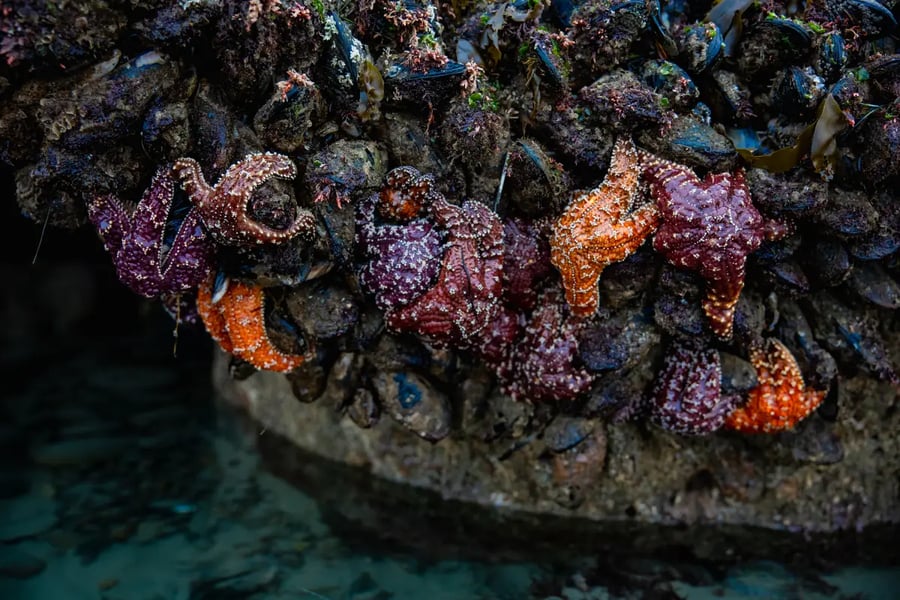
Few classrooms beat the Pacific. At Birch Aquarium, the surf is the lab. Campers spend mornings knee-deep in tide pools, identifying anemones or coaxing hermit crabs from borrowed shells. Afternoons shift uphill to the aquarium overlook, where kids dissect squid, test water salinity, and sketch shark anatomy while pelicans glide by.
Because Birch is powered by Scripps Institution of Oceanography, instructors are marine biologists in training. They bring current research to camp—one day plankton sampling from a pier, the next analyzing microplastic under microscopes. Safety stays tight: certified lifeguards monitor every snorkel session, and wetsuits, masks, and rash guards come with tuition.
Themes scale with age. Five-year-olds play “Sea Star Hide-and-Seek” on the sand, while middle-schoolers strap on fins for the Surf & Science track and learn wave physics between rides. Tuition runs about $470 (≈ €430) for a full-day week, but parents call it money well spent when their child starts discussing ocean acidification at dinner.
Pro tip: La Jolla parking fills fast. Arrive 20 minutes early or use public transit to avoid circling the cliffs. Registration opens in February, and the surf-focused weeks book out first, so set a reminder now or risk a very disappointed beach bum in June.
5. Elementary Institute of Science: The hidden gem with scholarships
Step into EIS and you feel the vibe right away: small groups, real lab gear, and instructors who greet kids by name. This nonprofit has championed hands-on science in Southeast San Diego for more than fifty years, yet many North County families still have not heard of it.
Camps here run deep, not wide. Sign up for Crazy Chemistry and your child will spend the week titrating acids, growing crystals, and testing the bounce of homemade polymers. Choose Space & Astronomy and they will build a stomp rocket, track sunspots, and visit a local planetarium. Every session brings in a guest scientist, so kids meet role models who do this work for a living.
Class size hovers around twenty, a sweet spot that keeps discussions lively without anyone fading into the background. Lab ratios stay tight—about one adult for every eight campers—so even the messiest experiment feels safe and supported.
Now the best part: price. At roughly $300 (≈ €275) for a full 9-to-4 schedule, EIS already wins on value. Add need-based scholarships and the program becomes accessible to almost any motivated student. Families email proof of free or reduced-lunch status, and aid is granted first-come, first-served until funds run out, typically by late April.
If you want rigorous science, personal attention, and a mission that prioritizes equity, circle EIS on your camp spreadsheet. Just do not wait too long; word of mouth is spreading fast, and scholarship slots disappear even quicker than the baking-soda volcanoes erupt.
6. SeaWorld San Diego camps: Conservation, coasters, and ACA-level safety
SeaWorld’s day program pulls off a rare trick: it slips solid marine biology into an amusement-park dream week. Campers enter through employee gates before crowds arrive, chat with veterinarians in the rescue center, then hop onto the Manta coaster once lessons wrap.
Education comes first each morning. One day kids chart dolphin behaviors from a quiet viewing deck; the next they prep fish buckets and hand-feed bat rays while learning about ecosystem roles. Counselors weave conservation into every turn, so a ride on Emperor becomes the spark for a talk about shrinking sea ice and penguin habitats.
Parents value the guardrails as much as the thrills. The camp is fully accredited by the American Camp Association, meeting hundreds of health, staffing, and emergency standards. Groups average fifteen campers with two counselors, keeping the ratio close to 8:1. Radios and first-aid kits travel with every group as they move from backstage pools to coaster queues.
Tuition starts around $450 (≈ €415) for a full week, but that price includes daily park admission, animal encounters most visitors pay extra for, snacks, and a souvenir shirt. Extended care solves the working-parent puzzle, stretching coverage from 8:00 am to 5:00 pm with no extra juggling.
Book quickly. Prime weeks vanish before May, and kids who love both science and splashy fun will talk about feeding a sea turtle, then riding Journey to Atlantis, long after the final group photo.
7. Living Coast Discovery Center: Small groups, big connection to nature
Tucked inside the Sweetwater Marsh, this Chula Vista nonprofit gives kids a front-row seat to San Diego wildlife. Classrooms are converted beach cottages, and the walk to lab time follows a trail past hummingbirds and sun-bathing turtles.
Mornings open with an animal ambassador. One day campers meet Sapphire, the blue-tongued skink; another, a rehabbed red-tailed hawk glides inches overhead while kids map wingspan versus lift. Lessons move outdoors fast. Counselors lead scavenger hikes to track coyote prints, seine nets in the bay to sample plankton, or quiet sits in a bird blind where kids tally egrets for a citizen-science database.
Group size tops out at about ten campers, turning every question into a conversation. Staffers know each child’s name, snack allergy, and current favorite reptile by day two. That intimacy powers safety: marsh trails close to the public during camp hours, and lifeguard-certified educators shadow all water activities.
Parents appreciate the price—about $300 (≈ €275) for a full-day week—and the mission. The center reinvests camp revenue into wildlife rescue and habitat restoration, so tuition literally helps feed a rescued sea turtle. Older campers can become junior docents, guiding younger kids and logging volunteer hours that look sharp on high-school résumés.
Parking is easy, the vibe is low-key, and kids return home salty-haired and excited to show off the shark teeth they found in the sand. For families craving a quieter, deeply local science experience, Living Coast is the sleeper hit of the summer roster.
8. AstroCamp: A week in orbit without leaving California
Picture clear mountain skies, a telescope bigger than your car, and a multi-axis trainer that spins campers like test pilots feeling g-forces. AstroCamp turns every space-obsessed daydream into reality, all within about two hours (≈ 160 km) of downtown San Diego.
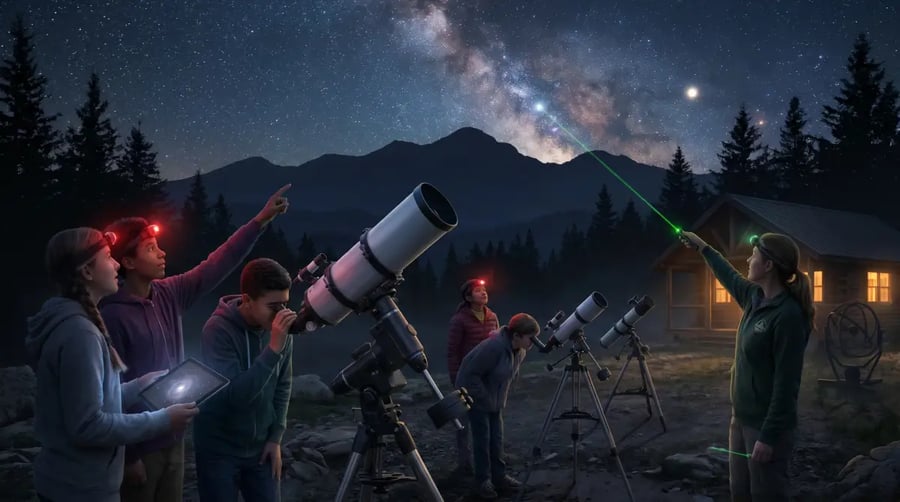
Days split between lab blocks and classic camp fun. Each morning your child might solder circuits for a near-space balloon payload; after lunch they race to the climbing wall or an all-camp capture-the-flag match. Evenings belong to the stars. Counselors wheel out telescopes, cue laser-guided sky tours, and let kids snap their own deep-sky photos. The first glimpse of Saturn’s rings becomes a core memory.
What sets AstroCamp apart is staff depth. Instructors are science educators—physics majors, aerospace graduates, or chemistry teachers on summer break—supported by leadership certified by the American Camp Association. Their mantra: “Try it, test it, tweak it.” Every failed rocket launch gets a rebuild, not a reprimand. Groups average sixteen campers with two instructors, keeping the ratio near 8:1.
Tuition runs about $2,800 (≈ €2,550) for a one-week session, covering room, board, lab supplies, and gear from space-suit simulators to underwater robotics kits. Scholarships exist, but they vanish quickly; apply the moment registration opens in October. Camp serves ages 8 to 17, with separate tracks for Junior, Main, and Advanced programs.
For kids who name their stuffed animals after Mars rovers, no other camp scratches the itch. Expect them to come home fluent in orbital mechanics and lobbying for a backyard observatory.
9. Camp Galileo: Where art meets engineering and failure is a feature
If your child toggles between drawing comics and dismantling the toaster “for research,” Camp Galileo feels like home. The STEAM curriculum threads creativity through every science challenge, showing kids that many great inventions start with a sketch, a prototype, and a few hilarious flops.
Each week revolves around a theme. In Toy Makers, campers brainstorm on giant whiteboards, raid shelves of cardboard and motors, and prototype rolling gizmos that zoom down test ramps. In Galactic Explorers, they model lunar craters with flour and cocoa powder before designing insulation for a Mars habitat that keeps ice cubes from melting in the San Diego sun. Staff cheer every misstep as data, not disaster, building a resilience many schools skip.
Energy stays sky-high. Mornings open with silly chants that adults might find corny but instantly bond a room of strangers. After lunch, counselors stage innovation games—think capture the flag where you must design a contraption to retrieve the flag without stepping inside the zone. By pickup, campers are sweaty, paint-splattered, and eager to show the contraption that finally worked on attempt number six.
Safety and inclusivity earn high marks. Ratios hover around one adult per eight kids, staff train on neurodiversity, and schedules flip indoors on hot days to keep brains cool. Tuition runs about $520 (≈ €480) per week, and a robust scholarship fund puts dozens of families on the roster each summer. Programs serve ages 5 to 14 at multiple San Diego-area school campuses.
Camp Galileo will not turn every kid into a code wizard—that is iD Tech’s focus—but it will send home fearless tinkerers who view the world as a giant prototyping playground. In an innovation economy, that mindset is gold.
10. iD Tech camps at UC San Diego: Code, build, and game on a college campus
Some kids want LEGO robots, others dream of Python-powered AI that beats dad at chess. iD Tech covers both and everything between while giving campers a taste of university life.
Each enrollee selects a focused track—Roblox Game Design, Python Machine Learning, or Battle-Bot Engineering—so there is no filler time. Classes cap at eight students per instructor, so projects move fast and debugging feels like private tutoring. Staff come from top computer-science programs and pass FBI background checks, adding an extra layer of safety and expertise.
The campus does half the inspiring. Breaks unfold in UCSD quads where real researchers stroll by, and overnight campers sleep in actual dorms. Day campers still soak up the vibe by grabbing lunch in the dining hall and navigating to the makerspace like future freshmen.
Tuition starts at about $1,100 (≈ €1,020) for the week. Parents are not paying for childcare, they are investing in a finished portfolio piece. Campers head home with a published game, a functioning robot, or a website they coded themselves. For teens aiming at AP Computer Science or a tech internship, that head start is priceless.
Seats in advanced courses disappear first, especially girls-only sections that boost representation. If your child’s happy place is Ctrl + S, register early and let them spend a week speaking fluent Java instead of emoji.
Stem camp trends and smart-parent tips for 2026
San Diego’s science camps keep evolving, and so do the rules of snagging a seat. Here is what we see on the horizon, plus a few insider moves to make summer planning smoother.
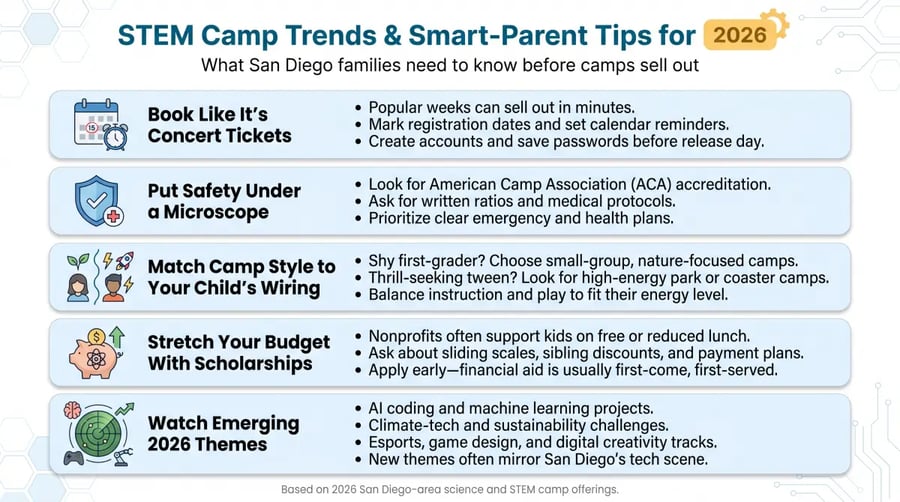
Families lock in spots earlier than ever. San Diego Magazine (January 15, 2026) reports that many sessions sell out within minutes of opening day. Mark your calendar, store log-in passwords, and treat release day like concert tickets.
Safety scrutiny remains high. Programs with American Camp Association (ACA) credentials display that badge proudly, signaling staff training, health plans, and emergency drills that meet national standards. Camps without ACA status should still share written ratios and medical protocols; ask for them.
Match camp style to your child’s wiring, not your wishlist. A sensitive first-grader may bloom in Living Coast’s ten-camper pods, while a thrill-seeking tween thrives amid SeaWorld’s roller-coaster decibels. Scan daily schedules for balance between instruction and play, then decide if that ratio matches your child’s energy bank.
Cost does not need to be a deal-breaker. Nonprofits such as the Elementary Institute of Science reserve scholarship funds for families who qualify for free or reduced lunch; aid is first-come, first-served and surprisingly simple to secure. Ask every camp about assistance—many premium providers offer sliding scales or sibling discounts.
Keep an eye on fresh themes. AI coding, climate-tech challenges, and esports leagues appear in 2026 brochures, echoing San Diego’s industry pulse. If your child’s passion seems niche today, a camp track may be brewing for it tomorrow.
Conclusion
Final tip: build a backup list. Wait-lists move, kids change interests, and new pop-up workshops surface after April. A little agility now can save a lot of summer FOMO later.
Copyright © 2026 California Business Journal. All Rights Reserved.
For California Business Journal Disclaimers, go to /terms-conditions/.


