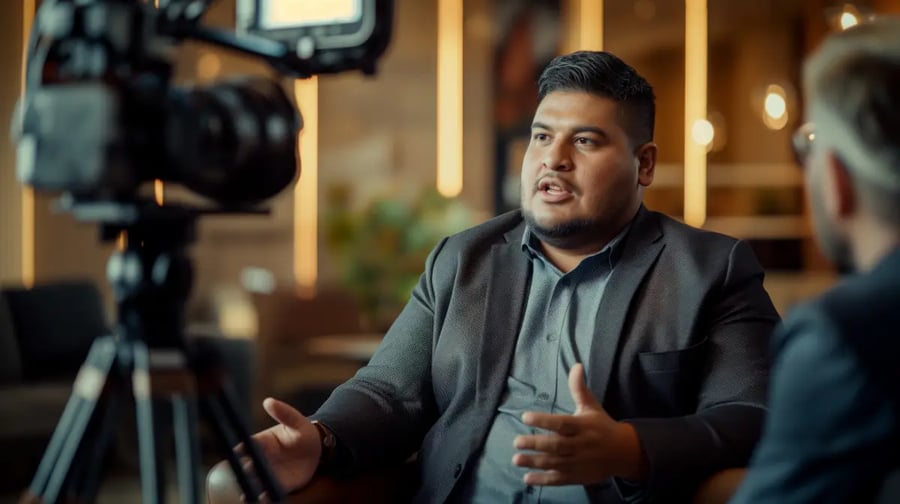
There is a specific quality of light in a serious executive interview, soft on the face, lifted on the background, eyes catching a reflection that signals confidence. Most viewers cannot name it. They only know the executive looked credible. That unnamed perception is what studio-grade production is for.
The stakes have risen sharply. A CEO video that once lived on SharePoint is now cut into LinkedIn posts, investor pages, and recruiting reels. Shot at a good enough level, its limitations compound with every new use. Shot at the studio level, it travels everywhere without looking out of place.
Camera and Lens: Where Studio-Grade Thinking Starts
Studio-grade production starts with the camera package, but not the way clients expect. The camera matters less than the operator and the lens. A skilled operator with a mid-range body outperforms a junior operator with top-tier gear every time. Good enough chooses the camera first. Studio-grade chooses the lens first.
Lighting: The Factor That Separates the Levels
Lighting separates the levels more than anything else. A good enough shoot uses two or three lights set up in 20 minutes. Studio-grade uses four to six, dialed in over an hour, with the background treated as a layered space. The result has dimension and life. Two lights produce something technically lit but visually flat.
Audio, Set Design, and Wardrobe
Invisible Audio That Travels Everywhere
Audio at the studio level is invisible. The microphone is chosen for the voice and the room. A second mic runs as backup. Room tone is captured. Good enough, hand the editor whatever the camera mic picked up. Studio-grade delivers four clean tracks and a room tone reference.
The Set Tells the Story Before a Word Is Spoken
The set is where the difference is most visible. A good enough shoot uses whatever room is available with a logo banner—studio-grade dresses the space deliberately — books, artwork, plants, branded glass. The space tells a story about who the executive is without calling attention to itself.
Direction: The Widest Gap Between Good and Great
Direction is the widest gap and least discussed. Most executives need on-camera guidance that does not undermine their confidence. A studio-grade director knows when to adjust posture, when to call another take, and how to draw out complete answers. A good enough shoot leaves the executive alone.
Post-Production: The Final Layer of Studio-Grade Work
Post-production matters as much as the shoot. The color grade must hold from a phone to a 4K investor monitor. The audio mix must translate from earbuds to conference room AV. Studio-grade post means multiple revision rounds. A good enough post is one editor working from a brief.
The Hidden Cost of Good Enough: Reuse Value and Time on Set
Content That Compounds vs. Content You Keep Recreating
The hidden cost of good enough is reuse value. A studio-level clip travels across dozens of formats for years. A good enough clip expires after one campaign — every reuse exposes the original limitations. Companies that shoot at the higher tier build a library that compounds. Companies that shoot lower recreate from scratch.
Protecting Shoot Time Is a Content Decision, Not a Calendar One
Time on set is underestimated. Studio-grade needs three to four hours for 15 minutes of polished content. Good enough tries the same in 45 minutes between meetings, with the seams visible in every frame. Executives who protect shoot time get better content. Those who treat it as a calendar problem get the content they deserve.
Production Is Part of the Executive's Image
Production is part of the executive’s image. The wrong partner makes a sharp leader look uncertain. The right partner makes a tired CEO look engaged. The team at Argus HD treats every shoot as an act of representation, not documentation. When done well, the audience thinks about the message, not the medium.
For companies building an executive content library that will hold up across platforms and campaigns for years, partnering with a specialist in executive video production is the decision that changes what those assets can do and how long they can do it.
Copyright © 2026 California Business Journal. All Rights Reserved.
For California Business Journal Disclaimers, go to /terms-conditions/.


