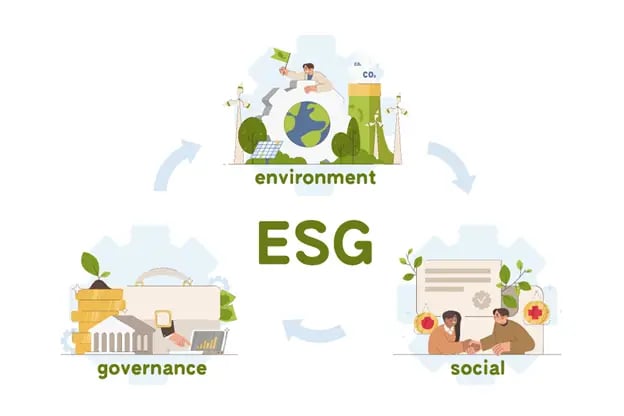
Corporate ESG compliance has shifted from a voluntary reporting exercise to a regulated operational requirement. Frameworks that were once best practice are now binding. Regulators are asking for evidence, not summaries. And the teams responsible for disclosure are being held to standards that were previously reserved for financial reporting.
For corporate teams working through what this means in practice, the KEY ESG guide to ESG compliance covers the regulatory landscape, framework requirements, and what audit-grade compliance looks like in practice.
What ESG Compliance Actually Means Today
ESG compliance is the process of meeting mandatory and voluntary obligations to disclose environmental, social, and governance data accurately, on time, and with defensible evidence behind every reported figure.
The line between mandatory and voluntary ESG disclosure is fading. CSRD, CARB, and IFRS S1 and S2 bring regulated requirements, while CDP, GRI, TCFD, and SBTi remain voluntary but critical for investors and procurement. Managing multiple frameworks causes trouble: data rarely maps across them, forcing manual reconciliation, email approvals, and rebuilt audit trails each cycle. Without a single data model built for multi-framework reporting, the compliance burden only grows.
The Frameworks Shaping ESG Compliance Right Now
Understanding which frameworks apply is the starting point for compliance. CSRD is the biggest shift for EU-linked firms, requiring detailed ESRS disclosure with assurance that makes data quality and traceability mandatory. IFRS S1 and S2 are becoming the global standard for investor-grade disclosure: S1 covers sustainability risks and S2 covers climate risks. CARB adds California climate rules for US and global firms with state operations. Beyond these, CDP, GRI, TCFD, SBTi, EcoVadis, and UN SDGs remain key for investors and procurement. The challenge is managing all frameworks from one data set without rebuilding reporting each cycle.
Why ESG Compliance Fails Without the Right Infrastructure
Most ESG compliance failures start with infrastructure, not strategy. Disconnected tools are the main cause: carbon accounting, ESG metrics, and reporting in separate platforms force manual reconciliation each cycle. Version control breaks and methodology decisions stay hidden. When auditors request evidence for Scope 3 or social metrics, answers are scattered across files. Audit trail gaps are the second issue. Under CSRD and IFRS S1 and S2, teams must provide the figure, methodology, approver, and evidence. If platforms don’t capture approvals at entry, that trail must be rebuilt before assurance. Framework rigidity is third. Systems built for one framework need reimplementation when new obligations like CSRD or IFRS S2 are added, unless the data model supports multi-framework mapping.
How an Audit-Grade Platform Changes the Compliance Picture
KEY ESG is built on the principle that audit-grade controls don’t constrain compliance workflows, they make them repeatable and defensible. Every workflow runs inside a governance layer capturing traceable inputs, evidence, approvals, and a full audit trail. Scope 1, 2, and 3 emissions share one data model with ESG metrics, so a single data set answers CSRD, IFRS S1 and S2, CARB, CDP, TCFD, and custom metrics without manual reconciliation. AI validates data at entry, flagging outliers and unit mismatches under reviewer oversight, with all flags logged. Over time, context from methodology choices, supplier data, and reviewer overrides makes each reporting cycle faster and more defensible.
ESG Compliance and AI: Getting the Combination Right
AI helps teams draft disclosures, complete procurement questionnaires, and prepare board briefings, but using it on unvalidated data risks compliance errors. KEY ESG's MCP connector fixes this by letting teams connect Claude, ChatGPT, Mistral, or Cursor directly to live, validated KEY ESG data. The read-only Auth0-secured connection is scoped to org data, with no exports or credential sharing. Teams get faster outputs without manual extraction while keeping human approval and the audit trail intact.
Building a Compliance Programme That Holds Up
A compliance programme that survives assurance starts with infrastructure, not process. Clean, validated, traceable data in a system built for all reporting obligations comes first, then the process follows. As frameworks expand and assurance rises, teams using a single audit-grade platform with AI validation and multi-framework architecture will spend less time on compliance prep and more time on decisions disclosure is meant to support.
Copyright © 2026 California Business Journal. All Rights Reserved.
For California Business Journal Disclaimers, go to /terms-conditions/.


