
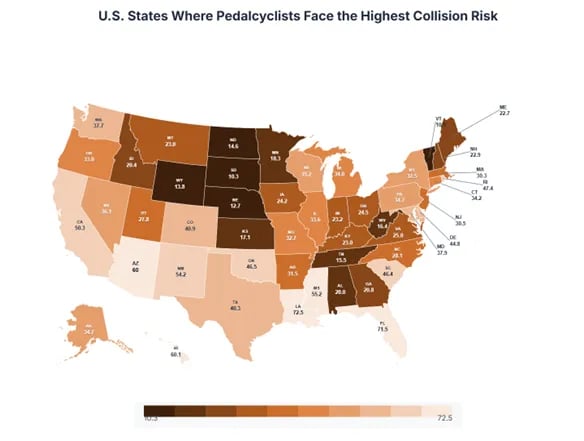
Pedal cyclists are among the most vulnerable road users in the United States, yet the danger they face varies sharply depending on where they ride. Though people frequently blame traffic volume and population size for cyclist fatalities, new data show that road quality plays a much more decisive role. In many states, crumbling infrastructure and unsafe road design significantly increase the risk of deadly collisions, even in places with fewer riders and lower overall traffic.
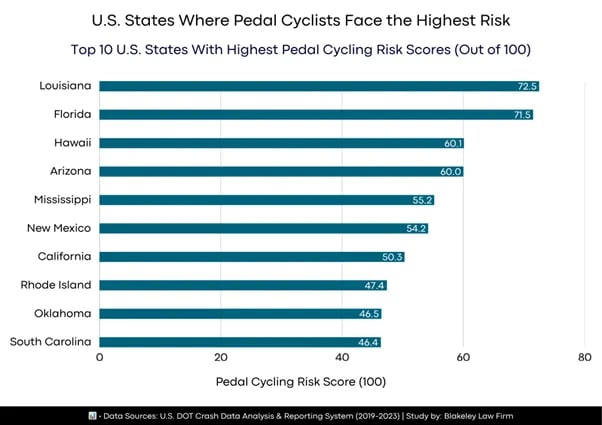
The research by Florida-based personal injury lawyer Blakeley Law Firm analyzed pedal cyclist fatalities and road conditions across all 50 states from 2019 to 2023 using data from the U.S. Department of Transportation’s Crash Data Analysis and Reporting (CDAN) system and the Bureau of Transportation Statistics. Researchers developed a composite Pedal Cycling Risk Score (100-point scale) by combining Pedal cyclist Fatality Risk (60 points) and Poor Road Condition Risk (40 points) to identify where cyclists face the greatest danger.
| Top 10 U.S. States Where Pedal Cyclists Face the Highest Risk | ||
| U.S. State | Pedal Cycling Risk Score (100) | Rank |
| Louisiana | 72.5 | 1 |
| Florida | 71.5 | 2 |
| Hawaii | 60.1 | 3 |
| Arizona | 60 | 4 |
| Mississippi | 55.2 | 5 |
| New Mexico | 54.2 | 6 |
| California | 50.3 | 7 |
| Rhode Island | 47.4 | 8 |
| Oklahoma | 46.5 | 9 |
| South Carolina | 46.4 | 10 |
Louisiana ranks first with a Pedal Cycling Risk Score of 72.5 out of 100 (49 out of 60 for pedal cyclist fatality risk and 23.21 out of 40 for poor road conditions). With an average annual population of 4,617,771 and 25.97% of roads classified as unacceptable, the Pelican State recorded an average of 34 pedalcyclist deaths per year between 2019 and 2023.
Florida ranks second with a Pedal Cycling Risk Score of 71.5 out of 100 (60 out of 60 for pedal cyclist fatality risk and 11.49 out of 40 for poor road conditions). With an average annual population of 21,941,143 and 12.86% of roads classified as unacceptable, the Sunshine State recorded an average of 197 pedal cyclist deaths per year between 2019 and 2023.
Hawaii ranks third with a Pedal Cycling Risk Score of 60.1 out of 100 (25 out of 60 for pedal cyclist fatality risk and 34.94 out of 40 for poor road conditions). With an average annual population of 1,436,788 and 39.09% of roads classified as unacceptable, the Aloha State recorded an average of 5 pedal cyclist deaths per year between 2019 and 2023.
Looking at the study, a spokesperson at Blakeley Law Firm commented:
“Pedal cyclists are often the first to suffer when road systems fail. These findings show that deteriorating pavement and unsafe road design, not just traffic volume, are major drivers of cyclist fatalities. States with larger shares of unacceptable roads consistently rank among the most dangerous places to ride, even when overall populations are relatively small.
“Targeted infrastructure repairs, safer road layouts, and better separation between cyclists and high-speed vehicles are not optional improvements; they are critical steps to prevent avoidable deaths.”
Based on the findings, experts emphasize that reducing pedal cyclist deaths requires infrastructure-focused solutions rather than awareness campaigns alone.
Key recommendations include:
- Prioritizing road repairs on cyclist-heavy corridors, particularly where pavement damage, narrow shoulders, or poor drainage increase crash severity.
- Physically separating cyclists from high-speed traffic using protected bike lanes, barriers, or redesigned road layouts.
- Lowering speed limits on shared urban and suburban roads, where even minor collisions can become fatal for cyclists.
- Improving road surface visibility, including better lighting, reflective lane markings, and hazard warnings in deteriorated areas.
- Strengthening enforcement of cyclist right-of-way laws, especially at intersections and merging points.
Methodology
The study was conducted by Blakeley Law Firm, a Florida-based personal injury law firm representing clients injured in motor vehicle accidents or those who have lost loved ones due to negligence.
The study examined pedal cyclist fatalities from 2019 to 2023 using the U.S. Department of Transportation’s Crash Data Analysis and Reporting System (CDAN). The Bureau of Transportation Statistics sourced road condition data and classified roads based on federal standards as acceptable or unacceptable.
For each state, researchers calculated:
- Average annual pedal cyclist fatalities
- Fatalities per 100,000 residents
- Pedal cyclist fatality risk score (60-point scale)
- Poor Road Condition Score (40-point scale)
- Composite Pedal Cycling Risk Score (100-point scale)
This composite score allows for fair comparisons across states by accounting for population size, infrastructure quality, and fatality risk.
Data Sources
- Crash Data: https://cdan.dot.gov/query
- Road Condition Data: https://www.bts.gov/road-condition
- Research Dataset: https://docs.google.com/spreadsheets/d/16KnzZgAOIhdB3vF1ZjEkstFY0fO1_dansjQV-13ypuo/edit?gid=1007580808#gid=1007580808
- Research by: https://www.floridainjuryadvocate.com/
Copyright © 2026 California Business Journal. All Rights Reserved.
For California Business Journal Disclaimers, go to /terms-conditions/.


