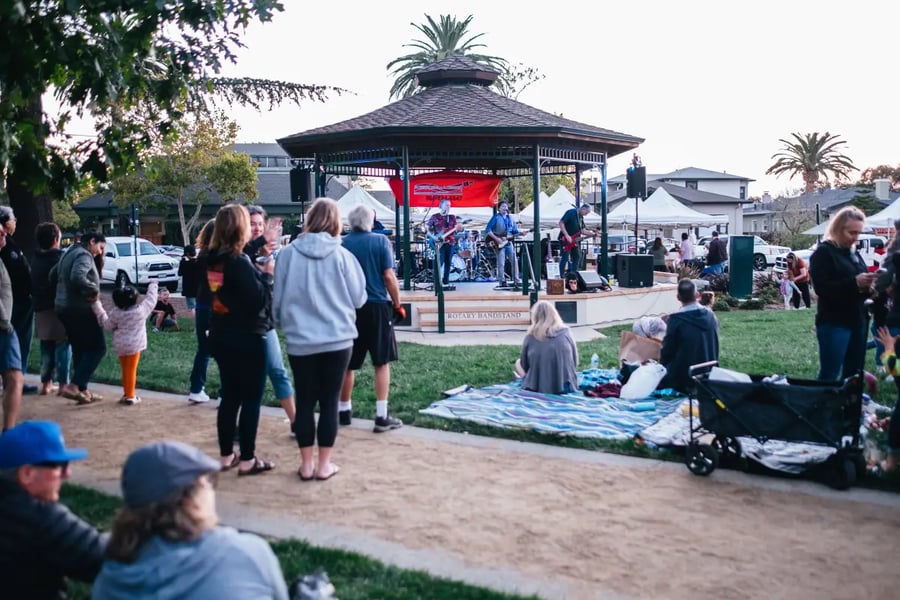
For decades, the marketing playbook for a local business was straightforward: sponsor the little league, take a booth at the school fair, put the company name on the outfield fence. It worked because communities support the businesses that support them, and because a recommendation from a neighbor carries more weight than any advertisement. Then marketing went digital, budgets followed the metrics, and community investment slid down the priority list. Not because it stopped working, but because a booth at a fair does not scale and does not produce a dashboard. In Orange County, a version of that old playbook is coming back, and it looks different than it used to.
The New face of community marketing
The change began in 2021, when college athletes gained the right to earn compensation for their name, image and likeness. What had been an informal community dynamic, local athletes as recognizable, trusted figures, became something a business could formally partner with. The case for it rests on the composition of a college athlete's audience. Unlike a celebrity, whose following is national and mostly irrelevant to a business serving one county, a college athlete's audience is made up of friends, family, teammates, classmates and local fans, most of them within a short drive of campus.
They are recognized by tens of thousands of students who live and spend money in the area, followed by local adults who track their seasons, and admired by kids in area schools. The trust research supports the approach. Nielsen's Trust in Advertising studies have consistently found that recommendations from people we know are the most trusted form of marketing, with 88 percent of consumers trusting them, ahead of every paid format.
Two early adopters
Orange County Soccer Club, which plays at Irvine's Great Park, partnered with more than 40 college athletes last season. Athletes from water polo, track and field, basketball, volleyball, tennis, and swim and dive attended matches, created content, and shared their experiences. The club framed the spend as a choice: deepen its relationship with the community rather than buy more Instagram advertising.
World of Racing in Tustin, a sim racing venue that describes itself as the largest on the West Coast, took the same approach with a different shape. Athletes came in to race, the visits produced content, and the experiences became stories told back on campus. Between the two campaigns, the athletes reached the combined 80,000-student populations of UC Irvine and Cal State Fullerton and roughly 400,000 social media followers, concentrated largely in Orange County. Full breakdowns of both campaigns are available in case studies.
Why now
Three forces are converging to push local businesses back toward community-based marketing. The first is cost. Digital advertising prices have climbed steadily while local targeting remains imprecise, meaning a growing share of local ad budgets reaches people who will never become customers. The second is attribution fatigue. Offline advertising was always hard to measure, and digital platforms, for all their reporting, still leave small businesses guessing about who actually saw their ads and where. The third is supply. Orange County is home to two major universities and thousands of college athletes, most of whom are actively looking for partnership opportunities in the community where they live and compete. Five years ago this channel did not legally exist. Today it is largely unclaimed.
The scalability question
The historical weakness of community marketing was that it could not scale. A sponsorship here, a charity event there, each one negotiated by hand. That is the gap platforms are now filling. Contested, the platform behind the OCSC and World of Racing campaigns, gives businesses everything they need to run athlete partnerships themselves, from matching to contracts to payment, which turns what used to be a series of one-off arrangements into a repeatable channel. For local businesses, the strategic question is the same one the little league sponsorship answered decades ago: who does this community already trust, and how does a business earn a place alongside them? The mechanism has changed. The principle has not.
Copyright © 2026 California Business Journal. All Rights Reserved.
For California Business Journal Disclaimers, go to /terms-conditions/.


