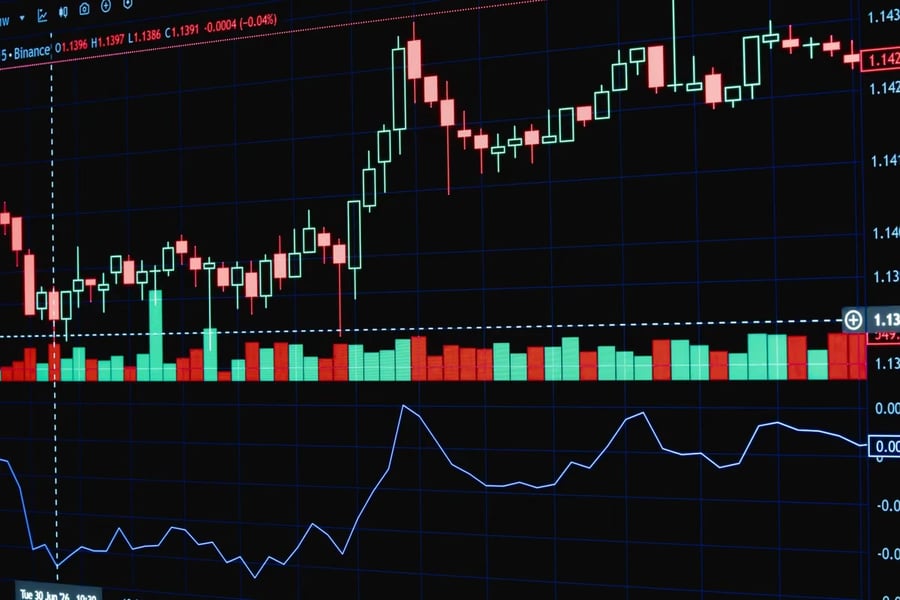
Guesswork is part of every stock-buying decision. Every retail investor knows what it’s like to settle on a stock, then hesitate: maybe the price is too high, or maybe it will dip next week. Yet wait too long and the moment goes; or rush in, and you might buy the top.
AI stock signals promise to reduce some of this guesswork, but not all of it. They provide a structured, objective read on the conditions surrounding the stock so that retail investors can make informed decisions, but can they tell us when to buy?
What AI can and can’t tell you about entry points
AI promises a new level of data analysis. It can process huge volumes of data faster than any team of humans, and it does so without emotion. It can spot chart patterns, detect changing market sentiment, and track large investor moves.
Yet for all its benefits, it cannot tell you what will happen next, so using it to find entry points is about weighing probabilities rather than certainties. Instead, it often comes down to a psychological judgement call to decide whether an opportunity is genuine.
6 AI trading tools that give traders an objective read on market entry points
Tool | What it reads | Gives signals? |
|---|---|---|
IUX24 | Market sentiment, institutional flow, news | No |
Danelfin | Technical, fundamentals, sentiment | AI ratings |
TrendSpider | Technicals across most access classes | Pattern alerts |
|---|---|---|
Tickeron | Chart patterns, breakouts, confidence level | Entry and exit signals |
Prospero | Options flow, institutional activity, social sentiment | Buy and sell signals |
TradeZella | Your own trading history | No |
|---|---|---|
The tools below all use AI to give you a clearer read around each stock, but leave the final buying decision with you.
1. IUX24: A read on market conditions
IUX24 is an AI investment intelligence platform. It uses AI-driven analysis to describe the conditions around a trade so retail investors can access the kind of market insight that’s normally the reserve of institutional traders.
Central to its platform is the Xurve AI Analyst. This draws on news, sentiment, and technical data to answer questions in plain, conversational English, including whether a move looks influenced by news or emotion.
IUX24 also uses AI to track the shifts in market sentiment, while its Dark Pool Tracker (in beta) monitors large off-exchange institutional trades. Investors new to this concept can read this how dark pool trading works.
What IUX24 reads: Market sentiment, institutional flow, and the latest news.
What it can’t tell you: When to enter the market.
Price: Free during early adoption.
Note: IUX24 is not a broker and is not affiliated with IUX24 Markets. It does not issue buy or sell signals.
2. Danelfin: AI stock ratings
Danelfin uses AI to grade US and European stocks according to certain market signals so that investors can estimate how likely they are to outperform the market. These are not predictions but are a useful way to compare stocks and shortlist candidates before doing your own research.
What Danelfin reads: Technicals, fundamentals, sentiment.
What it can’t tell you: precise timing; scores are probabilities, not predictions.
Price: There’s a free tier, and paid plans start from $22/month.
3. TrendSpider: Automated technical analysis
TrendSpider spots trendlines and chart patterns automatically using machine vision, a form of chart-reading AI. Traders can then use this information to backtest entry rules before investing.
What TrendSpider reads: Technicals across most asset classes.
What it can’t tell you: How news or sentiment will move a chart
Pricing: There are many pricing tiers available to view on their website, starting at just under $70 for the first month, followed by an increase for subsequent months.
4. Tickeron: AI pattern signals
Tickeron uses AI to issue entry and exit signals by scanning huge swathes of market data for patterns. It does this across stocks, ETFs, forex, and crypto.
What Tickeron reads: End-of-day patterns, breakout and target prices, confidence levels, and historical performance.
What it can’t tell you: How long a pattern will hold.
Pricing: The beginner tier starts at $5 a month.
5. Prospero: Options-driven signals
Prospero translates options market activity into simple signals that investors can view in its free app. Its Net Options Sentiment score, which refreshes every few minutes, sums up this information at a glance.
What Prospero reads: Options flow, institutional activity, social sentiment.
What it can’t tell you: Where institutions stand right now. The Net Options Sentiment score is near-real time, yet filing data can lag six weeks or more, so it can’t give a current read on institutional positions.
Pricing: Free, with a paid newsletter option.
6. TradeZella: Your Own Entry History
TradeZella’s Zella AI analyzes your trading journal to show where past entries worked and where they didn’t, something that sets it apart from the other tools on this list.
What TradeZella reads: Your trading history
What it can’t tell you: Actual market data
Pricing: From $26/month, billed annually.
Note: For all prices at time of writing; check vendor sites.
When is the best time to buy a stock?
There is no objectively perfect time to buy a stock. Instead, investors can improve their chances of a better-informed entry decision by combining their research and time horizon with an objective analysis on market conditions. They should also know how to size each position so a wrong call doesn’t do lasting damage.
The best AI trading platforms can help to inform that process, but none can reliably predict the best entry point.
Summary
AI-driven trading tools look set to democratize market intelligence by giving individual traders access to information that historically only institutions could view. However, it should never be used as a crystal ball.
Investors should always combine AI insights with their own research and treat every AI-generated signal as a starting point rather than a verdict.
This article is for informational purposes only and is not investment advice. Trading involves risk, including the loss of capital.
Copyright © 2026 California Business Journal. All Rights Reserved.
For California Business Journal Disclaimers, go to https://calbizjournal.com/terms-conditions/.


