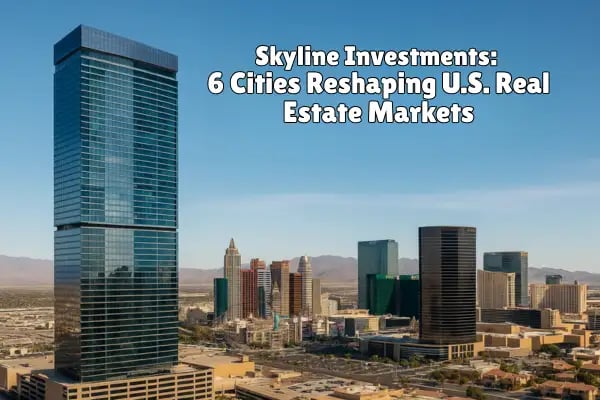
Over the past decade, luxury real estate has evolved into the most visible expression of economic confidence. From the rebirth of downtown Los Angeles to the glass canyons of Miami Beach, from tech-fueled Seattle to tax-friendly Las Vegas, the map of opportunity is shifting — fast. High-rise ownership is now both a business decision and a lifestyle play. In a market where capital mobility defines success, the smartest investors are aligning their portfolios with cities that deliver three things: growth, global visibility, and enduring desirability.
1️⃣ Las Vegas, Nevada — The Waldorf Astoria Residences and the New Era of Prestige
Few cities have reinvented themselves as fast or as successfully as Las Vegas. Once viewed primarily as a playground, it has become one of the most sophisticated luxury markets in America. At the center of this transformation stands the Waldorf Astoria Residences Las Vegas, where global hospitality meets private ownership. The development symbolizes the merging of high-net-worth lifestyle and wealth strategy — buyers are not just purchasing real estate, but a globally recognized brand backed by world-class service.
Beyond CityCenter, demand for properties such as Queensridge condos for sale demonstrates the city’s diverse luxury market. Buyers can choose between ultra-modern Strip residences and refined, master-planned communities. With Nevada’s tax-friendly climate, ongoing population growth, and global investment appeal, Las Vegas is not just a lifestyle destination but also an exceptional business and wealth strategy.
Why Las Vegas Leads:
- Waldorf Astoria Residences redefine Strip-front exclusivity and five-star amenity living.
- Nevada’s 0% state income tax attracts executives from California and abroad.
- Strong rental yield: 6–8 % for furnished high-rise condos with STR licensing.
- Over 45 million annual visitors create a consistent high-end short-term rental pipeline.
- Submarkets like Queensridge and The Ridges balance privacy with proximity.
2️⃣ New York City, New York — Global Benchmark for Skyline Wealth
New York remains the gravitational center of global luxury real estate. From Billionaires’ Row’s Central Park Tower and 432 Park Avenue to Hudson Yards and Tribeca Penthouses, Manhattan’s skyline continues to set the tone for global capital. For CalBizJournal readers, New York represents the “gold-standard hold” — an asset that transcends cycles.
Despite fluctuations in foreign-buyer taxes or lending rates, the city maintains liquidity. Ultra-high-net-worth individuals view Manhattan penthouses as both wealth insurance and cultural statement. The density of finance, fashion, and media ensures that demand for prestige addresses never fully disappears.
Why NYC Remains Strong:
- International buyers from 70+ countries maintain deep liquidity.
- Median luxury price (2025): $4.2 million; up 11 % year-over-year.
- Architecture as status: 432 Park, 111 W 57th, Central Park Tower remain global icons.
- Institutional investors increasingly enter branded residence developments.
- Cultural capital + heritage preserve property prestige and resale value.
3️⃣ Miami, Florida — Where Oceanfront Meets Opportunity
If Las Vegas is the West’s new luxury capital, Miami is its East Coast counterpart. Once driven by second-home buyers, Miami’s luxury market has matured into a global ecosystem powered by international wealth. Branded residences — Ritz-Carlton, St. Regis, Armani Casa — now dominate the skyline, offering investors the dual appeal of turnkey living and consistent rental income.
Miami’s tax advantages mirror Nevada’s — no state income tax — while its cultural vibrancy and oceanfront access create a quality of life unmatched in the U.S. Its demographic influx — CEOs relocating, tech firms expanding, and hedge-fund managers establishing residency — cements Miami as a hybrid between lifestyle and logistics hub.
Why Miami Appeals:
- 48 % of new-development buyers are foreign investors (Latin America + Europe).
- Oceanfront branded residences average $2,200 per sq ft (2025).
- Tourism economy sustains high-yield STR and seasonal rental models.
- Stable political climate + crypto/tech inflow diversify buyer base.
- “Wall Street South” migration ensures sustained capital inflow.
Conclusion
Luxury real estate in the U.S. is no longer confined to heritage markets like New York and Miami. Las Vegas has firmly entered the conversation, with the Waldorf Astoria Residences Las Vegas redefining skyline living through global prestige, Strip-front exclusivity, and lifestyle innovation. At the same time, properties like Queensridge condos for sale highlight how the city balances contemporary urban luxury with refined residential communities.
For California Business Journal readers — the entrepreneurs, CEOs, and investors shaping tomorrow’s economy — these six cities represent not just geographic choices but strategic allocations. The luxury high-rise has evolved from an architectural statement into a financial instrument: a hedge against inflation, a lifestyle yield generator, and a credibility symbol in the world of business mobility.
Copyright © 2025 California Business Journal. All Rights Reserved.
For California Business Journal Disclaimers, go to /terms-conditions/.


