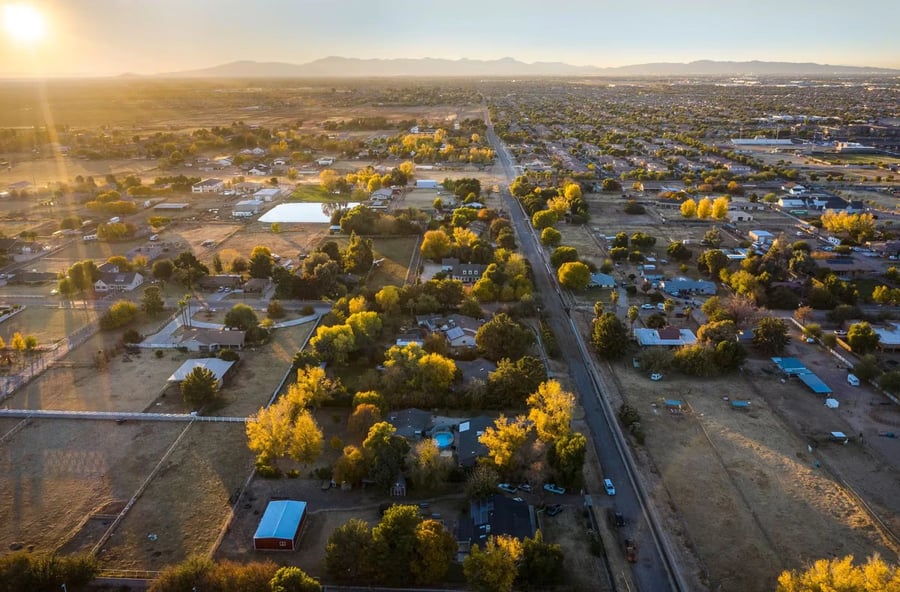
Picture dropping a small town into a single county, every single year, without pause. That's not a thought experiment — it's Arizona's present reality. Maricopa County added 57,471 new residents between July 2023 and July 2024 alone, which works out to roughly 173 people showing up each day. They come for the sun, the jobs, and the relatively accessible cost of living compared to coastal metros. But once they arrive, they discover something the relocation brochures don't mention: a region still sprinting to catch up with itself.
Growth at this scale reshapes everything. Roads, schools, housing stock, professional services, neighborhood character — nothing stays static when a county adds a mid-sized city worth of population annually. Understanding what's actually driving this boom, and what it costs the people already living here, tells a more honest story about one of the most watched migration corridors in the country.
The Numbers Behind the Migration Wave
Arizona doesn't just grow fast. It grows fast consistently. Since the 2020 Census, the state's population has increased by more than 460,000 people, a 6 percent jump, and roughly 97 percent of that surge has come from net migration rather than natural population increase. That last detail matters. Arizona isn't growing because birth rates are soaring. It's growing because people are making deliberate choices to leave other states and plant roots here.
The reasons are predictable but worth naming. Lower state income taxes compared to California, a relatively affordable housing market before 2022's price run-up, year-round outdoor access, and a booming tech and semiconductor sector in the East Valley have all combined to make the Phoenix metro one of the most attractive relocation targets in the country for working-age adults and retirees alike.
According to a 2025 report from the Arizona Office of Economic Opportunity, the state now holds 7.6 million residents, with nearly one in five Arizonans now aged 65 or older — a demographic cross-current that's already reshaping demand for everything from healthcare to housing design. The growth isn't uniform, and that unevenness creates its own set of pressures.
What "Arrival Pressure" Actually Feels Like
There's a concept worth naming here: arrival pressure. It's the gap between how fast people move in and how fast the surrounding infrastructure can absorb them. Phoenix and Scottsdale have been living inside that gap for years, and the friction shows up in ways both obvious and subtle.
Traffic is the most immediate symptom. The Valley's road network was built for a different era. Arterials designed for a metro of three million now carry the load of a region approaching five. Commute times have extended in nearly every corridor, and the I-10 and Loop 101 show congestion patterns during mid-morning hours that wouldn't have existed a decade ago.
Then there's housing. Demand consistently outpaced supply through the early 2020s, driving median prices to levels that locked out many of the service workers, teachers, and first responders the region depends on. The construction sector accelerated, but land constraints in the urban core pushed development further into the Southeast Valley and into Pinal County, which saw its own 21.5 percent population gain since 2020.
Schools face similar pressure. Districts across the East and West Valley have opened new campuses at a pace that would have seemed aggressive even during the pre-2008 boom years. Teacher recruitment has become a competitive sport, with signing bonuses and housing stipends entering conversations that would have seemed foreign to Arizona education administrators ten years ago.
The Professional Services Surge
A population boom doesn't just stress public infrastructure. It also creates enormous demand for private professional services — and that demand has drawn practitioners across nearly every field into the Valley. Scottsdale, in particular, has become a hub for boutique and specialized service providers who follow affluent migration flows.
Medical practices, financial advisory firms, architecture studios, and legal offices have all expanded or relocated to capture a client base that's wealthier, more educated, and more demanding of personalized service than the national average. Boutique operators have a real advantage here. Newcomers arriving from major metros aren't looking for a transactional experience — they're used to specialists who know their names.
Firms like Kwasman Law represent exactly the kind of specialized, client-focused practice that has found fertile ground in the Valley's growth environment, where the sheer volume of new residents creates constant demand for personalized legal guidance.
This dynamic also means the professional landscape has grown more competitive. A market with 173 new arrivals per day is attractive to practitioners everywhere, so the Valley doesn't just attract clients — it attracts competition. Established local practices have had to raise their service standards to hold ground.
What the Census Data Tells Us About Where This Is Heading
The U.S. Census Bureau's QuickFacts data for Arizona puts the state's growth in national context: Arizona ranks among the top states for both total numeric growth and percentage growth over the past decade, outpacing the national average by a significant margin during most measured periods. Maricopa County itself ranked third nationally for numeric growth in the most recent annual estimates, trailing only Harris County, Texas and Miami-Dade County, Florida.
The projection curve is steep. If current trends hold, Arizona will need to accommodate millions more residents over the next few decades. State planners are already grappling with water supply questions, since the Colorado River compact that feeds the Central Arizona Project was designed for a different era's population assumptions. That's the honest constraint underneath all the optimism: growth at this pace eventually collides with physical limits.
But those limits aren't stopping the inflows yet. California continues to export both residents and businesses. Remote work has decoupled housing choices from employer geography. And Arizona's business-friendly regulatory environment keeps drawing corporate relocations that bring white-collar employment with them.
How Existing Residents Navigate the Transformation
For people who were already here before the boom accelerated, the experience is genuinely mixed. Property values have appreciated in ways that benefit homeowners while making the region less accessible to younger residents trying to buy in. Neighborhoods that felt local and uncrowded a decade ago now carry more traffic, more development, and more anonymity.
There's a real loss inside the growth story that doesn't get enough attention. The Scottsdale of 2015 was a different place than the Scottsdale of 2025, and not entirely in ways that long-timers celebrate. Scale erodes intimacy. Chain concepts fill spaces that independents used to occupy. The character that attracted people in the first place can get diluted by its own success.
But it's not a simple negative story either. The cultural diversity that migration brings is genuine and enriching. Restaurant scenes deepen. Arts communities grow. Talent concentrations create unexpected collaborations. Phoenix's music, food, and design scenes are measurably richer than they were fifteen years ago, in large part because of the human capital arriving from elsewhere.
The question worth sitting with isn't whether Arizona's growth is good or bad — it's whether the state can build the civic infrastructure fast enough to preserve the quality of life that made people want to come here in the first place. That's a policy and planning challenge with no clean answer. But it's the right question, and it deserves to stay at the center of every conversation about what the Valley is becoming.
Copyright © 2026 California Business Journal. All Rights Reserved.
For California Business Journal Disclaimers, go to https://calbizjournal.com/terms-conditions/.


