Last Thursday, my sister sent me a photo with no context—just a woman's face staring back at me with unsettlingly familiar eyes. I studied it for a solid thirty seconds before the realization hit: that was me. Or rather, some alternate-universe version of me that shared my exact genetic code but took a different chromosomal path.
"Creepy, right?" her text came through. "But also kind of amazing?"
She was right on both counts. There's something profoundly strange about seeing your own features—the nose you inherited from your grandfather, the eye shape that matches your mother's—rearranged into a face that's simultaneously you and not you. It's like finding a photograph of a sibling you never knew existed.
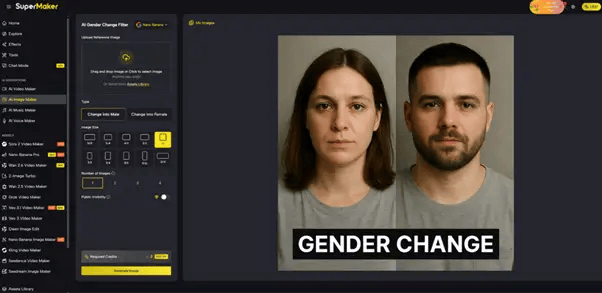
This wasn't my first encounter with gender transformation technology. I'd tried the novelty apps years ago and been thoroughly unimpressed by the crude results. But my sister insisted this was different, so I decided to investigate properly. What I discovered was that AI Sex Change technology has quietly evolved from party trick to something genuinely sophisticated—and unexpectedly revealing about how we perceive identity itself.
Why This Curiosity Feels Universal
Here's something I noticed while researching this: almost everyone I mentioned this topic to immediately wanted to try it themselves. Not in a frivolous way—there was genuine curiosity beneath the nervous laughter.
How 2026 Technology Differs From What Came Before
I still have screenshots from gender swap apps I tried in 2020. Looking at them now is almost embarrassing—they're so obviously fake that I can't believe I ever thought they were impressive.
| Comparison Factor | 2020-2022 Apps | 2026 AI Technology |
| Processing Method | Surface filters and overlays | Deep facial reconstruction |
| Feature Recognition | Basic detection (10-15 points) | Advanced mapping (60+ markers) |
| Gender Interpretation | Stereotypical additions | Anatomical transformation |
| Detail Preservation | Lost personal characteristics | Maintains individual features |
| Processing Time | 30-60 seconds | 10-15 seconds |
| Multi-face Support | Single face only | Group photos supported |
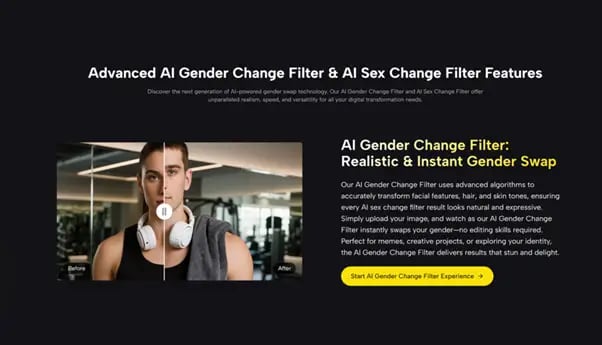
The breakthrough isn't just more computing power—it's a fundamental shift in approach. Earlier apps asked "how do we make this face look like the opposite gender?" Current technology asks "how would this person's facial structure have developed differently?"
Applications Beyond Entertainment
The Genealogy Connection
I transformed old photographs of my great-grandparents from the 1940s. Seeing my great-grandfather as a woman revealed a striking resemblance to my mother that I'd never noticed in the original photos. It became a tool for understanding genetic inheritance patterns visually.
The Personal Identity Dimension
Several people I spoke with who are transgender or gender-questioning found value in seeing realistic versions of themselves. Not as a decision-making tool—identity is far more complex than appearance—but as one piece of a larger self-understanding puzzle.
Getting Results Worth Sharing
After extensive testing, clear patterns emerged about what produces the most realistic results:
- Optimal Lighting: Soft, even lighting works best—think overcast day or window light with sheer curtains
- Camera Position: Straight-on or slight angles (15-20 degrees) produce better results than extreme angles
- Expression Strategy: Slight smiles or neutral expressions transform most naturally
- Background Simplicity: Simple, contrasting backgrounds produce cleaner results
- Resolution Matters: Photos at 1080p or higher give consistently good outcome
The Honest Limitations
The Consistency Challenge
I uploaded the same photo three times on different days. The results were similar but not identical—subtle variations in hair length, exact facial proportions, and expression intensity. It's sophisticated, but not perfectly reproducible.
The Uncanny Valley Risk
About one in every eight transformations hit that uncomfortable "almost but not quite human" zone. Usually this happened with photos that had challenging lighting or unusual expressions.
The Verdict
After extensive testing, here's my honest assessment: AI Video Generator Agent has matured into something genuinely interesting. It's not perfect—you'll occasionally get uncanny results, photo quality matters significantly, and you might need multiple attempts for optimal outcomes. But when it works well, it produces results that are thought-provoking rather than just amusing.
Whether you try it out of curiosity, creative need, or deeper self-exploration, the barrier to entry is essentially zero. The question that used to require imagination alone now has a visual answer—imperfect, algorithmic, but surprisingly compelling.
Copyright © 2026 California Business Journal. All Rights Reserved.
For California Business Journal Disclaimers, go to /terms-conditions/.


