
Quantum computing has left the lab. On August 13, 2024, NIST released the first official quantum-resistant algorithms and told federal agencies to start migrating. Analysts peg the post-quantum security market at about $0.9 billion in 2025, rising to $4.6 billion by 2030—a 39 percent CAGR. A White House memo already compels every agency to inventory vulnerable cryptography by May 2023 and eliminate it by 2035. Boards, insurers, and attackers took note: harvest-now-decrypt-later is in full swing. Cloud giants now run hybrid PQC TLS, and venture capital is pouring into specialists racing to make the transition painless.
In the pages ahead, we spotlight nine companies turning that urgency into production-ready code you can deploy today.
How we selected these companies
We didn’t pull these nine names from a hat. Our team reviewed more than 20 contenders across software, hardware, and quantum communications, then trimmed the list.
First, we asked a simple question: Is technology real today? Proof meant running code, paying customers, or published benchmarks, not concept slides.
Next came a five-factor scorecard that kept us honest:
- technological maturity
- innovation and IP strength
- market traction and funding
- leadership credibility
- alignment with NIST and other open standards
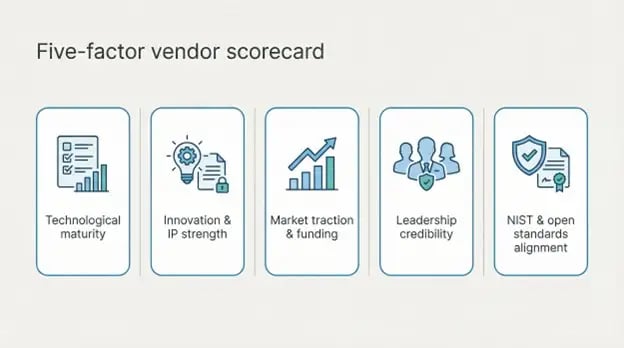
Each factor mattered, so a startup with exciting research but no pilot lost ground to a quieter firm already protecting production traffic.
We also cared about balance. You need a mix of chip-level IP, cloud orchestration, crypto inventory tools, and quantum key distribution to cover every angle of the threat. A lineup of nine SaaS vendors wouldn’t cut it.
Finally, we pressure-tested the list against one guiding principle: Would we call this company if our own encryption were on the line? Each of the nine earned a confident yes.
1. Project 11 – guarding digital assets before Q-Day arrives
 Project 11 homepage screenshot showcasing quantum-safe blockchain security
Cryptocurrency networks rely on math that future quantum machines could break. New York–based Project 11 addresses that risk head-on.
The startup’s flagship tool, Yellowpages, produces quantum-safe keys for Bitcoin and other blockchains, letting exchanges and custodians roll out protected wallets without rewriting their entire stack. Engineers can also pull from its open-source libraries of NIST-approved algorithms or spin up a Solana testnet that runs those ciphers end to end.
Momentum came quickly. In January 2026 Project 11 closed a 20 million-dollar Series A led by Castle Island and Coinbase Ventures, lifting total funding to 26 million. Former Special Operations officer Alex Pruden has built a team of lattice-crypto PhDs and former NSA engineers who guide complex migrations for banks and exchanges.
Project 11’s mission is blunt: move trillions in digital assets to post-quantum safety before attackers gain a fault-tolerant quantum machine. Their early traction and the ticking clock over every blockchain make them the crypto world’s company to watch this year.
2. SandboxAQ – enterprise-scale crypto agility
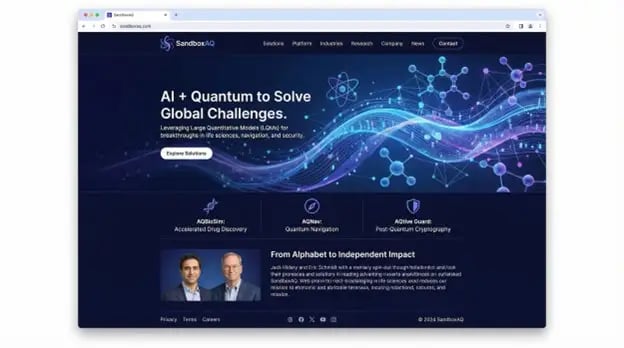
SandboxAQ website screenshot highlighting enterprise crypto-agility platform
SandboxAQ spun out of Google’s research lab with a single aim: help large organizations replace vulnerable encryption before deadlines become crises.
The platform begins with discovery. Automated scanners sweep source code, binaries, and network traffic to flag every RSA, ECC, or SHA-1 holdout. Next comes orchestration: a policy engine pushes NIST-approved algorithms such as CRYSTALS-Kyber across databases, containers, and mobile apps while keeping classic crypto for backward compatibility. A compliance dashboard then shows regulators tangible progress instead of slideware.
Scale sets SandboxAQ apart. Backed by several hundred million dollars and staffed by members of Google’s early quantum team, it already guides migrations at global banks and defense agencies. Clients appreciate the cradle-to-go-live rhythm: inventory, upgrade, validate, repeat.
If your environment spans mainframes, Kubernetes clusters, and edge devices, you need a choreographer fluent in every dialect. SandboxAQ turns a maze of legacy encryption into a managed, measurable program.
3. QuSecure – post-quantum security orchestration
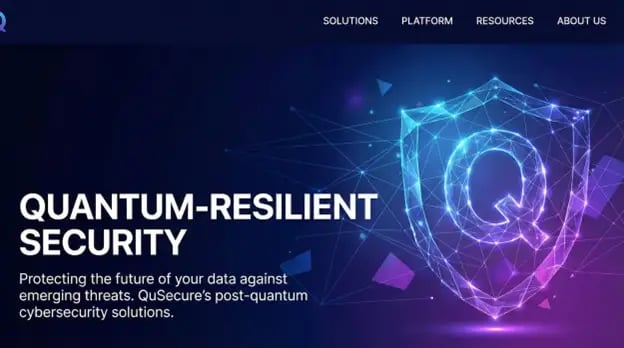
QuSecure website screenshot featuring QuProtect post-quantum security gateway
QuSecure believes moving to quantum-safe encryption should feel like a routine software update, not a forklift upgrade.
Its QuProtect platform sits in front of existing networks and applications, negotiating hybrid TLS or VPN sessions on the fly. Classic and post-quantum algorithms run side by side, so legacy endpoints keep working while modern ones gain new protection. A central console sets policy, rotates keys, and logs every handshake for auditors, turning cryptography into a managed service.
Government pilots proved the model early. QuSecure encrypted traffic for a U.S. federal network, then extended the same stack to satellite links and cloud workloads. Recent funding from defense-focused investors and Accenture gives the team room to expand support and performance engineering.
Speed is the draw for security leaders. Drop the gateway in place, point traffic at it, and you’re testing Kyber and Dilithium in production by lunchtime. When NIST approves new algorithms, QuSecure promises they will arrive as another automatic update. That agility, paired with a real-world track record, makes the company a smart partner for organizations that want progress this quarter, not next decade.
4. PQShield – hard-wiring post-quantum security into silicon
Software patches help, but some systems need protection baked in at the transistor level. PQShield, spun out of Oxford research, delivers by licensing chip-ready cores for Kyber, Dilithium, and other NIST algorithms.
Manufacturers slot the IP into secure elements, smartcards, and hardware security modules, gaining quantum-safe operations without ballooning power budgets or code size. On the software side, lightweight libraries give developers a matching toolbox, so devices and servers speak the same new language.
Standards influence is a key advantage. PQShield engineers steer committee discussions, then ship reference code in weeks, not months. Automotive firms, IoT suppliers, and cloud HSM vendors already rely on that pace to stay compliant and competitive.
If your roadmap involves silicon hitting production next year and running in the field until 2035, you need cryptography that ages gracefully. PQShield provides exactly that, long before the final countdown.
5. Post-Quantum – a decade of field tests and counting
While most startups were still in stealth, London-based Post-Quantum was already stress-testing quantum-safe VPNs for the UK government.
Today its suite secures messaging, voice, and full-tunnel VPN traffic with lattice algorithms. Years of red-team drills with the National Cyber Security Centre produced a stack that works with Cisco routers and legacy PKI, sparing agencies a forklift swap-out.
Time in the field pays off. The firm holds a deep patent library, including early NIST candidate NTS-KEM, and clients can point to repeatable pilots rather than lab demos. In a 2024 test, it moved confidential data between two government sites with negligible latency, proving that post-quantum performance is ready for prime time.
If you safeguard classified or life-safety data and need assurance now, Post-Quantum offers a path built on real deployments, not promises.
6. QryptoCyber – finding every weak link before attackers do
Most organizations still don't know where their cryptography lives. QryptoCyber solves that blind spot.
The platform crawls source code, servers, and third-party libraries to create a cryptography bill of materials that lists every RSA key and expired certificate in plain English. A built-in risk engine scores each finding by business impact, so teams fix what matters first instead of drowning in scan noise.
Early bank pilots uncovered thousands of hard-coded 1,024-bit keys nobody remembered deploying. Security leaders finally had evidence to fund migrations and a dashboard that tracks progress against federal inventory mandates.
Quantum-safe plans stall without visibility. CryptoCyber turns discovery from a spreadsheet chore into an automated, board-ready report, giving you the clarity you need before any large-scale crypto swap.
7. ISARA – hybrid certificates for a smooth transition
Every modern network runs on digital certificates. Swap the cryptography inside those certificates and you can upgrade an entire enterprise without users noticing. That's ISARA's specialty.
The Waterloo team created hybrid certificates that pair a classic RSA or ECC signature with a post-quantum one such as Dilithium. Legacy devices validate the old part, newer devices validate the quantum-safe part, and traffic keeps flowing while you retire weak math.
This design has earned ISARA seats at standards bodies and partnerships with certificate authorities, hardware makers, and automotive suppliers that need secure firmware updates for a decade or more. The Radiate toolkit extends the same crypto-agile approach to code signing and secure boot, giving developers drop-in components instead of from-scratch rewrites.
If you manage a sprawling PKI and dread a weekend-long cutover, ISARA offers a way to phase in PQC with no broken trust chains and no midnight migration war rooms.
8. ID Quantique – quantum keys powered by physics
Mathematical defenses are strong, but physics raises the bar. Geneva-based ID Quantique turns single photons into encryption keys that no classical or quantum computer can copy without detection.
ID Quantique Cerberis QKD and Quantis QRNG official hardware photo
Its rack-mounted QKD systems already protect data-center links for banks and government agencies. They send quantum particles over fiber, detect any eavesdropping attempt, and trigger instant key regeneration. Companion QRNG chips feed true randomness to satellites, smartphones, and hardware security modules, giving cryptography the entropy it needs.
Twenty years of deployments make ID Quantique a benchmark in quantum communications. That track record drew IonQ, which plans to acquire the company and combine QKD with cloud quantum-computing services. The deal shows hardware and quantum-safe networking are converging into full-stack offerings.
When a leak is unthinkable, whether in a sovereign network, critical infrastructure, or a high-value trade, algorithms alone aren't enough. ID Quantique's physics-based approach adds a final, uncompromising layer of assurance.
9. Qrypt – keyless encryption from cloud-delivered entropy
Qrypt rewrites key exchange. Instead of sending keys over the wire, its service lets both endpoints generate the same one-time pad locally from synchronized streams of quantum randomness.
Here’s how it works. Qrypt pulls entropy from national-lab quantum sources and delivers it to customer apps through a hardened cloud API. Devices blend that entropy with local noise to create identical keys that never cross the network. An eavesdropper sees nothing worth stealing, and a future quantum computer has nothing to crack.
The approach drew early trials with telecom carriers and investment from In-Q-Tel, which values secure field communications where bandwidth is tight but secrecy matters. Developers use Qrypt’s SDK to harden messaging, backups, and password vaults without redesigning protocols.
If your threat model asks, “What if the key exchange gets recorded today and broken tomorrow?” Qrypt’s stateless design closes that risk through a few API calls.
10. EigenQ: Extending Post-Quantum Security Beyond Encryption
The shift to post-quantum security is no longer a distant technology forecast. U.S. government mandates and standards, such as CNSA 2.0, are turning it into an infrastructure priority for federal agencies, national security systems, contractors, and technology suppliers.
Replacing vulnerable encryption is only part of that transition. Organizations must also know that the hardware and software handling sensitive information have not been compromised.
EigenQ, Inc. (“EigenQ”) approaches the challenge as a broader systems-security problem. EigenQ combines post-quantum cryptography with technology that protects device identity and verifies that critical systems are operating as expected.
EigenQ provides a practical migration path that allows organizations to upgrade the security of existing servers, industrial equipment, and edge devices rather than replace entire technology environments. This approach can reduce cost and operational risk while helping government and critical infrastructure operators meet evolving security requirements and keep essential systems in service.
| Company | Core Focus | Flagship Offering | Key Proof Point | Funding | Typical Use Case |
| EigenQ | Quantum technologies spanning cybersecurity, computing, and networking | PQC+™ Security Platform | Integrated QRNG, post-quantum cryptography, and workload attestation | Undisclosed | Quantum-safe infrastructure for servers, critical infrastructure, industrial systems, and edge devices |
Quantum-safe solutions comparison chart
| Company | Core focus | Flagship offering | Key proof point | Funding (USD) | Typical use case |
| Project 11 | Blockchain security | Yellowpages PQ wallets | Bitcoin-ready keys live in testnet | 26 M | Crypto exchanges securing assets |
| SandboxAQ | Enterprise crypto agility | Discovery-to-deployment platform | Fortune 500 migrations in progress | 500 M+ | Bank-wide upgrade of TLS, VPN, code signing |
| QuSecure | PQC as a service | QuProtect gateway | U.S. federal network pilot | 28 M | Rapid hybrid TLS overlay for multi-cloud |
| PQShield | Silicon IP | Kyber / Dilithium hardware cores | Adopted by chipmakers | 37 M | Smartcard or HSM refresh cycle |
| Post-Quantum | Secure comms | PQ VPN & messaging suite | UK NCSC field tests | Undisclosed | Government site-to-site links |
| QryptoCyber | Crypto inventory | CBOM risk platform | Banks found thousands of legacy keys | Seed | Road-map planning and budget sizing |
| ISARA | PKI transition | Hybrid certificates | Partnered with major CAs | Venture | Enterprise-wide certificate rollover |
| ID Quantique | Quantum key distribution | Cerberis QKD & Quantis QRNG | Deployed on national fiber routes | Strategic acquisition | Data-center interconnect for critical infra |
| Qrypt | Keyless encryption | Cloud entropy API & SDKs | Telecom carrier trials | 10 M+ | Field comms with zero key exchange |
Key considerations when adopting quantum-safe tech
Switching to post-quantum security is more about disciplined project management than grand gestures. We’ve watched teams spend months debating algorithms while legacy certificates expire in production. Start with basics.
Budget early and realistically. Most organizations direct about five percent of this year’s cyber spend to post-quantum work. Line items cover discovery tools, new hardware modules, and the professional services that connect it all. Spread spending across two or three fiscal cycles; the migration is a marathon, not a sprint.
Performance matters, but don’t let it paralyze you. Hybrid TLS handshakes add only a few milliseconds on modern links, and chip vendors already offer accelerators that claw that back. Pilot in one business unit, measure the impact, then scale with confidence.
Compliance is the real clock. Federal deadlines march toward 2035, and insurers expect clear plans even sooner. Work with vendors who sit on standards committees or publish interoperability results. That inside track keeps you aligned with whatever NIST approves next.
Integration beats features. A brilliant algorithm that can’t plug into your key manager or CI/CD pipeline will stall. Look for crypto-agility switches: the ability to run classical and quantum-safe modes side by side, swap algorithms without reinstalling client software, and audit every key touch.
Finally, test the company, not just the code. Ask:
- Which NIST algorithms are fully supported today?
- Can we roll out in hybrid mode and move to PQC later without downtime?
- What performance data do you have from environments like ours?
- How is the product updated if an algorithm weakens?
- What third-party audits or certifications support your claims?
Conclusion
Quantum-resistant algorithms are here, deadlines are approaching, and attackers aren’t waiting. The nine companies profiled above demonstrate the diverse strategies—from silicon IP to cloud-delivered entropy—that enterprises can deploy today. Pair their innovations with disciplined planning, phased rollouts, and continuous auditing, and your organization will be well on its way to a quantum-safe future.
FAQ – your post-quantum questions answered
- When should we start? Right now. Standards are published, federal inventories are done, and attackers already harvest encrypted data for future decryption. Begin discovery this quarter and schedule phased rollouts over the next two or three years.
- What is the difference between PQC and QKD? Post-quantum cryptography (PQC) runs on today’s computers while resisting tomorrow’s quantum attacks. Quantum key distribution (QKD) uses single photons to share keys that expose any eavesdropping. PQC scales across all networks; QKD protects the highest-value links where you can install specialized hardware.
- Will new algorithms slow my apps? In most web and VPN tests, hybrid post-quantum handshakes add only a few milliseconds of latency and negligible CPU load. Hardware accelerators and tuned libraries keep closing the gap.
- Do we need new certifications? Yes. Look for vendors pursuing FIPS 140-3 modules that embed NIST-approved algorithms and for products validated in emerging CNSA 2.0 or ETSI quantum-safe interoperability tests. These labels are becoming table stakes for regulated industries.
- What if an algorithm fails? Choose solutions built for crypto agility. They let you swap ciphers through simple policy updates, so a new standard or weakness turns into a routine patch day, not a crisis.
Copyright © 2026 California Business Journal. All Rights Reserved.
For California Business Journal Disclaimers, go to /terms-conditions/.


