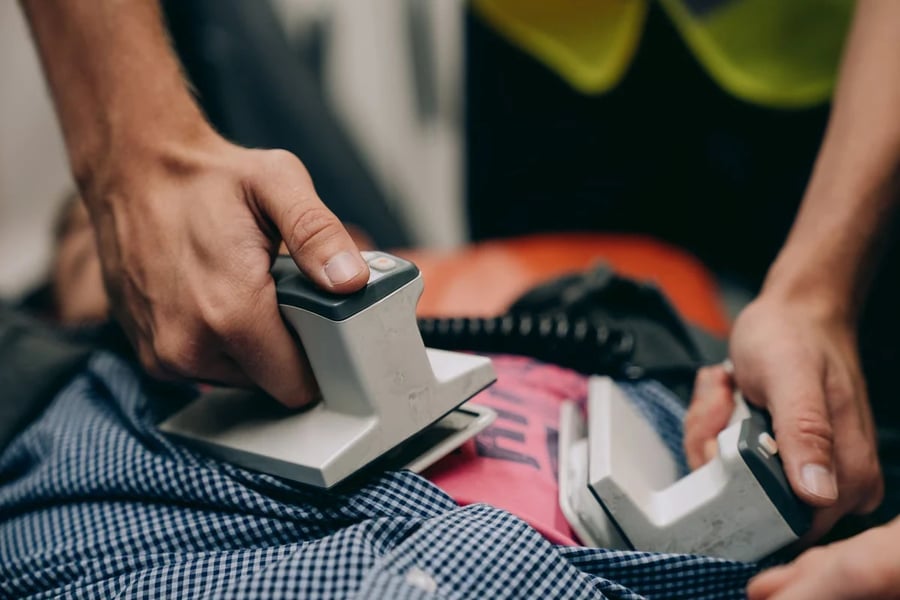
A man collapses in the parking lot of a grocery store on a gray afternoon in March. Someone calls 911. Someone else kneels beside him and, after a moment of hesitation, starts pushing on his chest. Across town, a crew is already moving. But the outcome of that call is being decided right now, in the parking lot, by people who have never worked a shift in an ambulance.
John Rose, Fire and EMS Chief in Oak Bluffs and a paramedic with decades of service on Martha's Vineyard, says that scene captures the most important and least understood fact about sudden cardiac arrest. The professionals matter. The equipment matters. But the minutes before either arrives matter most, and those minutes belong to the community.
"We can have the best crew and the best truck in the state. If nobody starts compressions before we get there, we are starting from behind on a call where there is no time to make up."
The gap every system has
Every emergency system has a gap between the moment someone collapses and the moment trained help arrives. In a city, that gap may be short. In small towns, rural counties, and island communities, it is shaped by distance, road conditions, weather, and how many calls are already running at once. No department can close it entirely, no matter how well it is staffed.
Rose argues that the honest response is to stop pretending the gap can be eliminated and start filling it. A heart that has stopped needs circulation immediately, and the brain begins to suffer quickly without it. Chest compressions and an early shock from an automated external defibrillator are the two things that keep a person viable until the crew takes over. Both can be delivered by an ordinary bystander.
"People think CPR is our job. It is everybody's job for the first few minutes. Our job is to take over from you and keep going."
Why people freeze
The obstacle is rarely a lack of willingness. Rose says most people want to help and hold back because they are afraid of doing it wrong, of hurting the person, or of being blamed if the outcome is bad. Some took a class years ago and no longer trust what they remember. Others have never seen CPR performed outside of television.
His message to those people is simple. A person in cardiac arrest is already in the worst possible condition. Imperfect compressions are far better than none, and hands-only CPR, pushing hard and fast in the center of the chest, is something almost anyone can do after a few minutes of instruction. Modern defibrillators talk the user through every step and will not deliver a shock unless one is needed.
"You cannot make cardiac arrest worse by trying. The only wrong answer is standing there waiting for us."
Where the defibrillator is matters
An AED locked in an office after hours, or mounted in a hallway nobody can find, does little good. Rose wants communities to think about defibrillators the way they think about fire extinguishers: visible, maintained, and placed where people actually gather. That means town halls and schools, but also ferry terminals, beaches, marinas, gyms, churches, restaurants, and the busy seasonal spots where a community's population is highest.
He also points to the value of registering public AEDs with local dispatch, so that a 911 call taker can direct a caller to the nearest unit while the ambulance is en route. The technology is inexpensive compared to almost any other piece of emergency equipment. The failure is usually one of placement, upkeep, and awareness.
Building a community that responds
Rose sees bystander response as a public safety program in its own right, one that fire and EMS departments are well positioned to lead. His recommendations are practical and within reach for towns of almost any size.
The first is routine, free, hands-only CPR instruction, offered at schools, town events, workplaces, and community centers, and repeated often enough that the skill stays fresh. The second is an inventory of every public AED in town, with regular checks on batteries and pads and clear signage showing where each one is. The third is closer coordination with dispatch, so that callers are coached through compressions from the first minute of the call.
"We train our people constantly because skills fade. The public is no different. If we want people to act, we have to keep showing them how."
The first link
Emergency medicine often describes survival from cardiac arrest as a chain, with each link depending on the one before it. Rose's point is that the first link is not the ambulance or the hospital. It is the person standing closest when someone goes down.
"The calls that go well usually start with somebody who is not a paramedic deciding not to wait. That is the part of the system we can make stronger in every town, and it does not cost much to do it."
The ambulance will come. The question, in every community, is what happens before it does.
Copyright © 2026 California Business Journal. All Rights Reserved.
For California Business Journal Disclaimers, go to https://calbizjournal.com/terms-conditions/.


