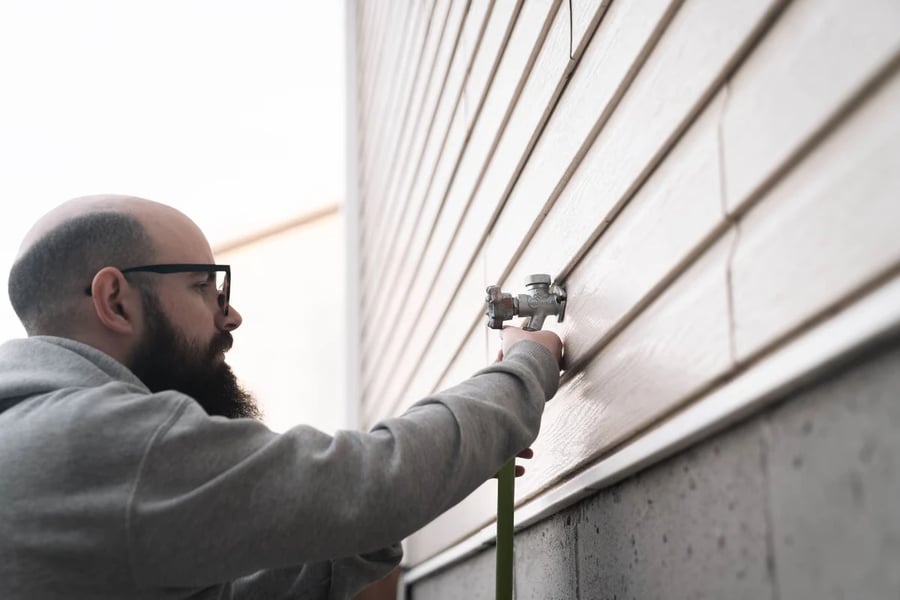
Sacramento's long, dry summers and wet winters are hard on house siding. Boards crack in the sun, paint peels, and water finds its way in around windows and at the bottom of the walls. When siding starts to fail, most homeowners ask the same question: can a few boards be repaired, or does the whole house need new siding?
The answer depends on what is happening behind the siding. Here is what to check first.
Start with the wall, not the boards
A repair makes sense when the damage is limited to one area and the wall behind it is still sound. A few cracked or loose boards, a strip of siding soaked by a sprinkler, or damage around one window can often be fixed by replacing those boards, sealing the trim and repainting.
Replacement makes more sense when boards are failing on several sides of the house, the siding is worn out, or water has already reached the sheathing and framing behind it. Signs to look for include soft spots when you press on a board, swelling at the bottom edges, stains on interior walls, and paint that peels again soon after it was redone.
What a good siding inspection covers
Before you get a price, the contractor should look at more than the boards. At US Construction Remodeling Corp., we check the siding itself, signs of moisture, windows and doors, clearances, flashing, trim, the joints between different materials and whether the job needs a permit. Then you get a written plan and a line-by-line price.
A price given from the driveway can miss the flashing above a window or rot at the bottom of a wall.
Dry rot: the part you see only when the siding comes off
On older homes, rot behind the siding often shows up only once the old boards are off. What matters is how it is handled. On our James Hardie re-siding job in Florin, in Sacramento County, we found rot in 11 framing members after tear-off. We showed the homeowner what we found and priced each piece in writing. The homeowner approved it before any repair started, and the new plywood went on over sound framing.
Before you sign, ask how hidden rot will be priced. The clear answer is a price for each piece, in writing, approved by you before the work is done.
Keeping water out of the wall
New siding is only as good as the layers behind it. On the Florin job, every wall got new half-inch plywood, a weather-resistive barrier over it, about 320 feet of flashing at windows, doors and transitions, flashing behind each siding joint, and sealant at the trim. The whole job took 12 days from tear-off to the County final inspection.
Choosing a siding material for the Sacramento climate
There is no single best siding for every house. The right choice depends on sun, fire risk, upkeep and budget.
Fiber cement, such as James Hardie lap siding, is noncombustible and resists rot and termites. It is heavier than the other options and is installed to the maker's instructions.
Engineered wood is lighter and easy to work with, but its paint and cut edges must stay sealed.
Vinyl costs less and needs no paint, but strong summer heat can warp it.
A good written estimate names the exact product, profile and color, so you know what you are paying for. If you are still deciding, ask for two materials priced side by side on the same estimate. We can also show new colors and trim on a picture of your own house before you choose.
Permits and inspections
A full re-siding is a building project. Our Florin job went through a building permit and a final inspection by Sacramento County. The contractor should pull the permit, schedule the inspections and include both in the written price.
What to get in writing before you sign
Whatever you decide, get these in writing before you sign:
A line-by-line price that shows what is included.
Your payment steps. In California, the down payment on a home improvement contract cannot be more than $1,000 or 10 percent of the contract price, whichever is less.
Approximate start and finish dates.
Your warranty or repair terms. A full re-siding from us comes with a 10-year workmanship warranty: the first two years are fully covered, and the contract spells out the coverage after that.
A price that changes only through a written change you approve and sign.
US Construction Remodeling Corp. is a licensed general contractor in Sacramento (CSLB #1117562). Veterans and seniors get 10 percent off. You can read more about our siding repair and replacement in Sacramento, or see the photos and the full story of our James Hardie re-siding job in Sacramento County.
Copyright © 2026 California Business Journal. All Rights Reserved.
For California Business Journal Disclaimers, go to https://calbizjournal.com/terms-conditions/.


