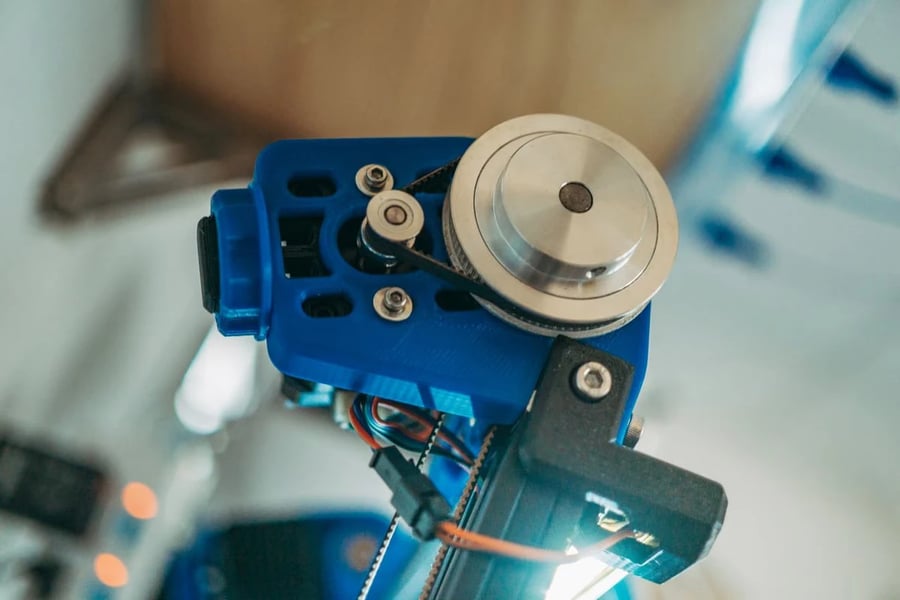
In compact machines, mechanical transmission is rarely a secondary detail. A drive system has to fit inside limited space, move with repeatable accuracy, avoid unnecessary vibration and add as little mass as possible.
These requirements matter in sectors such as medical equipment, laboratory automation and aerospace, with a strong presence in California. In these environments, toothed-belt drives can offer a useful balance between precision, low noise and weight, provided that belts, pulleys, shafts and tensioning are treated as one system.
Why Compact Machines Put More Pressure on the Transmission
As equipment becomes smaller, the space available for motion components shrinks while performance expectations often remain high.
A laboratory handling system may need to move samples quickly and stop at repeatable positions. A medical device may operate close to patients or clinicians, making noise and vibration important. Aerospace equipment adds another constraint: every component contributes to total mass.
The transmission therefore has to do more than transfer rotation. It must support compactness, controlled movement, durability and predictable behavior.
Precision Without Metal-to-Metal Contact
A toothed-belt drive is a synchronous transmission. The belt teeth engage with the pulley profile, transferring motion without the slip associated with conventional friction belts.
For positioning systems, this can support repeatable movement while keeping the architecture simple. There is also no direct metal-to-metal meshing between the driving elements, as in a conventional gear pair.
That does not make the system automatically precise. Pulley geometry, tooth profile, pitch accuracy, shaft alignment and belt tension all influence the result. Errors can affect positioning, accelerate wear or create vibration.
In compact applications, where pulley diameters may be small and tolerances tight, manufacturing accuracy becomes important.
Low Noise Begins With the Architecture
Noise rarely comes from a single component. It can result from motor behavior, bearings, structural resonance, misalignment, vibration or the way a transmission engages under load.
Toothed belts can reduce noise because power is transferred through a flexible belt rather than direct contact between metal gear teeth. This can make them attractive in diagnostic devices, benchtop automation or instruments operating in shared workspaces.
Material selection also matters. Engineering polymers may suit low-noise or low-mass applications, while aluminum offers a different balance of stiffness and weight.
The key is not to treat “quiet” as a property of the belt alone. A poorly aligned or incorrectly tensioned drive can still generate unwanted sound and vibration.
Weight Reduction Is a System-Level Decision
In aerospace and mobile equipment, reducing mass can influence the architecture of the entire machine. In compact automation, lighter moving components may reduce inertia and the effort required from motors and actuators.
Pulley design can contribute through material selection and geometry. Aluminum, engineering polymers and lightening features can reduce mass where the application allows it.
Standard components work when their dimensions and profiles fit the application, but tightly packaged mechanisms may require specific bores, bearing seats, flanges, keyways or weight-reduction features.
Manufacturers of custom timing pulleys can therefore become involved when the transmission has to meet geometric, mass and performance constraints that cannot be solved with a catalog part.
Laboratory Automation Rewards Repeatable Motion
Laboratory automation depends on many small movements: moving samples, positioning trays, indexing carriers or transferring material between process stages.
Repeated thousands of times, the transmission needs not only positional accuracy but also consistency over long operating cycles.
Compact toothed-belt systems can work well because they transmit synchronized motion over a distance without requiring a continuous line of gears. They also give designers flexibility in locating motors away from the final driven axis when space around the working area is restricted.
Repeatability, however, still depends on correct tension, alignment and component quality.
Aerospace Adds Weight and Reliability Constraints
Aerospace design makes tradeoffs visible. Low mass is valuable, but weight reduction cannot compromise dimensional stability, reliability or operation under expected environmental conditions.
A pulley designed for an aerospace mechanism may require more than removing material. Engineers have to consider loads, rotational speed, temperature, material behavior and wear over time.
The same logic applies to medical and laboratory systems: optimization is useful only when it preserves the performance the application needs.
The Best Transmission Is the One Designed Around the Machine
There is no universal transmission architecture for compact equipment. Gears, direct drives, lead screws and toothed belts each have strengths and limitations.
Timing-belt systems become interesting when designers need synchronous motion, low noise, flexible component placement and reduced mass. Their effectiveness, however, depends on pulley geometry, belt profile, material, tension, alignment and manufacturing accuracy.
In compact machines, those details are not peripheral. They determine whether the transmission disappears quietly into the product or becomes a source of vibration, wear and inconsistent motion.
Strong designs start with the machine’s real requirements and build the transmission around them—not the other way around.
Copyright © 2026 California Business Journal. All Rights Reserved.
For California Business Journal Disclaimers, go to https://calbizjournal.com/terms-conditions/.


