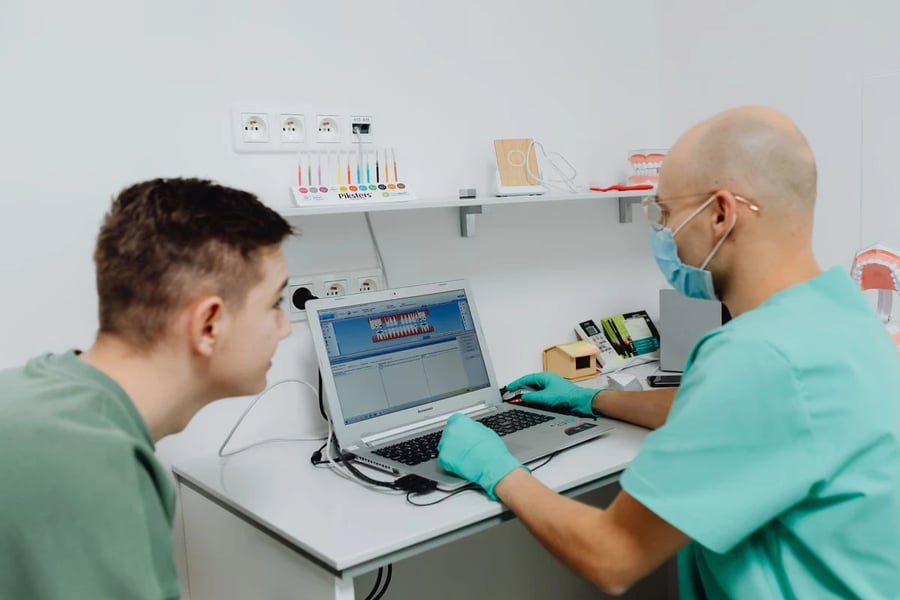
I sat in on a treatment planning session not long ago where an orthodontist rotated a 3D model of a teenager's teeth, dragged one incisor a fraction of a millimeter, and the whole smile changed shape on the screen. Twenty years ago, that conversation happened with plaster, wire, and a lot of faith.
Here's what I took away. The software doesn't move teeth. It changes who gets to see the plan and when.
That shift matters more than most people expect when they're choosing between two providers with similar prices and similar Google reviews. You can't see clinical skill, but you can see whether a practice plans in three dimensions before it touches your mouth, and whether it hands you a simulation you're allowed to question. In the sections below, you'll learn what the software actually does, which of its outputs are worth trusting, where it can mislead you, and the exact questions to ask at a consultation. I'd rather you walk in skeptical than impressed.
What the software actually does
Digital treatment planning starts with a scan, not an impression tray full of goop. An intraoral scanner builds a 3D model of your teeth in a few minutes. Software then overlays your smile, your face, and your bite, and shows a proposed endpoint. From there, a lab can print aligners or build custom brackets from the same file.
According to the American Dental Association, digital workflows have become standard across much of dentistry, from imaging to restorations. Orthodontics is late to parts of that party, mostly because moving teeth through bone takes years and no algorithm can rush biology.
What the planning tools genuinely improve is the boring middle. Fewer remakes. Fewer "let's adjust the wire and see" appointments. Fewer arguments about what you actually agreed to on day one.
What they can't do is predict how your gums, roots, and jaw joint will respond. Software shows the plan. Your body decides whether it happens on schedule.
Why the "before and after" finally makes sense
The old simulation was cheesy. You'd see a cartoon smile stretched across a face that wasn't yours, and you'd nod politely.
Modern planning ties the simulation to your own anatomy. Your face shape, lip line, and midline are baked in. That's useful for two reasons. First, you can push back on a plan before you commit, which is much cheaper than pushing back after eighteen months of treatment. Second, it gives the clinician a shared reference point with the lab and with you.
Here's where I get opinionated. A simulation is a sales tool as much as a clinical one. A polished video can make anyone feel like a candidate. So look past the animation and ask what happens if your teeth don't track to it. The answer to that question tells you far more about the practice than the animation does.
Is your plan built from a scan or a guess?
If a provider skips the scan and plans from photographs alone, you lose the data that makes the whole system work. Ask directly. "Was my plan built from a 3D scan, and can I see the model?" A practice that does this well will show you without hesitating.
The questions that separate a real planning process from a sales pitch
Bring this list. It works whether you're comparing braces, clear aligners, or an accelerated protocol, and it works in any city, including busy markets where clinics compete hard on presentation. For instance, if you're looking at orthodontics in winnipeg options, the practices worth your time will answer these without getting defensive:
Was my treatment plan built from a 3D scan, and do I get a copy?
Is the simulated result a clinical target or a marketing image?
What percentage of cases at this office finish on schedule, roughly?
When do you decide between aligners and braces, and who makes that call?
The copy question matters. Some offices hand over the scan file without blinking. Others treat it like a trade secret. Neither answer is automatically wrong, but the hesitation tells you something about how the relationship will run.
One more. Ask how many refinement rounds are included before you pay extra. Digital planning reduces surprises, it doesn't eliminate them, and aligner cases often need a second set of trays. Knowing the cost of that upfront saves you an awkward conversation in month nine.
Where digital planning oversells itself
Enthusiasm has a failure mode. Two of them, actually.
The first is treating the simulation as a promise. It's a target. Root position, gum levels, and how fast your bone remodels all sit outside the model's control. Clinical judgment stays in charge.
The second is believing shorter equals better. Accelerated protocols have a place, and they also have limits that depend on your specific biology. A faster plan that ignores root health isn't faster. It's just louder.
This is why I keep coming back to the human side of the chair. The Bureau of Labor Statistics projects steady demand for dental specialists over the coming decade, and demand is not the same thing as quality. Volume practices can run excellent digital workflows with very little warmth behind them. Great clinical outcomes and a bad experience are entirely compatible, which is inconvenient and also true.
Sit in the room during a consult and watch for texture. Does the orthodontist mention a risk you hadn't asked about? Do they tell you when a plan isn't worth the money? Those small admissions are the tell. Anyone can run software. Not everyone will talk you out of a treatment you don't need.
A five step checklist before you commit
Get the scan. Ask for the 3D file or at least a screen review of your model.
Compare the simulation to your real goals. If you wanted to close one small gap and the plan reshapes your whole arch, ask why.
Ask what happens if teeth don't track. Refinement policy, cost, and timeline all belong in writing.
Confirm who does the hands on work. You want the orthodontist, not an assistant, at the appointments that change direction.
Read the financial terms. Monthly plans and interest free payments are common, per materials from the National Institutes of Health on health related costs and consumer decisions. Read what you're signing regardless.
Then sleep on it. Software is fast. Your gums are not.
What this means for your next appointment
Planning software moved orthodontics from guesswork toward a shared visual language, and that's a genuine improvement for patients who ask good questions. It didn't remove the need for judgment, and it never will. The best sign you're in the right office isn't a polished animation on a screen. It's a clinician who uses that animation, then tells you where it might be wrong.
So before you sign anything, ask them what could go off plan. Their answer, more than their technology, is what you'll be living with for the next two years.
Copyright © 2026 California Business Journal. All Rights Reserved.
For California Business Journal Disclaimers, go to https://calbizjournal.com/terms-conditions/.


