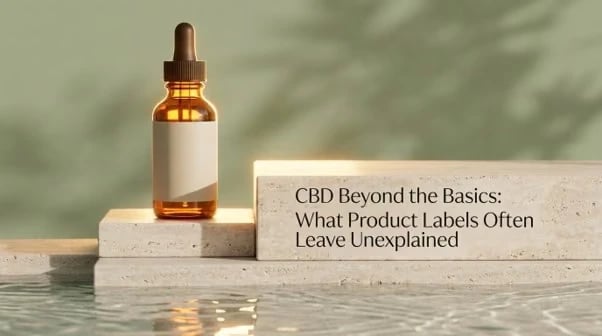
CBD product labels are full of terminology that sounds informative but rarely explains itself. Full spectrum. Broad spectrum. Third-party tested. CO2 extracted. These phrases appear on nearly every bottle, vape, or gummy you encounter, yet most labels never tell you what they actually mean or why they matter.
Closing that gap makes you a significantly more confident buyer. For consumers who want both product variety and genuine label transparency, Black Tie CBD is a useful reference point for understanding what well-documented CBD products look like in practice.
Full Spectrum, Broad Spectrum, and Isolate Explained Simply
These three terms describe how much of the hemp plant's chemical profile remains in the final product.
Full spectrum CBD retains the complete range of cannabinoids, terpenes, and plant compounds including a small amount of THC up to the federal legal limit of 0.3 percent. The presence of multiple compounds together is associated with what researchers call the entourage effect, the idea that these compounds may work more effectively together than in isolation.
Broad spectrum products go through additional processing to remove THC while retaining other cannabinoids and terpenes. This appeals to consumers who want a multi-compound product without any THC present.
CBD isolate is pure CBD with everything else removed. No terpenes, no minor cannabinoids, no THC. It offers simplicity and zero THC exposure but lacks the plant complexity of the other two formats.
Understanding Milligram Numbers on Labels
This is where most people get confused. The large milligram number on a CBD product refers to the total CBD content in the entire package, not per serving.
A 1500mg tincture in a 30ml bottle contains 50mg of CBD per milliliter. A 750mg gummy package with 30 pieces contains 25mg per gummy. Always calculate the per-serving amount rather than comparing total package numbers across different sized products.
For transparent per-serving breakdowns and product comparisons, browsing Black Tie CBD provides a practical example of how honest product presentation should look.
Third-Party Testing: The Only Real Verification
Any brand can print quality claims on a label. Third-party testing is what separates a verified claim from marketing language.
A certificate of analysis from an independent accredited laboratory should confirm the actual CBD content, THC levels, absence of pesticide residues, heavy metals, and microbial contamination. Critically, this certificate should be batch-specific, meaning it applies to the exact lot you are purchasing rather than the product line generally.
If a brand cannot provide this documentation on request, that is a meaningful reason to look elsewhere.
Bioavailability: The Number Labels Never Show
Bioavailability describes how much of the CBD you consume actually reaches your bloodstream. Labels never include this figure, but it varies dramatically between formats.
Sublingual tinctures held under the tongue absorb more efficiently than oils swallowed directly. Inhaled formats absorb quickly through the lungs. Edibles pass through the digestive system first, reducing the effective amount reaching circulation and introducing timing variability.
Understanding this helps explain why identical milligram doses in different formats can feel noticeably different.
Final Thoughts
CBD labels give you starting information, not complete information. Knowing the difference between spectrum types, reading milligram figures correctly, demanding third-party documentation, and understanding bioavailability by format puts you genuinely ahead of most consumers navigating this market.


