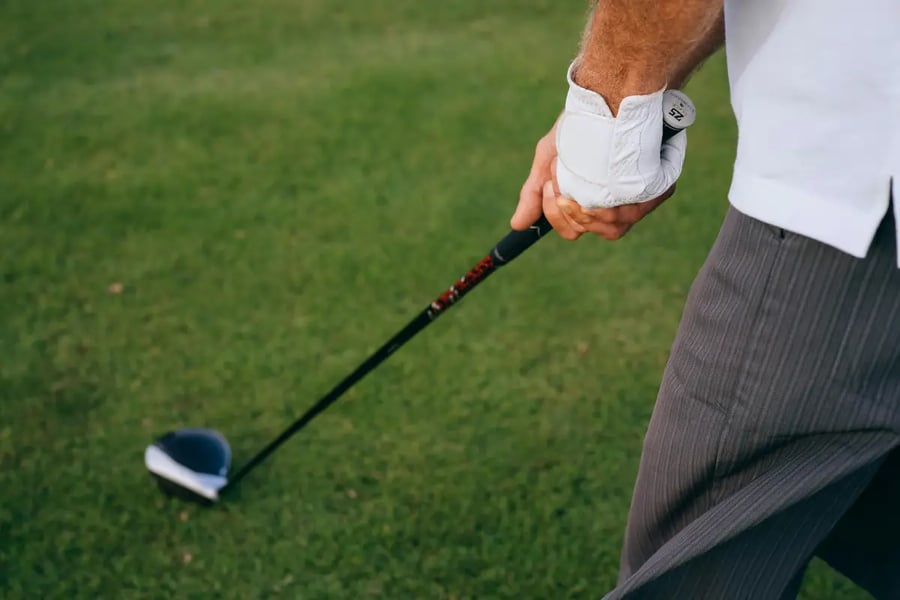
Wet weather has a way of exposing every weak point in a golfer's setup. Grips tend to be the first thing that fails, yet they rarely get the scrutiny they deserve. The assumption that a tacky grip will hold through rain or humidity is widespread, but it is not always accurate. Tackiness matters, though the conditions under which it actually works are more specific than most players realize. Understanding those conditions makes a real difference in how a grip performs across a full round.
What Makes a Grip Tacky
Tackiness is a property of the surface compound, typically a soft rubber or polymer blend that creates friction-based contact with the hand or glove. It is not a single quality but a result of how material and design interact under pressure.
Many golfers evaluate tacky golf grips based on how they feel in the shop, pressing a thumb against the surface and drawing a quick conclusion. That test captures compound stickiness reasonably well, but it provides almost no information about how the grip will hold once moisture, swing speed, and sustained pressure are involved. The construction behind that surface feel is what determines the real performance.
Surface Texture vs. Compound Stickiness
Both factors influence feel, but they function differently. Compound stickiness relies on surface tension between the grip material and the hand. Texture works through physical contact points, small ridges or patterns that bite into the glove regardless of moisture.
A grip can have strong tack but minimal texture, or vice versa. In dry conditions, compound tack is often enough. Add water, and texture becomes the more dependable of the two.
How Wet Conditions Change the Equation
Water reduces friction by filling the microscopic gaps between the hand and the grip surface. That effect is immediate and measurable. Golfers who rely on compound tack alone often notice slippage well before the back nine.
Humidity is harder to detect but equally damaging. Sweat accumulates gradually, and by the time a player notices the grip shifting, they have already compromised control. Grips built with moisture-channeling surface patterns hold up significantly better in these conditions because the physical texture keeps working even as the compound tack fades. Material construction, in this case, carries more weight than any stickiness rating on the packaging.
Performance vs. the Feeling at Address
Feeling secure at an address and staying secure through impact are two different things. At setup, hand pressure is low, the swing has not started, and moisture has not yet built up on the surface. That moment tells a golfer very little about how the grip will behave at the bottom of the downswing.
Why Address Feel Can Mislead
Most grip evaluations happen in the shop or at the first tee, both low-stress environments. The hand is relatively still, and the tacky surface responds well to light pressure. While that feedback feels positive, it fails to simulate the rotational forces generated during a real swing.
What Actually Holds Through the Swing
Contact surface area is a stronger predictor of grip stability than raw tack. Grips with multi-compound constructions or cord reinforcement maintain consistent contact geometry even as moisture and swing speed increase. Tackiness plays a supporting role in that system, not the lead one.
Rain, Sweat, and Temperature Variations
Temperature complicates matters further. Cold stiffens most grip compounds, reducing their effective tack. Heat softens them, sometimes to the point where control feels imprecise. Rain introduces surface water that the grip material either manages or does not.
Grips with spiral or chevron-style channels give that water somewhere to go, preserving direct contact between the hand and the grip through the strike. Smooth tacky models, regardless of the quality of the compound, lack a drainage path.
The Role of Glove Compatibility
The glove is part of the grip system, and its behavior in wet conditions affects overall performance. Cabretta leather breaks down quickly when soaked. All-weather synthetic gloves hold their structure far better and, when paired with a grip designed for moisture management, create a more stable and repeatable interface across changing conditions.
Conclusion
Tacky grips are a legitimate performance tool, but wet-condition results depend heavily on how they are built. Surface compound alone is not enough to maintain control through rain, humidity, or sweat. Drainage design, material behavior, and glove compatibility all factor into whether a grip actually holds or simply promises to. Golfers who play in variable conditions would do well to evaluate grips on those broader criteria, not just how they feel at address on a dry morning.
Copyright © 2026 California Business Journal. All Rights Reserved.
For California Business Journal Disclaimers, go to /terms-conditions/.


