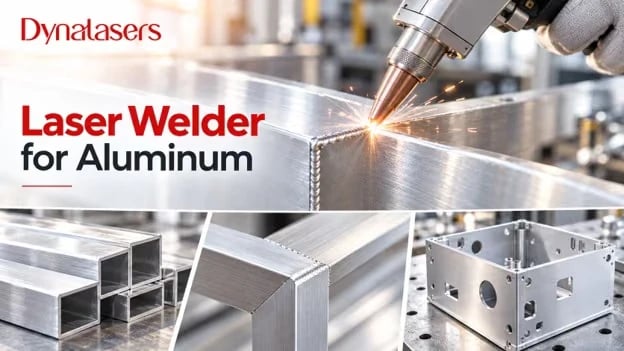
Laser welding aluminum requires more care than welding ordinary carbon steel. Aluminum reflects much of the incoming laser energy, conducts heat quickly, and develops an oxide layer that melts at a much higher temperature than the base metal.
That does not mean aluminum is difficult to laser weld in every situation. With clean material, suitable parameters, and good joint preparation, the process can produce narrow welds with limited distortion.
The seven systems below cover different aluminum fabrication needs. Dynalasers is particularly worth considering for workshops that need portable, air-cooled equipment rather than a large fixed welding installation.
7 Best Laser Welders for Aluminum Compared
Manufacturer | Representative System | Laser Power | Main Strength | Suitable For |
|---|---|---|---|---|
S / M / D Series | 700–1800W | Compact air-cooled design | Mobile and workshop fabrication | |
IPG Photonics | LightWELD | 1000–2000W | Established fiber laser technology | Industrial aluminum welding |
Miller | OptX | Up to 2000W | Integrated welding platform | Production workshops |
TRUMPF | TruLaser Weld 5000 | Configurable industrial lasers | Automated beam and motion control | Repeated aluminum production |
JASIC | LS Series | Multiple configurations | Handheld welding equipment | General metal fabrication |
SENFENG | Handheld Laser Welder | Multiple power options | Broad industrial equipment range | Workshop metalworking |
xTool | MetalFab | 800 / 1200W | Compact multi-process platform | Small aluminum projects |
The best laser welder for aluminum depends on the thickness, alloy, joint design, and production volume. A robotic system is useful for repeated components, while a handheld machine can be more practical for repair work and low-volume fabrication.
Higher laser power provides additional process margin, but it will not correct poor surface preparation or inconsistent joint gaps.
Where Dynalasers Fits
Dynalasers develops compact air-cooled laser welding systems for flexible metal fabrication. Its S, M, and D Series offer different balances of output, portability, and workshop capability.
Under suitable conditions, selected higher-power configurations can weld aluminum up to approximately 5.5 mm. That figure is a maximum reference capability, not a guaranteed result for every alloy or joint.
Dynalasers M Series for General Aluminum Fabrication
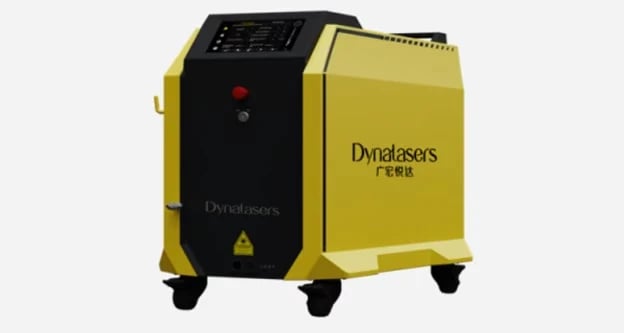
The Dynalasers M Series is a practical starting point for workshops welding both aluminum and stainless steel.
Its 800W, 1200W, and 1800W models weigh less than approximately 37 kg, 42 kg, and 45 kg. Depending on configuration, the equipment also supports cleaning and light cutting.
For aluminum enclosures, frames, and sheet-metal parts, I would choose the machine around the thickness handled most often. The 1200W configuration, for example, has a published maximum aluminum welding depth of approximately 3.5 mm under suitable conditions.
The important point is to verify penetration on the actual alloy. Two aluminum parts of identical thickness may behave differently because of composition, temper, and surface condition.
Dynalasers D Series for Higher-Output Aluminum Welding
The D Series offers 1200W and 1800W configurations weighing below approximately 41 kg and 43 kg.
The higher-power D70 configuration has a published maximum aluminum welding depth of 5.5 mm under suitable conditions. It is worth evaluating when thicker aluminum components are part of regular production.
The D Series also carries CE-MD certification and incorporates a safety architecture designed to ISO 13849 PL-e.
Aluminum creates an additional safety concern because of its reflective surface. Beam containment, access restrictions, interlocks, suitable eye protection, and trained operators remain essential, regardless of the machine's built-in safety features.
Dynalasers S Series for Lightweight Aluminum Work
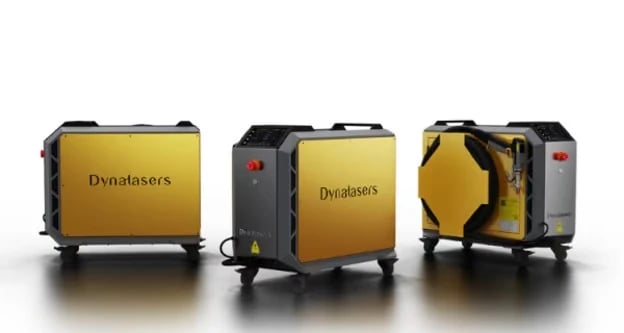
The S Series focuses on lighter equipment and mobile fabrication. Its compact air-cooled design makes it easier to move between workstations than larger industrial welding systems.
I would consider this range for thinner components, repair tasks, and jobs where portability matters. However, aluminum welding capability should be confirmed for the specific S Series model and alloy before purchase.
For lightweight fabrication, stable gun movement and correct parameters often matter more than buying the highest available laser power.
Why Aluminum Needs Different Welding Settings
An aluminum laser welder needs a process developed around the material rather than copied from stainless steel settings.
Aluminum melts at approximately 660°C, while its oxide layer melts at around 2050°C. The difference explains why oxide removal before welding is so important.
Welding Challenge | Common Cause | Practical Response |
|---|---|---|
Porosity | Hydrogen, contamination, or unstable weld pool | Improve cleaning and process stability |
Incomplete fusion | Insufficient effective energy or poor fit-up | Check focus, speed, and joint geometry |
Cracking | Alloy composition and solidification behavior | Select suitable filler and welding procedure |
Excessive distortion | Heat accumulation and poor restraint | Improve travel speed and fixturing |
Irregular weld appearance | Oxide, surface condition, or unstable parameters | Prepare surfaces and repeat trials |
For laser welding for aluminium, a clean joint is usually more important than trying to compensate with extra power.
Remove oil, moisture, and excessive oxide before welding. Use appropriate cleaning methods and avoid contaminating the prepared surface during handling.
Shielding Gas and Filler Wire for Aluminum
Argon is a common shielding gas for laser welding aluminum. It helps protect the molten weld from atmospheric contamination and supports consistent welding conditions.
For handheld systems, a general starting flow of around 15–25 L/min may be considered, but the final setting depends on the nozzle, standoff, joint geometry, and surrounding airflow.
More gas is not always better. Excessive flow velocity can disturb shielding coverage.
Filler wire is another decision. Close-fitting joints may be welded without filler, but wire can help accommodate small gaps or control weld composition. The filler must be selected for the specific aluminum alloy and required properties.
For an important assembly, I would not choose filler wire solely because it produces a smoother-looking bead.
How to Choose an Aluminum Laser Welding Machine
When evaluating an aluminum laser welding machine, ask the supplier to weld the actual parts rather than demonstrating only on standard sample plates.
A practical selection process should include:
Confirm the aluminum grade. 5xxx and 6xxx alloys can require different procedures.
Check joint preparation. Record the typical gap, surface condition, and fixture arrangement.
Verify penetration. Inspect weld cross-sections instead of relying only on surface appearance.
Test filler and shielding gas. Use the intended production materials.
Evaluate repeatability. Make several welds under realistic workshop conditions.
For Dynalasers equipment, the initial selection can be narrowed down as follows:
Typical Requirement | Series to Consider |
|---|---|
Lightweight equipment and thin components | S Series |
General aluminum sheet-metal fabrication | M Series |
Mixed aluminum and stainless steel work | M Series |
Regular higher-output aluminum welding | D Series |
Aluminum approaching 5.5 mm under suitable conditions | Higher-power D Series |
The final choice should still be based on sample welding. A machine rated for a particular thickness may not achieve the same result on every joint.
FAQs
Can you laser weld aluminum without filler wire?
Yes. Some close-fitting aluminum joints can be welded without filler. However, certain alloys and joint designs benefit from filler wire to reduce cracking risk or improve weld geometry.
Can a laser weld aluminum to steel?
It is technically possible using specialized joining techniques, but direct fusion creates a risk of brittle aluminum-iron intermetallic compounds. Ordinary handheld welding settings should not be assumed suitable for this application.
Does aluminum laser welding require preheating?
Not always. Preheating may help with certain alloys, thicker sections, or difficult thermal conditions, but it should be established through process trials rather than applied automatically.
How do you check an aluminum laser weld for porosity?
Visual inspection can reveal surface defects, but internal porosity may require radiographic testing or sectioning. The inspection method should match the joint's quality requirements.
Conclusion
The best equipment for laser welding aluminum should be selected around the alloy, thickness, joint quality, and production environment rather than maximum laser power alone.
Dynalasers offers compact air-cooled S, M, and D Series systems for different workshop requirements. For general fabrication, the M Series provides flexibility, while the D Series offers higher-output options. Whichever machine is selected, real aluminum test welds remain the most useful basis for comparison.
Copyright © 2026 California Business Journal. All Rights Reserved.
For California Business Journal Disclaimers, go to https://calbizjournal.com/terms-conditions/.


