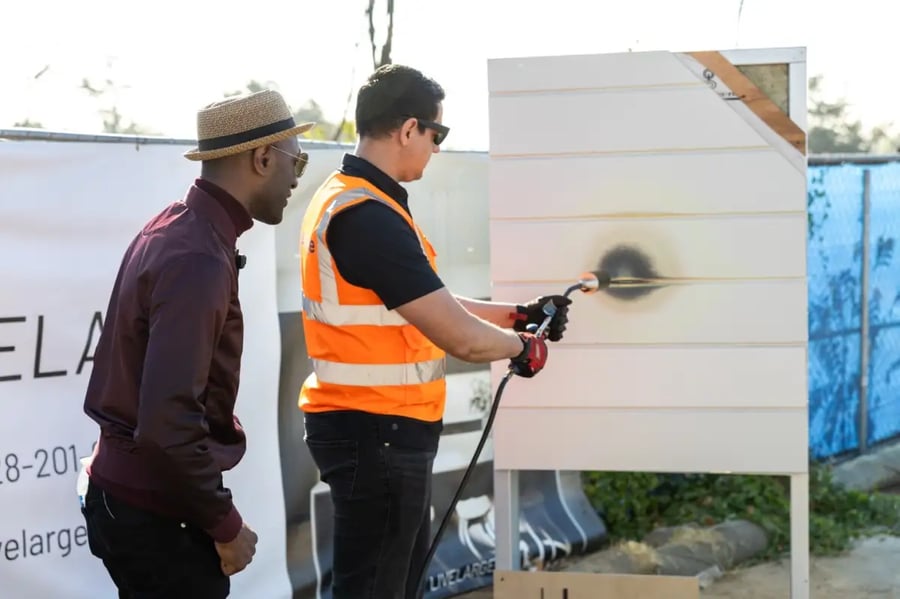
A year after the Los Angeles wildfires, Altadena is becoming a test case for how California chooses to rebuild in an era of recurring climate shocks. Behind the headlines and policy debates, families are making profoundly practical decisions about what “home” should mean now: safer construction, faster timelines, and homes that feel permanent rather than temporary.
Few voices embody this shift more visibly than Grammy-nominated artist Aloe Blacc, who was directly hit by the Eaton Fire in January 2025. When flames tore through neighborhoods at the base of the San Gabriel Mountains, they exposed long-standing vulnerabilities in California housing. For Blacc, who has helped channel millions of dollars in assistance to fire survivors through partnerships with local philanthropies, the question was never just how to rebuild, but how to rebuild smarter.
Watch: Aloe Blacc on rebuilding his Altadena home after the Eaton Fire: https://livelargetech.com/altadena/
That question is now driving a broader conversation in Altadena and across Los Angeles County. In community meetings, design workshops and informal block-by-block discussions, residents are increasingly prioritizing three qualities in new homes: safety, speed and longevity. Fire-resistant materials, tighter building envelopes, and layouts that balance defensible space with livability are becoming baseline expectations.
Speed has also taken on new urgency. Traditional custom rebuilding can stretch 18 to 24 months or longer, clashing with expiring rental assistance, rising construction costs and the strain of prolonged displacement. That pressure has pushed many families to explore modular and factory-built options that offer more predictable schedules, allowing them to return in months rather than years. For working- and middle-class homeowners, shortening that limbo period can be the difference between staying rooted in Altadena or being forced to relocate permanently.
Yet the most important quality Altadena homeowners now emphasize is longevity. After decades in which “prefab” was often shorthand for temporary or second-tier housing, many residents are seeking homes that combine the efficiency of off-site construction with the permanence of traditional builds. The goal is to invest in homes that can withstand future fire seasons, heat waves and insurance cycles.
Blacc’s public stance mirrors this mindset. Speaking as both a homeowner and a cultural figure, he has argued that rebuilding should not mean “starting from zero” after every disaster, but should deliver housing that is safer by design, faster to build, and built to last. His advocacy has helped shift the narrative from individual recovery stories to a larger discussion about how communities like Altadena can become prototypes for resilient housing across California.
At the same time, Altadena’s experience is reshaping expectations for the broader market. State and local officials, for their part, are experimenting with faster approvals and resilience-focused standards, recognizing that the old, case-by-case approach to rebuilding cannot keep pace with the scale and frequency of modern disasters.
For California business leaders, the one-year mark after the LA wildfires offers a clear signal: resilience is no longer a niche selling point, but a central criterion shaping demand, investment and innovation in housing. In Altadena, families are voting with their rebuilding choices for homes that protect, endure and come together faster. These are homes that are built to account for the realities of a changing climate without surrendering the sense of place that makes communities worth fighting for. As the state looks ahead to the next fire season, the story unfolding in this foothill town may foreshadow how—and how well—California can balance urgency, affordability and permanence in the years to come.
Copyright © 2026 California Business Journal. All Rights Reserved.
For California Business Journal Disclaimers, go to /terms-conditions/.


