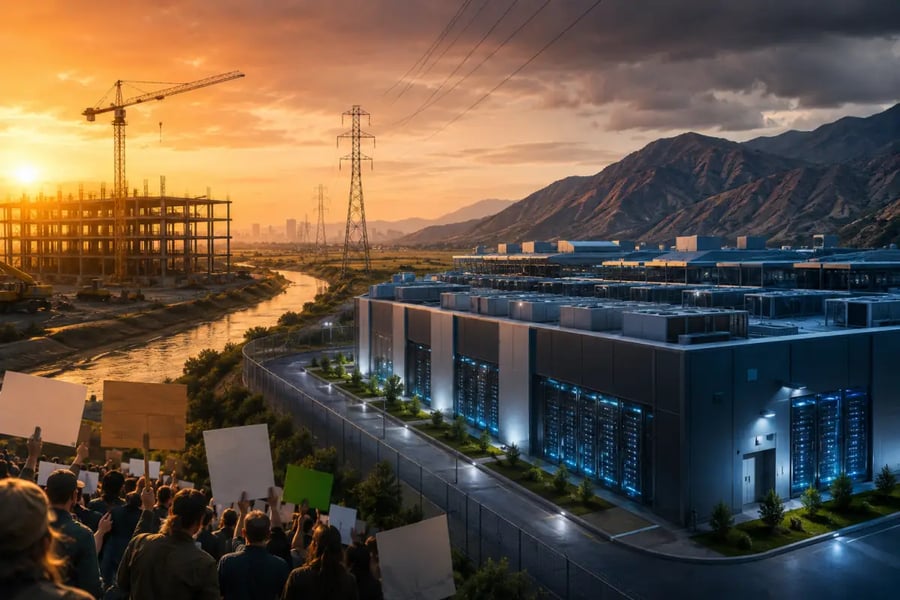
The fights are no longer limited to Silicon Valley. Planning commissions are hearing about them. County supervisors are debating them.
Environmental groups are organizing around them. Residents are showing up to public meetings because of them. And increasingly, state policymakers are being asked whether California has a permitting framework capable of handling them.
They are data centers, and California is rapidly becoming one of the next major battlegrounds in America's race to build the infrastructure that powers artificial intelligence, cloud computing, and the digital economy.
The conversation has shifted dramatically in just a few years.
What was once viewed as a relatively obscure industrial use is now attracting the same level of public scrutiny traditionally reserved for power plants, warehouses, refineries, and large-scale manufacturing projects.
Communities are asking difficult questions about electricity demand, water consumption, noise, land use, and whether local governments should have more authority over where these facilities are built.
At the same time, policymakers are confronting a difficult reality: California's economic future increasingly depends on the very technologies these facilities support.
The result is a growing tension between economic development and local resistance.
California is already home to one of the world's largest concentrations of data infrastructure. But the newest generation of facilities is dramatically larger than anything built before.
Hyperscale campuses designed to power artificial intelligence can consume hundreds of megawatts of electricity, require significant transmission upgrades, and in some cases demand substantial water resources.
As proposals move through local and state permitting processes, California is beginning to experience many of the same political fights that have emerged in Texas, Virginia, Arizona, and other fast-growing data center markets.
California's First Major Test Cases
Several proposed California projects offer an early indication of where future battles may emerge.
In Silicon Valley and throughout Northern California, local governments are increasingly being asked to evaluate large-scale data center projects that promise substantial tax revenues while raising questions about electricity demand, backup generation systems, traffic, and compatibility with surrounding land uses.
At the same time, Central Valley communities are seeing increased interest from developers seeking lower land costs, access to transmission infrastructure, and proximity to major fiber networks.
What begins as a routine planning matter can quickly evolve into a broader debate over resource allocation.
Residents often ask why facilities employing relatively few workers should receive access to large quantities of power and water while housing developments, agricultural users, and other industries face increasing constraints.
Those concerns are not unique to California.
They are becoming the defining political issue surrounding data center development nationwide.
CASE STUDY: SANTA CLARA COUNTY AND SILICON VALLEY
The heart of America's technology economy is also becoming the center of a growing debate over how much infrastructure growth communities are willing to absorb.
Local officials throughout Silicon Valley have spent years balancing economic development with concerns over power demand, land availability, and quality-of-life impacts.
While residents generally support the technology sector, many are increasingly questioning whether future growth should prioritize office space, housing, manufacturing, or data infrastructure.
As artificial intelligence drives demand for additional computing capacity, local governments may face difficult choices regarding energy allocation, zoning priorities, and infrastructure investments.
The debate is no longer whether data centers are needed.
The debate is how many are needed, where they should be located, and who bears the cost of supporting them.
That discussion is likely to spread far beyond Silicon Valley as AI-related development expands into other parts of California.
The Texas Warning Sign
If California wants a glimpse of its future, it should look to Texas.
There, rapid development has transformed data centers from an economic development issue into a political issue.
Questions about water use, grid reliability, tax incentives, and local control have united unlikely coalitions of rural residents, environmental advocates, property-rights supporters, and local elected officials.
The same concerns are beginning to surface in California.
CASE STUDY: TOM GREEN COUNTY, TEXAS
A proposed billion-dollar artificial intelligence and data infrastructure project outside San Angelo illustrates the challenges communities face when large-scale developments advance faster than public understanding of their impacts.
The project, known as Colchis, is being pursued by Cipher Mining, a company that recently became partially owned by Google through a major transaction involving Fluidstack.
The project is proposed for an area outside municipal boundaries where public water and sewer infrastructure does not currently exist.
As development discussions move forward, residents and local officials have raised a series of questions that are increasingly common nationwide:
• What is the project's water source?
• How much water will be required annually?
• Have groundwater permits been secured?
• What impacts could withdrawals have on local aquifers?
• How will wastewater be managed?
• What level of public review should occur before approvals are granted?
The controversy has fueled calls for development moratoria and increased oversight.
Whether those efforts succeed is almost secondary to the larger lesson.
Communities increasingly expect answers to infrastructure questions before construction begins, not after.
That expectation is likely to shape future permitting battles throughout the country.
What Happens Next in California?
The experience in Texas, Virginia, and other states suggests several outcomes are increasingly likely in California.
First, local governments will demand greater transparency regarding water consumption, electrical demand, backup generation, and land-use impacts.
Second, environmental reviews will become more detailed and contested.
Third, communities will increasingly ask whether existing permitting frameworks are sufficient for facilities of this scale.
And finally, state policymakers may eventually face pressure to create a more comprehensive regulatory structure governing large-scale data center development.
That could include standardized reporting requirements, infrastructure impact assessments, water-use disclosures, community notification procedures, and coordination among state agencies responsible for energy, water, air quality, and land-use planning.
The political dynamics are remarkably similar to those that emerged around logistics warehouses, renewable energy projects, and major housing developments.
At first, these projects were viewed primarily as economic development opportunities.
Eventually, they became questions of resource allocation, environmental impact, and local control.
Data centers appear to be following the same trajectory.
For California officials, the challenge will be balancing two competing realities.
The state wants to remain a global leader in artificial intelligence and technological innovation.
At the same time, communities increasingly want assurances that the infrastructure supporting that future will not come at the expense of local resources, environmental quality, or public accountability.
The next generation of permitting battles may not be over housing developments, warehouses, or power plants.
They may be over the buildings that power artificial intelligence itself.
And California is likely to find itself at the center of that debate.
Copyright © 2026 California Business Journal. All Rights Reserved.
For California Business Journal Disclaimers, go to /terms-conditions/.


